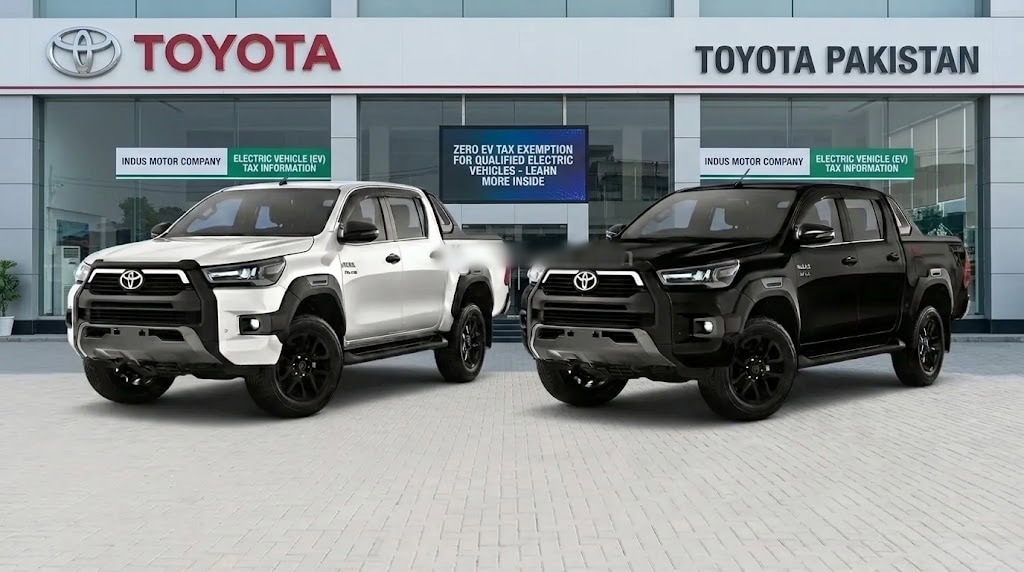
KARACHI – Toyota Pakistan fired a fresh warning over tax loophole that could give range-extended electric vehicles (REEVs) a major edge in the country’s fiercely competitive car market.
Toyota’s assembler in Pakistan Indus Motor Company (IMC) challenged the growing tax advantage enjoyed by some REEVs, arguing that vehicles carrying a petrol engine are being allowed to access treatment meant for battery electric vehicles (BEVs). The controversy landed on the table of the Federal Board of Revenue (FBR) as Pakistan faces a surge of Chinese electrified vehicles and prepares its next automotive policy.
The issue was highlighted at IMC’s 37th Annual General Meeting following the company’s FY2026 results. The entire dispute turns on what actually powers the wheels. An REEV is driven by an electric motor, while its internal combustion engine works as a generator to recharge the battery.
Unlike conventional hybrid or plug-in hybrid, the engine does not mechanically drive the wheels. That technical difference allowed certain REEVs to fall under the same customs classification used for electric vehicles.
Pakistan’s Customs Classification Committee previously classified specific REEV models under PCT/HS 8703.8090, covering vehicles propelled by electric motors. The decision follows current World Customs Organization (WCO) framework, which focuses on the vehicle’s propulsion mechanism. A separate tariff subheading for range-extended vehicles is expected under HS 2028.
The classification becomes a major issue once taxes enter the picture.
Pakistan provides preferential customs and tax treatment to qualifying BEVs as part of its push toward electric mobility.
But an REEV still carries a fuel-powered combustion engine. Industry representatives, including Pakistan Automotive Manufacturers Association (PAMA), challenged the treatment, arguing that REEVs have important characteristics of series hybrids because they consume fuel and can generate emissions when the range extender operates. The industry’s concern is simple, should a vehicle that can burn petrol receive the same incentives as a vehicle that never does?
The dispute comes as Chinese automotive brands rapidly expand their footprint in Pakistan. REEVs, PHEVs and BEVs are increasingly appearing in the pipeline, with models of Changan and Deepal among those discussed in connection with range-extender technology. REEVs offer an attractive proposition in Pakistan: electric driving without complete dependence on charging stations.
That can be particularly valuable in a country where charging infrastructure remains limited. But the same feature that makes REEVs attractive to consumers has become a flashpoint for established manufacturers.
The tariff code assigned to an imported vehicle can dramatically affect its landed cost. Earlier reports highlighted cases where similar vehicles were reportedly classified differently by the Pakistani importer and Chinese exporter, with Pakistani side using an electric-vehicle code carrying lower duty while the export documentation treated the vehicle as a hybrid.
That creates the possibility of a substantial tax difference. And in a market where manufacturers are competing aggressively on price, tax treatment can become a competitive weapon.
The authorities could leave the existing classification untouched. They could instead treat REEVs more like hybrids, potentially exposing them to higher duties and taxes. Another possibility is to maintain the customs classification but impose separate conditions on access to EV incentives. Pakistan could also establish a dedicated domestic category for range-extender vehicles.
The dispute arrives as Indus Motor seeks clarity over Pakistan’s next automotive policy. The company has indicated that Toyota’s plans for EV and PHEV launches will depend partly on the new policy framework. Meanwhile, IMC outlined plans for around Rs4–5 billion in localization investment during FY2027.
The company has also reported higher inventory levels because of geopolitical and shipping risks, while lower Hilux sales have been linked to reduced government procurement. At the same time, competitive pricing and incentive changes have put pressure on gross margins.
This is no longer just a fight over a customs code. It is a battle over who gets the EV tax advantage in Pakistan. If REEV incentives are restricted, their prices could rise and Chinese imports could lose some of their current advantage. If the existing treatment survives, REEVs could become even more competitive, putting greater pressure on traditional automakers to speed up electrification and localization.
Budget 2026: Toyota Corolla prices may surge by up to Rs3Lac after New 6% Levy
News Desk
About the Author