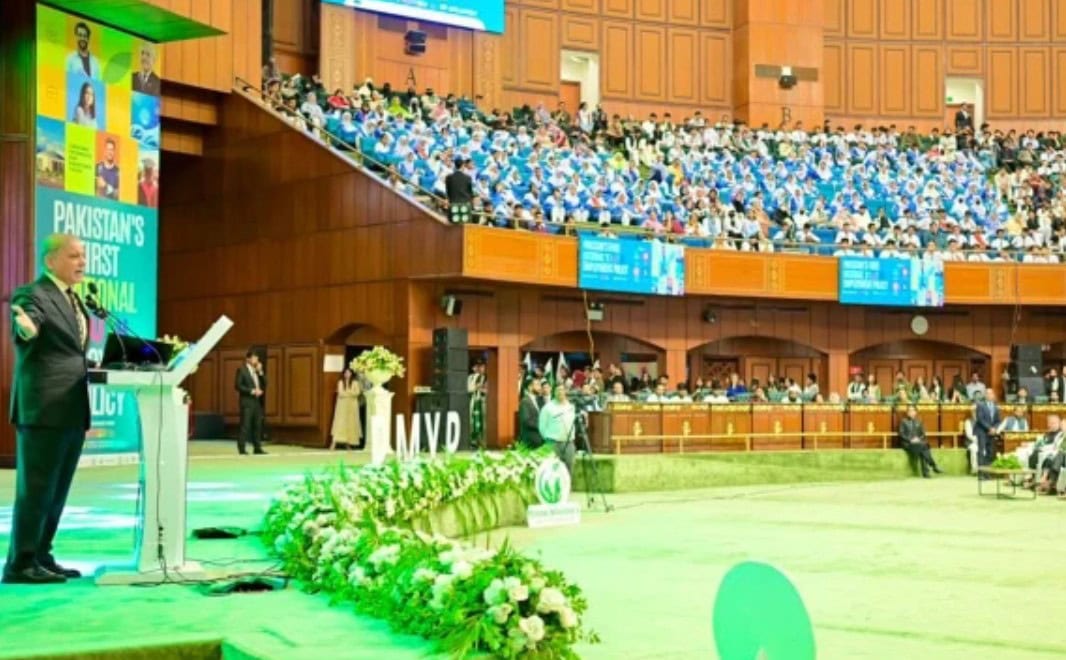
ISLAMABAD – Prime Minister Shehbaz Sharif on Wednesday unveiled Pakistan’s first-ever National Youth Policy, announcing a sweeping package of education, employment and entrepreneurship initiatives aimed at giving the country’s young population a bigger role in shaping Pakistan’s future.
Speaking at International Youth Day ceremony in Islamabad, the premier announced mandatory 35% quota for women in the labour force and a 10% quota for young people seeking to establish startups, shifting the policy focus from conventional employment towards entrepreneurship.
Under the new education initiatives, 1,000 Pakistani students will be sent to China at government expense to study Information Technology and Artificial Intelligence, building on last year’s programme under which students were sent to China for advanced agricultural education.
The government will also distribute 250,000 additional Chromebooks to students this year. Shehbaz Sharif said 700,000 laptops have already been distributed on merit, with no recommendations involved, and described the laptop programme as a “mission” rather than merely a technology scheme.
PM highlighted the government’s push to bridge the education gap between rich and poor, arguing that a child from a disadvantaged family should have access to the same quality of education as children from wealthy households. Referring to Aitchison College, he said a poor child could not even set foot in the prestigious institution, which prompted the establishment of Daanish Schools.
He said the Daanish School network has expanded across Punjab and is now being extended to Gilgit-Baltistan, Azad Kashmir and Balochistan, where students will receive free education. The standard of education, he claimed, would be no less than Aitchison College.
Daanish University Coming to Islamabad
Shehbaz Sharif further announced that Daanish University Islamabad will become operational next year, with classes expected to begin during the same year.
The university will focus heavily on technical and modern fields, while admissions will be based on merit, ensuring that talented students can secure quality education regardless of their financial background.
Sharif said Pakistan was created by its elders in 1947, but the country’s youth would determine what Pakistan becomes in 2047.
With a 35% women’s labour-force quota, startup support, expanded digital access, overseas technical education and free elite-standard schooling, the first National Youth Policy represents a major attempt to place education, technology, entrepreneurship and equal opportunity at the centre of Pakistan’s youth agenda.
News Desk
About the Author