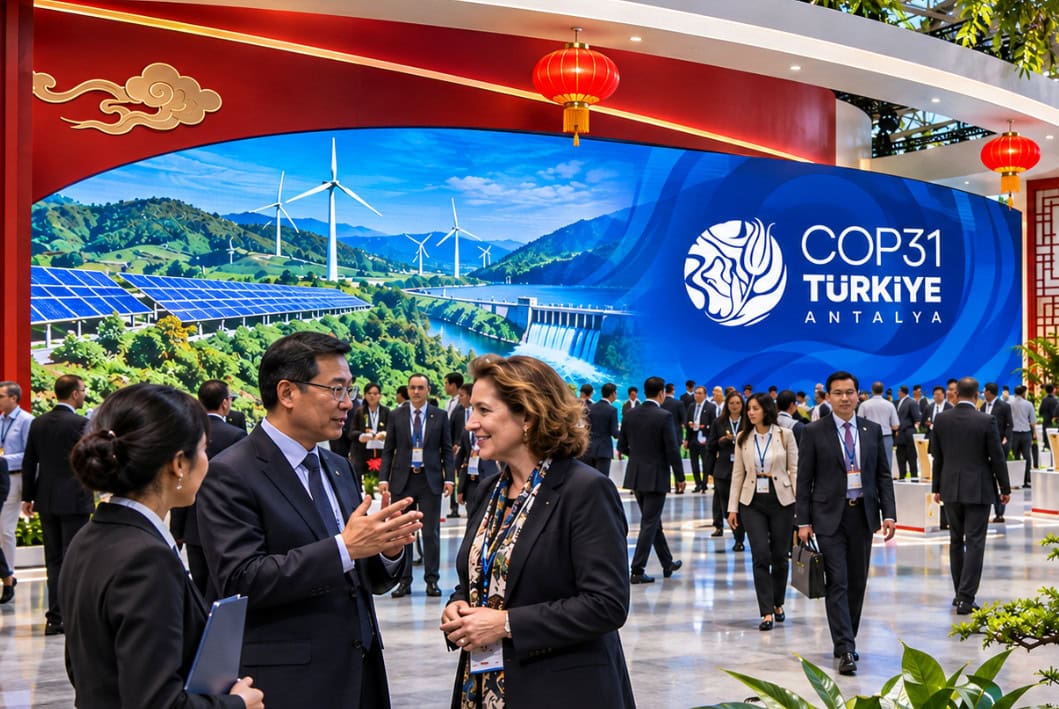
ANTALYA – China’s transformation into global clean-energy powerhouse turns heads at COP31 Climate Change Conference in Turkiye, with influential international figures praising Beijing’s green development strategy and its growing role in making renewable technologies more affordable worldwide.
From futuristic EVs and solar energy to advanced battery storage and environmental restoration, Beijing’s rapid progress gets all the deserved attention from climate policymakers, energy experts and industry leaders.
The recognition comes as world leaders face mounting pressure to turn ambitious climate pledges into practical measures capable of reducing emissions, protecting natural resources and accelerating the global transition towards sustainable energy.
A major highlight of China’s participation came with launch of English-language report, Lucid Waters and Lush Mountains Are Invaluable Assets – China’s Path to Green Development, at COP31 China Pavilion. Presented during a special gathering dedicated to ecological civilisation and China’s environmental practices, the publication offered an extensive account of how Beijing is attempting to combine economic expansion with environmental protection.
The report was jointly prepared by the Research Center for Xi Jinping Thought on Ecological Civilization, the Xinhua Institute and the Development Research Center of China’s National Forestry and Grassland Administration.
It sheds light at China’s green development philosophy, the policies introduced to implement it nationwide and the country’s increasing influence on international environmental efforts. China’s approach promotes environmental conservation, renewable energy and responsible resource management as essential elements of long-term economic prosperity.
UN Climate Chief all praise for China’s Extraordinary Transformation
UN Climate Change Executive Secretary Simon Stiell acknowledged pace of China’s clean-energy transition, drawing attention to its far-reaching consequences for the international energy market. Stiell calls China’s progress unmatched in scale, showing how its expanding green industries have encouraged technological breakthroughs while helping reduce the cost of renewable-energy solutions across the world.
His comments shows increasingly influential role Chinese manufacturing and investment have played in making cleaner energy technologies accessible to a wider range of countries.
IEA Chief hails China for Leading Global Clean-Energy Innovation
International Energy Agency Executive Director Fatih Birol also recognised China’s achievements, particularly in electric vehicles, renewable electricity and battery storage technologies. Birol pointed to the country’s rapid advances as an example of how sustained investment, industrial innovation and supportive policies can accelerate an economy’s transition towards cleaner energy.
His remarks placed particular focus on lessons other countries can draw from China’s experience in expanding clean-energy industries at scale. The country’s progress has not only strengthened its domestic energy transformation but has also helped reshape international markets for technologies considered vital to reducing greenhouse gas emissions.
Stewart Maginnis, Deputy Director General of the International Union for Conservation of Nature, highlighted another dimension of China’s environmental strategy: the relationship between ecological protection and economic development. He welcomed the country’s ecological civilisation philosophy, stressing that environmental responsibility and economic advancement should not be viewed as opposing objectives.
According to Maginnis, China’s efforts to rehabilitate ecosystems, conserve biodiversity and integrate natural resources into national development planning demonstrate how environmental protection can support broader economic goals.
China’s environmental progress also received recognition from Australian industry representatives attending the conference. Tennant Reed, Director of Climate Change and Energy at the Australian Industry Group, welcomed the report and highlighted the improvements he had observed during his visits to China.
He particularly pointed to advances in urban air quality, an area where environmental reforms and industrial modernisation have contributed to noticeable changes.
China’s green development strategy is connected to longstanding Chinese philosophy that natural landscapes and environmental resources possess considerable economic value. The concept, commonly expressed through the idea that clear waters and green mountains are invaluable assets, has influenced Chinese environmental policymaking for more than two decades.
Under this framework, protecting nature is presented
About the Author