I got the opportunity to attend the seventh World Media Summit in Beijing last week, at Xinhua News Agency’s invitation. As a journalist, I found the gathering both encouraging and unsettling: encouraging because technology offers extraordinary possibilities; unsettling because nobody can confidently describe what our profession will look like a few years from now.
The summit was jointly organised by Xinhua and the Beijing municipal government. Nearly 500 representatives attended, drawn from almost 330 media outlets, think tanks, government bodies and other organisations across 112 countries and regions. Its theme captured the urgency: Media in the Intelligent Age: From Consensus to Action.
The first summit took place in Beijing in 2009 and was initiated by nine organisations: Xinhua, News Corporation, AP, Reuters, ITAR-TASS, Kyodo News, the BBC, Turner Broadcasting System and Google. Seventeen years later, technological change remains central to the conversation, but AI has made the questions much more immediate.
Xinhua President Fu Hua put inclusion near the centre of this discussion: “We should lead the way in ensuring that all media professionals have a fair chance to benefit from AI.” His call to share technologies and experience matters to journalists in countries such as Pakistan, where newsrooms do not all have equal resources.
The Beijing Consensus, adopted at the opening ceremony, gave that ambition a defining framework. It stresses commitment to inclusive and responsible AI use, with benefits reaching media organisations in every country and at every stage of development. To me, that is an important test of progress: innovation should not simply widen the distance between a handful of powerful organisations and everyone else.
Listening to the discussions, I noticed a common concern beneath the enthusiasm. AI can help us gather, process and distribute information. Yet the internet is getting increasingly crowded with fake images, voices and videos. For audiences, distinguishing a real image/ video from a convincing fabrication is becoming harder. Producing more content doesn’t mean doing better journalism.
AFP CEO Fabrice Fries drew an important boundary: “It’s a tool, a very efficient tool, but it’s not a substitute. In the end, it’s the journalist that decides, that verifies, and that publishes.” That distinction stayed with me. An assistant can make a journalist more effective; it should not take over the responsibility for deciding what is true or worth publishing.
In other words, the takeaway was simple: AI should assist the journalists, not command them.
Reuters president Paul Bascobert raised some interesting points regarding the importance of human judgement. He described how reporters notice hesitation, changes in tone and a glance away during an interview. These signals provide context that a transcript alone may miss. As he put it: “We automate tasks; we do not automate judgment.” Body language does not establish truth by itself, but it can tell an experienced reporter where another question is needed.
AP CEO Daisy Veerasingham connected this responsibility to public confidence: “Trust cannot be demanded or manufactured; it must be earned through reporting that is rigorous, transparent, and free from influence.” For Pakistani newsrooms, too, that is a useful reminder: faster publication cannot compensate for weak verification or compromised independence.
Narasimhan Ram, director of the Hindu Publishing Group, offered a practical example. He offered insights into The Hindu’sProject Spandana, which analyses election results across constituencies for emerging trends, and Drishti, which turns audience-engagement and content-performance data into morning editorial briefings. He also revealed details about Sarvajna, an AI search tool to extract relevant information from more than 150 years of archives maintained by the publication. These applications promise better access to data and context, while leaving judgement to journalists.
Xinhua also presented its AI newsbot, Xinhua Yudian. According to Xinhua, it draws on the agency’s proprietary data and offers AI chat, subscriptions and notifications, a knowledge workspace and an assistant hub. Its functions include source tracing, information verification, news questions and answers, topic analysis and drafting assistance. These are useful ambitions, though its effectiveness has yet to be fully tested by users at scale.
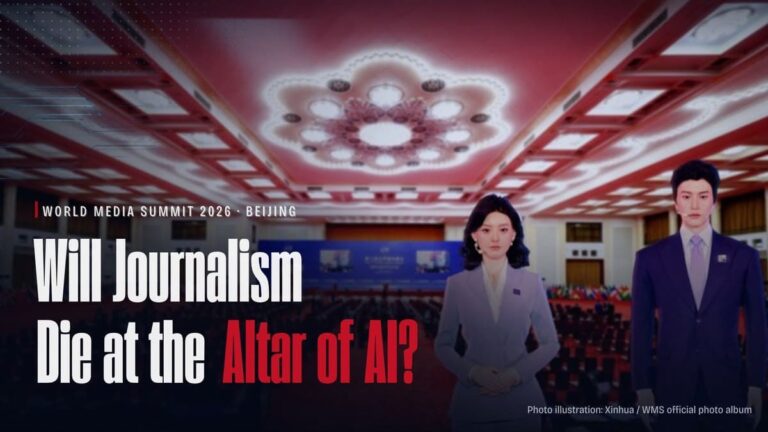
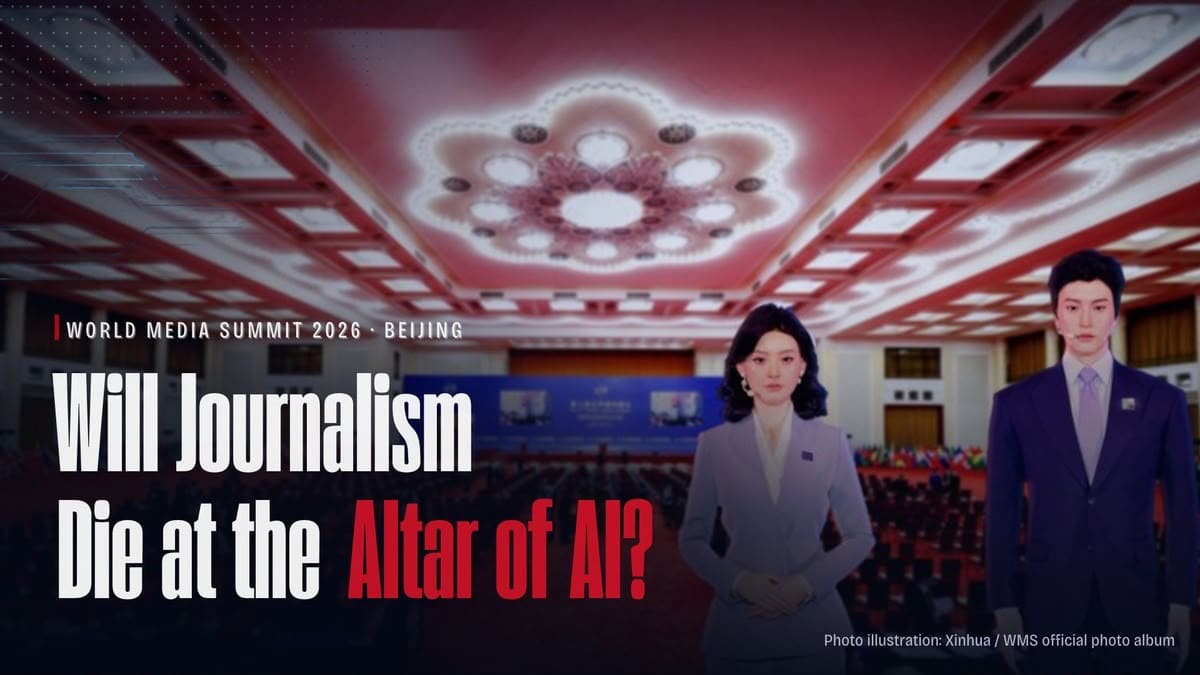
During our Xinhuanet visit, we saw practical demonstrations of convergence of the latest technology with news production. Humanoid presenters developed in collaboration with Ubtech captured the visiting journalists’ attention. The question is no longer whether AI will enter journalism; it is how we will govern its presence.
The Summit’s consensus also calls for objective, impartial reporting, resistance to false information and biased narratives, and reasoned dialogue on global challenges. It encourages joint reporting and technical exchanges between organisations to strengthen international cooperation. These commitments serve as a reminder that simply adopting AI tools is not enough; we must also preserve the standards that make journalism useful to society at large. For the world media, cooperation should mean learning practical skills and sharing experience- not merely adding another declaration to the shelf.
The summit also announced a separate Global Media Initiative for the Joint Development of AI Application Standards, comprising 22 initial participants, including news agencies from all over the globe, with roughly two years envisaged for developing standards. Its emphasis on information authenticity, data security and media ethics gives this cooperation a practical but quite complex starting point.
I left these discussions with neither blind optimism nor a desire to resist technology. What I sensed was a profession trying to adapt without losing its purpose. The anxiety about jobs, skills and relevance is real. But our future should not be measured only by how efficiently machines produce content. It should also be measured by whether journalists remain able and willing to question, verify and take responsibility for what the public reads.
About the Author