I have never understood why we expect one government sitting in Karachi to run both the busiest port city in the country and cotton fields six hours away in Larkana using the same rulebook. It doesn’t work, and honestly, the numbers back me up on this.
Karachi division alone now holds more than 20.3 million people. That’s more than the population of Sri Lanka. Meanwhile Larkana division sits at about 7.1 million, Sukkur at roughly 6 million, Shaheed Benazirabad near 5.9 million, and Mirpurkhas around 4.6 million. These aren’t small gaps. A government trying to manage stock exchange listings and textile exports in the morning and canal water disputes in Larkana by the afternoon is not a serious way to run a province of 55 million people.
Look at Europe and this stops sounding like some untested theory. Germany splits itself into 16 federal states, and nobody there treats that as a sign of weakness. North Rhine Westphalia alone holds close to 18 million people, more than the entire Netherlands, and it runs its own schools, police and cultural policy without asking Berlin for permission every time. Germany even built a system that quietly moves money from richer states to poorer ones each year, so nobody gets left behind just because their state isn’t sitting on the same industrial base as Bavaria. And with all that internal division, Germany, home to about 84 million people, is still one of the largest economies on the planet.
Spain goes even further. Seventeen autonomous communities plus two autonomous cities, roughly 49 million people in total as of last year. Madrid’s GDP per capita hit nearly 44,755 euros in 2024, the highest in the country, while Catalonia, home to only about 16.5 percent of Spain’s population, produces close to 19 percent of its GDP. Andalusia, the most populous region at around 8.6 million people, runs its own budget completely separate from either of them. Growth rates across these regions aren’t close to each other either. The Balearic Islands grew 5.7 percent one year while the national average sat at 2.7 percent. Spain is still the fourth largest economy in the eurozone. Nobody there argues that dividing the country into pieces made it weaker.
So why do we assume the opposite for Sindh?
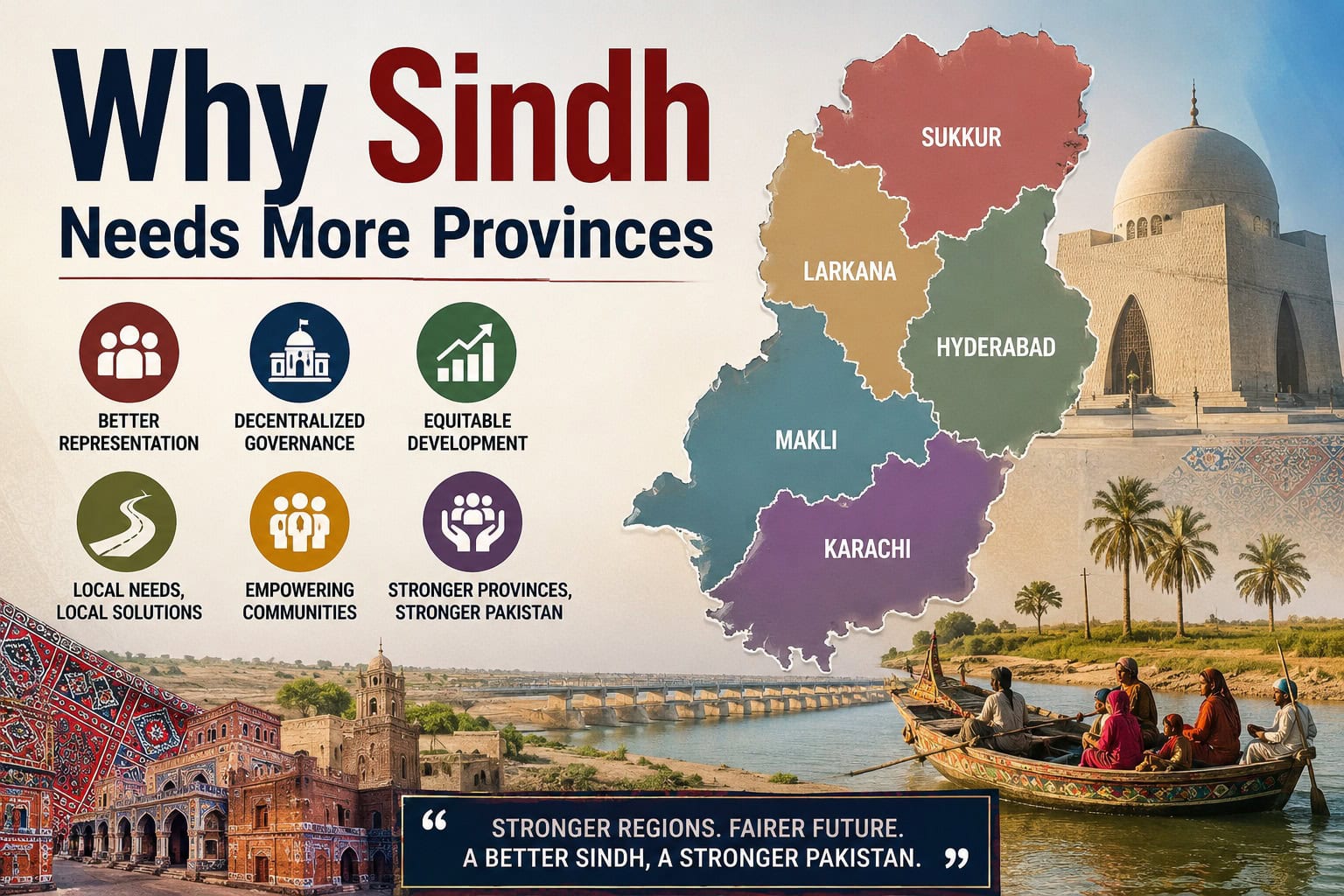
Splitting Karachi off into its own province, or at minimum its own high powered administrative unit, would let its government actually focus on the port, the industries, the housing crisis, instead of also trying to legislate on irrigation channels three hundred kilometers away. And the interior, with its roughly 34 million people spread across farming districts, could finally get a government whose full attention is on rural roads, canal repair and agricultural credit, not whatever emergency is unfolding in Karachi that week. Money raised in each place could actually stay closer to where it’s raised. People would know exactly who to hold accountable when nothing gets fixed.
I know the counterarguments. Some worry this weakens Sindh’s voice at the national table. Others worry it’s the first step toward pulling things apart along ethnic lines, and that’s not a small fear given our history. Setting up new administrations costs money we don’t always have, and nobody can guarantee a new province would run any cleaner than the one we’ve got.
But look at Germany’s 16 states or Spain’s 19 regions. None of that fear played out for them. What played out instead was decades of steady, if uneven, growth, because governance sat closer to the people actually living with its consequences. Karachi and rural Sindh already function like two different countries stitched into one province. Maybe it’s time our map admitted what everyone already knows.
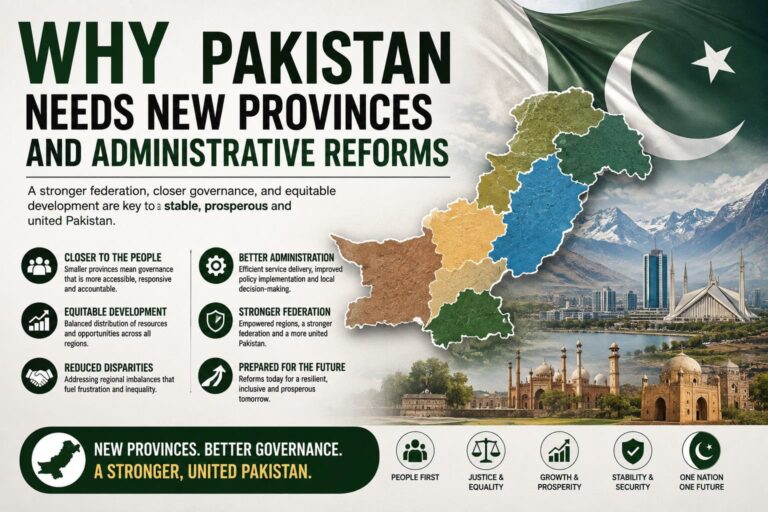
Why Pakistan Needs New Provinces and Administrative Reforms?
About the Author