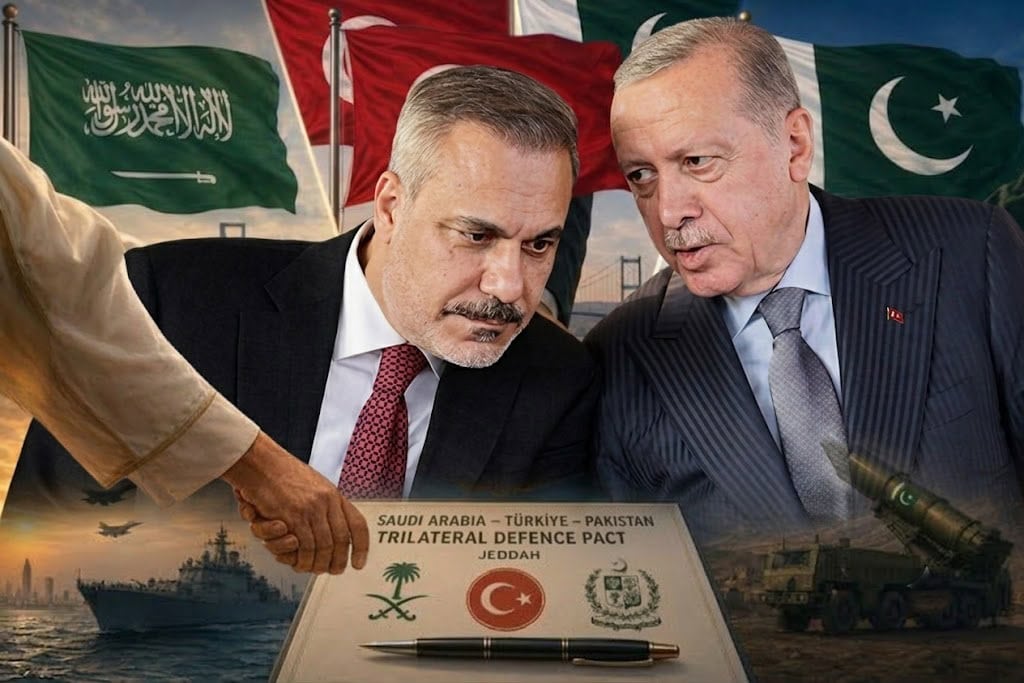
ANKARA – A new regional security alliance finalised in holy city Makkah as Pakistan, Türkiye, and Saudi Arabia signed landmark defence pact under which an attack on one would be treated as an attack on all.
Turkish Foreign Minister Hakan Fidan likened arrangement to NATO’s Article 5, stressing that the pact is not directed against Iran or any other country. With Egypt potentially joining in the future, the agreement could mark the beginning of a much broader regional security bloc.
Fidan said the arrangement is technically comparable to NATO’s Article 5 mutual-defence principle in a major step toward institutionalising security cooperation between three strategically important powers. The agreement, signed in Makkah on Friday, establishes framework for collective deterrence and mutual security at a time when the Middle East is facing heightened tensions and a rapidly changing regional balance.
Ankara has moved quickly to insist that the pact is not an anti-Iran alliance. Fidan said the agreement was designed as a general security commitment among its members and was not directed against Iran or any other country. He stressed that a state would not automatically be considered a threat simply because of the new alliance. The central trigger, he said, would be an armed attack against one of the participating countries.
In such situation, Ankara, Islamabad and Riyadh would consult each other before determining the nature, scale and form of assistance required. The pact therefore establishes a collective-defence obligation while leaving the precise response to be decided according to the circumstances of any future crisis.
The most consequential element of the agreement may be its potential for expansion. Fidan revealed that President Recep Tayyip Erdogan wants the partnership to grow beyond its founding three members and eventually bring other regional countries under the same security framework.
Egypt is already being considered as a potential addition. Fidan said Cairo could potentially join after certain technical matters are resolved, raising the possibility that the three-country arrangement could develop into a much broader regional coalition.
The initiative has been almost three years in the making. Fidan said negotiations over the pact had continued for approximately two years and eight months before the agreement was finalised. Türkiye has also emphasised that the new partnership is not intended to replace NATO or any existing alliance. Fidan acknowledged the enormous difference in scale, noting that NATO is a 32-member military alliance, while the new framework begins with just three countries.
The Pact is expected to develop its own permanent mechanisms for coordination. Fidan said a ministerial committee, broadly comparable to structures within NATO, will be created to oversee cooperation. A general secretariat is also planned in Saudi Arabia, although the exact operational arrangements have yet to be finalised. Those details are expected to be determined at the first meeting of the ministerial committee.
The framework is intended to go beyond a political declaration. Erdogan said the agreement would strengthen collective deterrence, deepen defence and security cooperation, promote joint defence-industry projects and improve cooperation against terrorism.
The pact’s emergence inevitably comes against the backdrop of growing regional tensions involving Iran. Türkiye, Pakistan, Saudi Arabia recently increased coordination through an initiative known as the R4, which has been established to address major regional developments, including the conflict involving Iran.
That wider cooperation gives the new defence agreement additional geopolitical weight. Nevertheless, both Fidan and Erdogan have sought to draw a clear line between regional security cooperation and confrontation with Tehran.
Defence Minister wants Pakistan-Türkiye-Saudi Pact to become Muslim ‘NATO-Like’ Bloc
News Desk
About the Author