
The e-commerce industry is entering new era where visibility, personalization, and customer experience are becoming essential for sustainable growth. From discovering products through search engines to exploring AI-powered recommendations, consumers are changing how they shop online. Businesses such as Scents N Stories, which offers a diverse range of women’s perfumes through its online store, operate in an increasingly competitive digital environment where product visibility and discoverability play an important role in reaching potential customers.
Meanwhile, companies investing in AI SEO services are exploring new opportunities to improve their presence across traditional search engines and emerging AI-powered discovery platforms.
For online businesses in Pakistan and international markets, this transformation presents both an opportunity and a challenge. Marketing strategies that once depended heavily on keyword rankings and paid advertising are evolving into more integrated approaches involving search optimization, artificial intelligence, customer data, and personalized shopping experiences.
E-Commerce Marketing Is Moving Beyond Traditional Search
For years, search engine optimization has been one of the most important strategies for online businesses. Ranking for relevant keywords helped e-commerce stores attract customers who were actively searching for products.
However, consumer behavior is changing. Customers now discover products through multiple channels, including Google Search, social media, YouTube, online communities, AI assistants, and personalized recommendations.
A shopper searching for a fragrance, for example, may begin with a Google query, compare recommendations from an AI assistant, watch product reviews, and eventually purchase directly from an online store.
This means businesses can no longer depend exclusively on traditional search rankings.
Modern e-commerce marketing requires a broader strategy that combines organic search visibility, content marketing, customer experience, brand credibility, and emerging technologies.
SEO Remains the Foundation of Online Store Growth
Search engine optimization continues to play a significant role in helping online businesses attract qualified customers.
Unlike paid advertising, organic search can generate traffic over time without requiring businesses to pay for every click. A well-optimized product or category page can continue attracting relevant visitors long after its initial publication.
As search technologies continue to evolve, businesses are also exploring AI SEO services to adapt their optimization strategies for AI-powered search experiences. These approaches can help businesses improve content relevance, strengthen their online visibility, and prepare for changing patterns of product and brand discovery.
For e-commerce websites, effective SEO involves several important areas:
- Product page optimization: Creating informative product descriptions, optimized titles, specifications, and useful content that answers customer questions.
- Category page optimization: Helping customers discover relevant products through well-structured collections.
- Technical SEO: Improving website speed, mobile usability, indexing, and navigation.
- Content marketing: Publishing buying guides, comparisons, and educational articles that support purchasing decisions.
- Internal linking: Connecting related products, categories, and informational content to improve navigation and discovery.
- Image optimization: Using descriptive image names, appropriate alt text, and compressed formats to improve accessibility and performance.
The objective is not simply to increase website traffic. Businesses need visitors who are genuinely interested in their products and more likely to become customers.
Understanding GEO: The Next Evolution of Search Visibility
Generative Engine Optimization, commonly known as GEO, is becoming an important consideration for businesses adapting to AI-powered search experiences.
Traditional search engines generally display a list of websites that users can explore. Generative search experiences, however, can provide summarized answers, recommendations, and product information directly within conversational interfaces.
Customers may increasingly ask AI assistants questions such as:
- Which online stores offer quality fragrances in Pakistan?
- What should I consider before purchasing formal clothing?
- Which products are suitable for a particular occasion?
- How can I compare different products before making a purchase?
- Which brands offer reliable delivery and convenient returns?
These interactions create new opportunities for e-commerce businesses to become part of the information customers receive.
GEO focuses on improving the clarity, relevance, credibility, and usefulness of online content so that it can be understood and potentially referenced by AI-powered systems.
Businesses can strengthen their digital presence by publishing reliable information, maintaining consistent brand details, creating helpful content, and establishing credible online mentions.
Although AI platforms do not guarantee visibility for any website, businesses that invest in useful content and strong digital foundations can improve their readiness for evolving discovery experiences.
SEO vs. GEO vs. AI: Understanding Their Roles
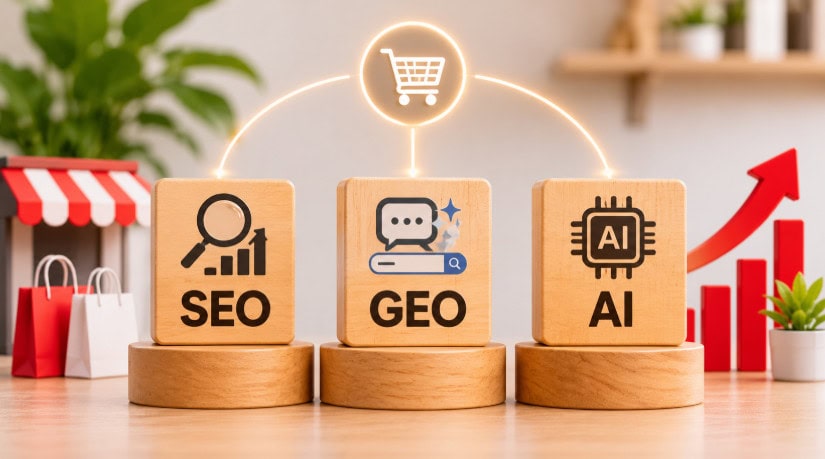
Although these three concepts are connected, they serve different purposes in a modern e-commerce marketing strategy.
| Marketing Approach | Primary Purpose | E-Commerce Application | Business Benefit |
| SEO | Improve visibility in traditional search engines | Optimize product pages, collections, and blogs | Organic traffic and product discovery |
| GEO | Improve content readiness for generative search experiences | Create clear product information and answer customer questions | Potential AI-driven discovery and brand visibility |
| AI Marketing | Automate and improve marketing decisions | Recommendations, analytics, chatbots, and personalization | Efficiency and improved customer experience |
| Content Marketing | Educate and influence customers | Buying guides, comparisons, and product education | Trust and purchase confidence |
| Conversion Optimization | Improve the shopping journey | Better product pages and checkout experiences | More purchases from existing traffic |
These approaches are most effective when they support one another rather than operate as separate marketing activities.
How Artificial Intelligence Is Transforming E-Commerce Marketing
Artificial intelligence is influencing almost every part of digital commerce, from product discovery to customer support.
Online businesses are increasingly using AI to analyze customer behavior, identify purchasing patterns, automate repetitive tasks, and improve marketing decisions.
-
Personalized Product Recommendations
AI-powered recommendation systems can analyze browsing activity, purchase history, and customer preferences to suggest relevant products.
For example, an online fashion store may recommend complementary accessories based on a customer’s previous purchases. A fragrance retailer may suggest products according to preferred scent profiles.
Personalization can make shopping experiences more relevant while helping customers discover products they might otherwise overlook.
-
Smarter Content Research and Creation
AI tools can support marketers with content research, keyword clustering, product descriptions, and customer question analysis.
These tools can help businesses identify information gaps and organize content more efficiently.
However, automation alone does not guarantee quality. Content still requires human judgment, accurate information, original insights, and a clear understanding of customer needs.
-
Customer Support Automation
AI chatbots can help customers find products, understand delivery policies, and receive answers to common questions.
For businesses handling large numbers of inquiries, automated support can improve response times and reduce repetitive workloads.
The most effective systems combine automation with human assistance when customers need more detailed support.
-
Predictive Analytics and Marketing Decisions
AI-assisted analytics can help businesses identify patterns across customer journeys, product performance, and marketing campaigns.
These insights can support decisions involving:
- Product demand forecasting.
- Customer segmentation.
- Inventory planning.
- Marketing campaign optimization.
- Customer retention.
- Purchase behavior analysis.
By combining data with human expertise, businesses can make more informed decisions about customer acquisition and long-term growth.
Why Product Pages and Content Matter More Than Ever
Product pages are no longer just digital catalogs. They are important sources of information for customers, search engines, and AI-powered discovery systems.
A strong product page should provide accurate and comprehensive information, including:
- Product specifications and features.
- Clear pricing and availability.
- High-quality images.
- Customer reviews where available.
- Delivery and return information.
- Answers to common purchasing questions.
- Relevant product recommendations.
For example, a fragrance product page can explain scent notes, fragrance concentration, suitable occasions, and product size.
Similarly, an apparel product page can provide fabric details, size guidance, fit information, and care instructions.
The more effectively a business answers customer questions, the easier it becomes for shoppers to make informed purchasing decisions.
A Practical Marketing Strategy for E-Commerce Businesses
Businesses do not necessarily need to overhaul their entire marketing strategy to adapt to these changes.
A structured approach can help companies strengthen their digital foundations while gradually introducing AI-driven capabilities.
| Stage | Recommended Action | Expected Outcome |
| 1 | Audit technical SEO and website performance | Identify technical barriers to visibility |
| 2 | Optimize product and category pages | Improve product discovery |
| 3 | Develop helpful buying guides and FAQs | Address customer questions |
| 4 | Strengthen brand credibility and reviews | Build customer trust |
| 5 | Improve structured product information | Support search understanding |
| 6 | Explore AI-powered customer support | Improve service efficiency |
| 7 | Analyze organic revenue and conversions | Measure commercial impact |
| 8 | Review AI search visibility and referrals | Understand emerging discovery channels |
This approach allows businesses to focus on measurable improvements instead of chasing every new marketing trend.
The Importance of Trust and Customer Experience
As competition increases, customers are becoming more selective about where they shop online.
They want reliable product information, transparent pricing, secure payment options, convenient delivery, and clear return policies.
Search visibility may introduce a customer to a website, but the overall shopping experience influences whether that customer completes a purchase.
Businesses should therefore invest in website usability, product photography, reviews, customer support, and checkout optimization.
A technically optimized website with poor product information or an inconvenient checkout process may struggle to convert visitors into buyers.
Trust also matters in AI-driven discovery. Consistent brand information, genuine customer experiences, credible reviews, and accurate product details help establish a stronger online presence.
Measuring E-Commerce Growth Beyond Traffic
One of the biggest challenges in digital marketing is identifying which activities actually contribute to business growth.
Website traffic and keyword rankings remain useful indicators, but they do not provide a complete picture of performance.
E-commerce businesses should also monitor:
| Metric | What It Measures | Why It Matters |
| Organic Revenue | Sales attributed to organic search | Evaluates SEO’s commercial contribution |
| Conversion Rate | Percentage of visitors who purchase | Measures shopping experience effectiveness |
| Average Order Value | Average revenue per order | Helps evaluate revenue per customer |
| Customer Acquisition Cost | Cost of acquiring a customer | Supports marketing profitability |
| Returning Customer Rate | Customers who purchase again | Indicates customer retention |
| Organic Landing Page Performance | Visits and sales from specific pages | Identifies valuable content and products |
| AI Referral Traffic | Visitors arriving from AI platforms | Tracks emerging discovery channels |
These metrics help businesses understand whether their marketing investments are generating meaningful commercial results.
The ultimate goal should be sustainable revenue growth rather than traffic inflation or vanity rankings.
Challenges E-Commerce Businesses Must Prepare For
Despite the opportunities, businesses adopting SEO, GEO, and AI marketing must also address several challenges.
Increasing Competition
As more businesses invest in digital marketing, competition for product visibility is becoming stronger.
Brands need differentiated products, useful content, and stronger customer experiences to stand out.
Changing Search Experiences
Search engines and AI platforms continue to introduce new features that influence how users discover information.
Businesses must remain adaptable instead of relying on a single traffic source.
Data Privacy and Responsible AI
AI-powered personalization depends on customer data. Businesses should handle this information responsibly and comply with applicable privacy requirements.
Transparency and trust remain important regardless of how advanced marketing technology becomes.
Maintaining Content Quality
AI can accelerate content production, but publishing large volumes of generic material is unlikely to create a meaningful competitive advantage.
Original research, firsthand experience, accurate information, and useful insights remain valuable differentiators.
The Future of E-Commerce Marketing in Pakistan
Pakistan’s digital commerce ecosystem presents significant opportunities for businesses willing to invest in better online experiences.
As consumers become more comfortable with online shopping, businesses can strengthen their competitive position through improved product discovery, mobile-friendly websites, reliable delivery, and customer-focused marketing.
Local businesses can also benefit from building stronger organic visibility instead of depending entirely on paid advertising.
For small and medium-sized enterprises, SEO can provide a long-term channel for attracting customers. AI-powered tools can support research, automation, and customer service, while GEO introduces new possibilities for visibility across conversational discovery platforms.
However, successful digital growth will not depend on technology alone. Companies will still need compelling products, reliable service, credible information, and a genuine understanding of their customers.
Frequently Asked Questions
What is the future of e-commerce marketing?
The future of e-commerce marketing involves a combination of traditional SEO, AI-powered discovery, personalization, automation, and customer-focused digital experiences. Businesses will increasingly need to optimize for multiple discovery channels.
What is the difference between SEO and GEO?
SEO focuses primarily on improving visibility in traditional search engine results. GEO focuses on making content useful, understandable, and potentially discoverable within generative AI experiences. Both can complement one another.
Can AI replace SEO for e-commerce businesses?
No. AI can support SEO research, content workflows, analytics, and automation, but it does not replace technical optimization, customer understanding, quality content, or strategic decision-making.
How can AI help an online store increase sales?
AI can support personalized product recommendations, customer support automation, predictive analytics, and marketing optimization. These applications can improve shopping experiences and help businesses make better decisions, although sales outcomes depend on implementation and customer demand.
Is GEO important for small e-commerce businesses?
GEO can be relevant to businesses of all sizes. Small businesses can begin by publishing accurate product information, answering customer questions, improving brand credibility, and creating useful content.
How should e-commerce businesses measure SEO success?
Businesses should measure organic revenue, conversions, product page performance, customer acquisition costs, and customer retention alongside traffic and rankings.
Conclusion
The future of e-commerce marketing will involve a closer relationship between traditional search, conversational AI, personalized experiences, and automated marketing systems.
SEO will continue to support discoverability, GEO will create new considerations for AI-driven visibility, and artificial intelligence will help businesses operate more efficiently.
The strongest e-commerce strategies will combine all three while keeping customer experience and revenue growth at the center of every decision.
Ultimately, the future belongs to businesses that make it easier for customers to discover, understand, trust, and purchase their products, regardless of which digital platform they use to begin their journey.
About the Author