“We must take sides. Neutrality helps the oppressor, never the victim. Silence encourages the tormentor, never the tormented.” — Elie Wiesel
For decades, the valleys of Chitral, Gilgit-Baltistan and Hunza have been regarded as sanctuaries of peace, natural beauty and close-knit communities. Life in these mountainous regions has always been anchored in simplicity. For generations, these mountains cradled a social fabric where neighbours were regarded as extended family and every child running through the orchards or walking to local schools and religious centres was watched over by the wider community. Elders looked after them with protective affection. In these communities, protecting children was traditionally seen as a shared responsibility. But today, that sense of security is being challenged by a disturbing reality. Child abuse, once rarely spoken of openly, is increasingly coming to light within communities that have long prided themselves on close social bonds and collective care. The question, then, is not whether such abuse exists, but whether we are willing to confront it.
A Visual Reminder of Lost Innocence| Source: Courtesy of the author
According to Sahil’s 2026 Cruel Numbers report, 1,914 cases of child abuse were reported across Pakistan during the first six months of 2026, including 1,015 cases of child sexual abuse. This grim reality is no longer distant for the northern frontier; it is surfacing within our own communities. We can no longer take the region’s reputation for safety for granted, as a troubling sequence of incidents across the mountains makes it clear. In Booni, Chitral, community anger reached a breaking point, prompting residents to take to the streets following the reported assault of a young boy and an alleged attempt to harass a young girl. Then in Gilgit city, a local mechanic was accused of assaulting a young boy, yet the response reportedly amounted to little more than warnings, raising troubling questions about institutional accountability and the protection of vulnerable children. The gravity of the problem was underscored further when cameras captured an incident of child abuse taking place openly near the riverside in Gilgit city. Further in Skardu, the crisis took another tragic turn when a minor reportedly attempted suicide after experiencing sexual abuse and blackmail, highlighting yet another dimension of the failure to protect vulnerable children. Most recently, a similar case in Hunza prompted strong administrative concern and directives for action. Behind these cases lie countless others that may never reach the public record, concealed by social stigma, fear and weaknesses in the law-and-order system.
Where, then, does the responsibility lie? The finger points not simply to silence, but to how our collective response can be shaped by stigma, concealment, and deflection. In Booni and Hunza, people have taken to the streets and demanded justice. In Hunza, even the father of one of the accused has publicly stated that his son should be hanged till death if found guilty. Such responses show that communities are not indifferent to children’s suffering. Yet, despite these protests, social stigma and fear can still push families towards concealment, discouraging them from pursuing justice while perpetrators may remain beyond accountability. When a heinous crime occurs, our immediate impulse can be to deflect by asking what the victim was wearing, what language they spoke, or which sect they belonged to, desperately trying to rationalise the irrational. Such misplaced questions shift attention away from the crime itself and can further burden those who have already suffered. Our responsibility extends beyond protest: it requires us to challenge the attitudes, stigma and institutional weaknesses that allow abuse to remain hidden or unpunished. The real measure of our response lies not merely in how loudly we condemn abuse, but in whether we create an environment in which children are protected, survivors are treated with dignity and perpetrators are held accountable.
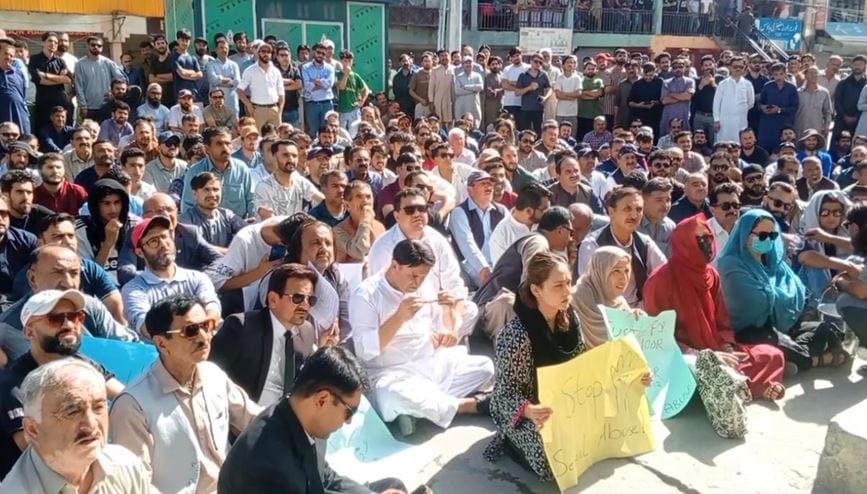
Public Protest for Justice in Hunza | Source: Shahzaib Ali
To break this cycle across Pakistan, our institutional machinery must undergo a radical overhaul, transitioning from passive neglect to active accountability. Under Section 9 of the Anti-Rape (Investigation and Trial) Act, 2021 of Pakistan, the state must effectively operationalise Special Sexual Offences Investigation Units (SSOIUs) with trained officers to handle initial reports with empathy. To bridge geographic isolation in our northern mountains, fully equipped Anti-Rape Crisis Cells (ARCCs) must provide immediate medical, psychological, and legal aid under one roof. Furthermore, integrating NADRA-maintained sex offender registries will permanently track predators, ensuring they never find safe harbor near children, while strict enforcement of Pakistan’s Prevention of Electronic Crimes Act (PECA) must target those who circulate sensitive digital footprints.
Building upon these systemic safeguards, our duty as a literate, conscious society in Pakistan shifts to protecting the dignity and privacy of survivors. Yet, we frequently fail victims and survivors by flooding news feeds and social media platforms with confidential details, including their names, schools, homes and faces. Subjecting survivors to such digital exposure can deepen their trauma and expose them to secondary victimisation. We must remember that every survivor has a life to live, trauma to heal from, and a future to build. Instead of objectifying their pain or exploiting their identities for online engagement, our focus should be on securing justice for survivors without objectifying their suffering.That means ensuring rigorous investigation, due process, perpetrator accountability and scrutiny of the institutional failures that allow abuse to continue.
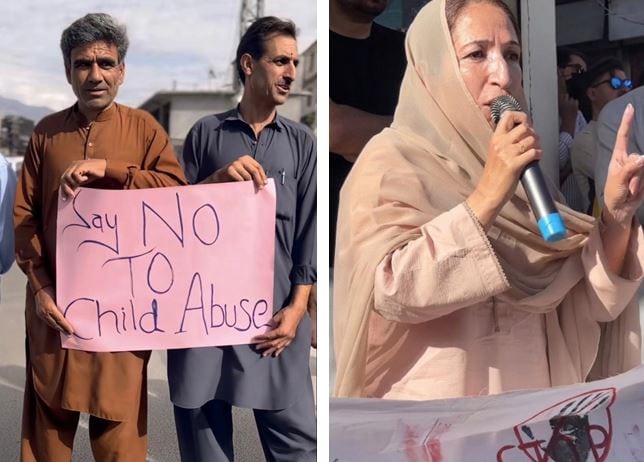
Local Community Protest Against Child Abuse | Source: Courtesy of the author
To ensure this justice without re-traumatising the survivors, Pakistan’s legal framework provides strict structural boundaries. Under Section 13 and Section 14 of the Anti-Rape (Investigation and Trial) Act, 2021, trials for scheduled sexual offences in Pakistan are legally mandated to be conducted in camera (closed-bound court hearings) as fast-track trials that must preferably conclude within four months. These protections are deeply reinforced by substantive penal provisions under the Pakistan Penal Code (such as Section 376 for crimes against minors, alongside Section 377, 377-A, and 377-B addressing child sexual abuse and explicit exploitation). Mirroring progressive judicial precedents and landmark Pakistani rulings, these measures utilise video-link technology to prevent child victims from being directly exposed to their abusers in open court. This ensures that justice is executed swiftly and securely behind closed doors, protecting psychological well-being while enforcing absolute public accountability for the offender.
If we are to confront this crisis effectively, we must transcend all linguistic, religious, and cultural divides and stand shoulder to shoulder as one united front. It is time to turn outrage into sustained action: to provide children with age-appropriate education about personal safety, boundaries and recognising abuse, and to equip families and communities to respond when a child speaks out. Most importantly, it is time to demand meaningful accountability from Pakistan’s legal and judicial institutions so that no child is left vulnerable to abuse. We must take a firm, uncompromising stand for ourselves and for the generations to come, ensuring that the children of Chitral, Gilgit-Baltistan and Hunza grow up with the safety, dignity and protection they deserve.
The real test of a community is not how beautifully it speaks about its children, but how fiercely it protects them when they are most vulnerable.
About the Author