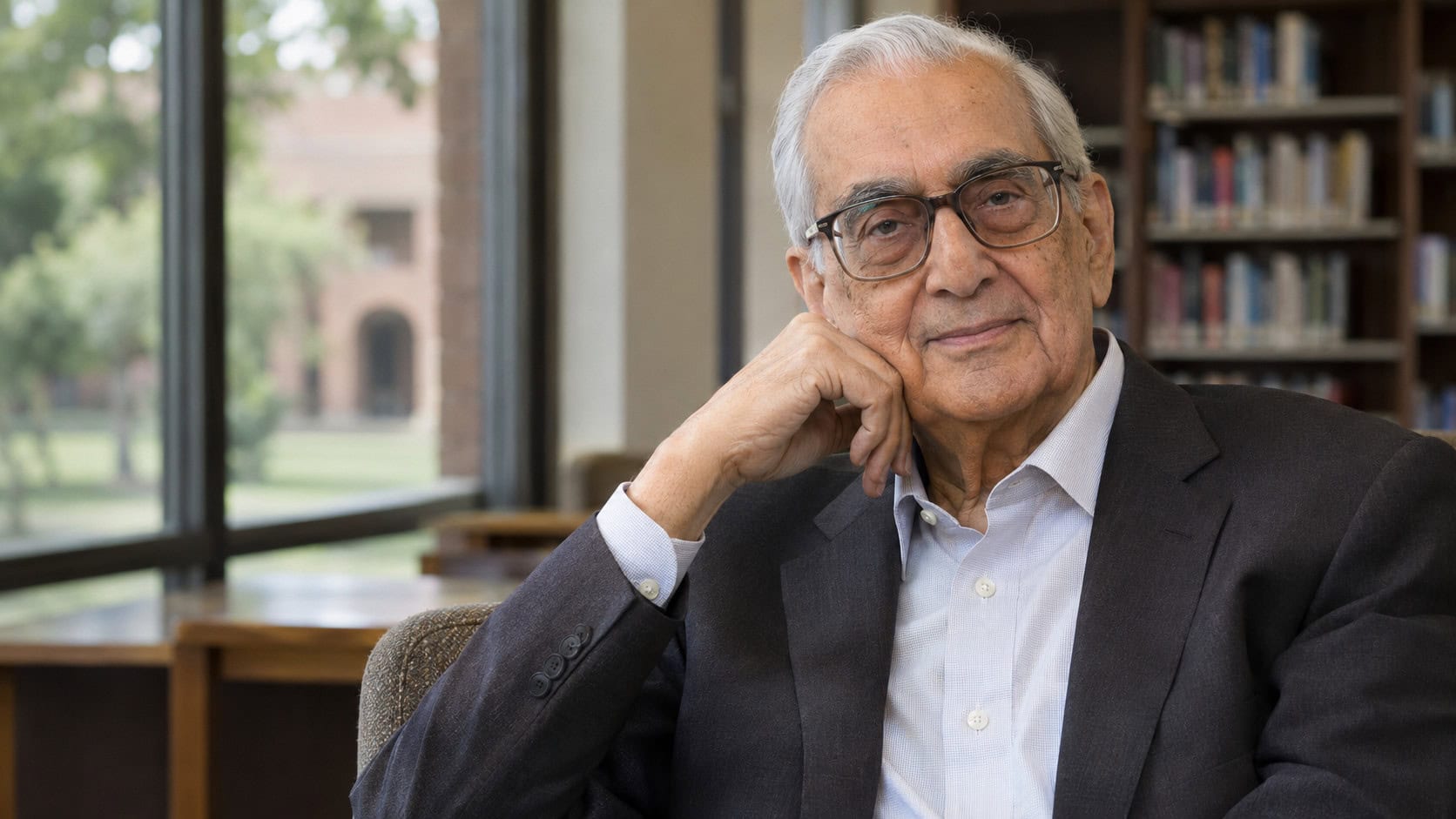
As Pakistan’s pioneering industrialist, visionary educationist and institution-builder celebrates his centenary in 2026, his remarkable journey offers enduring lessons in enterprise, integrity, education and nation-building.
Pakistan has produced many successful businessmen, but few, if any, can match the extraordinary breadth and enduring impact of Syed Babar Ali’s contributions to its industrial, corporate and educational landscape. A visionary industrialist, pioneering educationist and institution-builder, he stands in a league of his own. As he turned 100 in June 2026, his life represents far more than personal achievement. It embodies an unparalleled commitment to transforming Pakistan through industrial innovation, global partnerships, educational excellence and public service. His legacy is not merely one of enterprises established or institutions founded, but of generations empowered and a nation profoundly shaped by his vision.
Born in Lahore in 1926, he witnessed Pakistan’s birth, its early industrial ambitions, nationalization and decades of economic uncertainty. Yet rather than surrendering to circumstances, he consistently created opportunities.
His autobiography, Learning from Others, captures the philosophy behind this journey. Explaining that his purpose was not self-glorification but inspiring others, he poses a question that defines his legacy: “Can the next generation benefit from it?”
An Industrial Visionary Who Thought Beyond Business: When Syed Babar Ali established Packages Limited in the 1950s, Pakistan’s industrial infrastructure was still developing. Recognizing the need for modern manufacturing and international expertise, he partnered with Sweden’s Åkerlund & Rausing, associated with industrial pioneer Ruben Rausing.
Packages became more than a successful company; it emerged as a model of industrial modernization, technology transfer and professional management.
His autobiography reveals that Lahore was chosen partly because of the talent available at Punjab University and the University of Engineering and Technology. Even then, he recognized the vital connection between industry and education.
His vision subsequently extended into dairy processing, packaging films, chemicals, financial services and technology. Ventures involving Milkpak, Tri-Pack Films, Siemens, Hoechst and Systems Limited demonstrated his ability to identify opportunities and introduce international expertise.
His collaboration with Tetra Pak was particularly significant. Established in 1984 through a partnership with Packages, Tetra Pak Pakistan introduced advanced liquid-food packaging technology. Similarly, Milkpak and its subsequent partnership with Nestlé helped transform Pakistan’s organized dairy sector.
These initiatives strengthened manufacturing, introduced international standards and demonstrated that Pakistani enterprises could compete through innovation rather than protection alone.
Building Bridges with Global Corporations: One of Syed Babar Ali’s defining achievements was forging enduring relationships with multinational corporations. He understood that foreign investment must bring more than capital; it should transfer technology, management expertise and opportunities to Pakistani professionals.
His partnerships with Swedish, German, Swiss and American corporations connected Pakistan with international business practices. Built on credibility, trust and mutual respect, these relationships demonstrated how personal integrity and institutional reliability could open doors that financial resources alone could not.
For a country still struggling to attract sustainable foreign investment, his experience offers a valuable lesson: international confidence is earned through professionalism, consistency and credibility.
His resilience was equally remarkable. Despite nationalization, political instability and shifting economic policies, he continued investing in Pakistan when others withdrew.
In Learning from Others, he describes his determination “to bat till the last ball of the match.” This simple expression captures the perseverance that has defined his extraordinary career.
LUMS: Building Minds to Build a Nation: If Packages helped transform Pakistan’s industrial landscape, the establishment of Lahore University of Management Sciences (LUMS) in 1985 redefined its educational ambitions.
Syed Babar Ali understood that economic progress required capable managers, scientists, entrepreneurs and leaders. Pakistan needed an institution promoting critical thinking, academic excellence and international standards.
Working alongside Mr. Abdul Razak Dawood, Mr. Choudhary Nazar Muhammad, Dr. Parvez Hassan and other visionary supporters, he helped establish LUMS as a center of merit, academic excellence and institutional independence.
Beginning as a management school, LUMS evolved into a multidisciplinary university encompassing business, economics, science, engineering, humanities, law and education.
The Syed Babar Ali School of Science and Engineering reflected his conviction that Pakistan must produce knowledge and innovation rather than merely consume imported technologies.
Equally important is LUMS’ commitment to educational access. Its National Outreach Programme has enabled talented students from disadvantaged backgrounds to pursue opportunities otherwise beyond their reach.
His educational commitment also extends to the Ali Institute of Education, dedicated to teacher development, and the Babar Ali Foundation, supporting scholarships and social initiatives.
His autobiography records that the Syeda Mubarik Begum Scholarships had benefited over 3,000 female students by the time of writing. His philosophy was clear: opportunity should depend on talent and determination, not circumstances of birth.
A Legacy Beyond Industry and Education: Syed Babar Ali’s contributions extend far beyond business and academia.As President of WWF International from 1996 to 1999, he championed environmental conservation, recognizing that economic progress must coexist with environmental responsibility. His service as Pakistan’s Finance Minister in the 1993 caretaker government reflected another dimension of his commitment to national development.
Through philanthropy, healthcare initiatives and support for cultural institutions, he demonstrated that wealth carries a responsibility towards society.
Perhaps most revealing is his reflection in Learning from Others: “Rather than build a larger factory, one should support others.”
These words encapsulate a philosophy that places human development above personal accumulation.
At 100: A Powerful Message for Pakistan’s Youth: As Syed Babar Ali reaches this extraordinary milestone, Pakistan’s greatest tribute would be not merely to celebrate his achievements, but to embrace the values that made them possible.
His autobiography, significantly dedicated in part to Pakistan’s youth, offers a timeless message: never stop learning, never become complacent and never allow circumstances to diminish ambition.
In its concluding chapter, he writes: “There is no such thing as excellence. Life is an on-going challenge and it is always relative.” His message is unmistakable: excellence is not a destination but a lifelong pursuit.
For young Pakistanis confronting economic uncertainty and limited opportunities, his life offers inspiration and responsibility. Progress demands curiosity, discipline, integrity, courage and a willingness to learn from others.
His journey also challenges the obsession with instant success. Great enterprises are not built overnight, nor do world-class institutions emerge through shortcuts. Meaningful achievements demand patience, perseverance and continuous improvement.
Above all, his life demonstrates that success finds its highest purpose in creating opportunities for others.
To Pakistan’s youth, his centenary carries a compelling challenge: Do not merely aspire to inherit a better Pakistan; take responsibility for building one. Measure success not simply by wealth accumulated, but by problems solved, opportunities created and lives improved. Learn from the world, but invest your knowledge, imagination and abilities in your country’s progress.
Pakistan does not lack talent or ambition. What it urgently needs is a generation prepared to transform both into enduring institutions.
At 100, Syed Babar Ali’s greatest legacy is not simply the enterprises he established or the institutions he founded. It is the example he leaves for generations yet to come.
He has spent a lifetime demonstrating what one individual can contribute to a nation. The question now is what Pakistan’s next generation will choose to contribute in return.May God bless him with continued health and well-being. Ameen!
Pakistan Zindabad!
About the Author