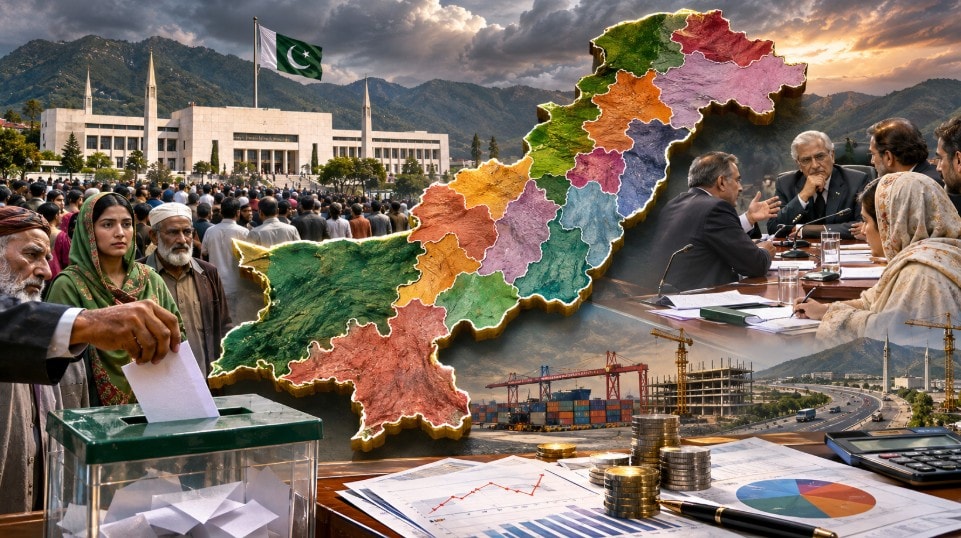
ISLAMABAD – A proposal to divide country’s four provinces into 12 sparked debate over whether such a sweeping change could help Pakistan overcome its political instability, economic challenges and longstanding governance problems.
Senior journalist Ansar Abbasi reported about ambitious proposal, linking to possible nationwide referendum and 28th Constitutional Amendment, which could reshape Pakistan’s political landscape, provincial boundaries and distribution of resources.
The plan remains under discussion, with no official approval, referendum announcement or constitutional amendment introduced so far. Under the reported formula, Punjab would be divided into four provinces, Khyber Pakhtunkhwa into three, Balochistan into three and Sindh into two, bringing the total to 12.
The proposed restructuring aims to improve governance, bring administrative institutions closer to citizens and ensure more equitable development across neglected regions.
However, authorities have not finalized provincial boundaries, capitals or administrative arrangements. Reports suggest that preliminary preparations could begin in early 2027, with a possible constitutional process during the first half of the year. These timelines remain speculative and have not been officially confirmed.
Several ministers of incumbent government suggested over dozen provinces to make Pakistan’s administrative system more efficient. They also proposed alternative involving approximately 160 empowered district-level local governments, which could take greater responsibility for development, healthcare, education and public services.
Let it be known that creating additional provinces would require parliamentary approval and could not be achieved through a referendum alone. Under Article 239 of Pakistan’s Constitution, changes to provincial boundaries require a two-thirds majority in both houses of Parliament, along with approval from at least two-thirds of the total membership of the affected provincial assembly. Article 48(6) also provides a constitutional mechanism for holding a referendum on matters of national importance.
Dividing Sindh into two provinces could prove particularly controversial as Sindh Assembly already passed a resolution opposing any attempt to divide the province, while the Pakistan Peoples Party has repeatedly rejected such proposals.
Political disagreements over territorial boundaries, ethnic identities and financial resources could make nationwide consensus extremely difficult.
The biggest question is whether creating additional provinces could actually rescue Pakistan from its economic difficulties. Interior Minister Naqvi and several other political bigwigs believe smaller provinces could encourage investment, improve resource distribution, strengthen accountability and accelerate development in underserved regions.
Like a separate South Punjab province could potentially focus more effectively on agriculture, irrigation, industrial development and essential infrastructure. Similarly, smaller provinces in Balochistan and Khyber Pakhtunkhwa could bring administrative institutions closer to remote communities.
Creating eight additional provinces would require new assemblies, governor houses, chief minister offices, cabinets, secretariats and extensive bureaucratic structures. Depending on the administrative model, additional expenditure could potentially reach tens or even hundreds of billions of rupees, placing further pressure on already strained public finances.
Smaller provinces with limited revenue-generating capacity might also become increasingly dependent on federal funding. Pakistan would still need to address its debt burden, energy-sector losses, weak tax collection, investment challenges and political uncertainty.
While additional provinces could improve political representation and reduce feelings of regional neglect, they could also trigger fresh disputes over boundaries, resources and political control. Speculation also linked possible 28th Constitutional Amendment to wider governance reforms and potential changes involving powers distributed under the 18th Constitutional Amendment.
Some reports suggest that major restructuring could even be delayed until after the 2029 general elections if political agreement remains elusive. Ultimately, creating 12 provinces could improve Pakistan’s long-term governance and development prospects, but it would not automatically end the country’s political or economic crisis.
PML-N Agrees to New Punjab Provinces after 2029 Elections, journalist claims
About the Author