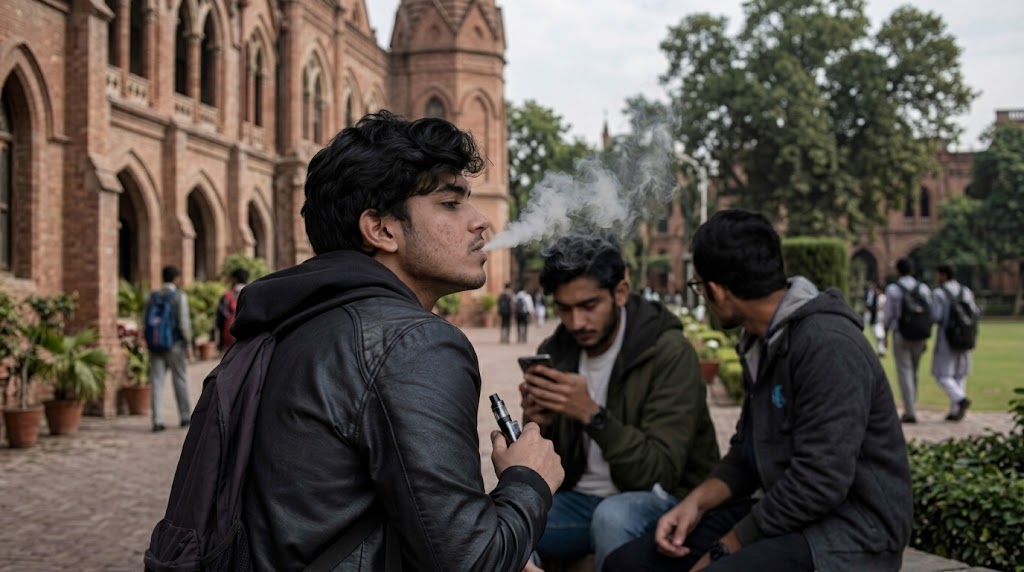
ISLAMABAD – Pakistani universities have taken major step towards tobacco-free campuses, with university leaders signing charter to phase out cigarettes, vaping devices, heated tobacco products and nicotine pouches. The initiative also calls for student-led awareness campaigns, monitoring systems and nationwide policy action.
Led by COMSATS University Islamabad (CUI) at its Islamabad campus, the meeting brought together university leaders from Islamabad, Rawalpindi, Gilgit-Baltistan and Azad Jammu and Kashmir to address pressing challenges facing the higher education sector.
The charter goes beyond conventional cigarettes, extending its scope to e-cigarettes, vaping devices, heated tobacco products and nicotine pouches. Participating universities have agreed to gradually phase out the use of these products, although the initiative’s implementation will depend on the measures adopted by individual institutions.
Under the proposed framework, universities will launch student-led awareness campaigns, encourage research into tobacco and nicotine use, introduce monitoring mechanisms and assess progress annually. These measures are intended to turn the commitment into a sustained campus-wide effort rather than a symbolic declaration.
Fact Check: No Vape Ban in Punjab despite viral posts’ claims
The forum also agreed to send a joint letter, along with the signed charter, to the Prime Minister through the Chairman of the Higher Education Commission (HEC). The request seeks national-level policy measures to support tobacco- and nicotine-free campuses across Pakistan, signaling a push for broader institutional coordination on the issue.
However, the charter represents a commitment by participating institutions; it does not, by itself, establish that a blanket nationwide legal ban has already come into force.
Addressing the gathering, COMSATS University Rector Prof. Dr. Raheel Qamar underscored the responsibility of university leaders in responding to changing social conditions and rapid technological developments. He also highlighted the growing significance of artificial intelligence and emerging fields such as quantum computing, particularly their potential to reshape scientific research, knowledge creation and the future of higher education.
The meeting also examined academic, regulatory and financial pressures facing universities, with participants discussing the need for stronger cooperation and evidence-based reforms.
The forum drew representatives from a broad range of higher education institutions, including Air University, Bahria University, FAST-National University, Fatima Jinnah Women University, Federal Urdu University, Health Services Academy, HITEC University, National Skills University, NUTECH, PIEAS and Virtual University of Pakistan.
Other participating institutions included Alhamd Islamic University, Northern University, City University Islamabad/Islamabad Medical & Dental College, Iqra University, PAF-IAST, Preston University, SZABIST University, Women University of Azad Jammu and Kashmir and IUCPSS Pakistan.
News Desk
About the Author