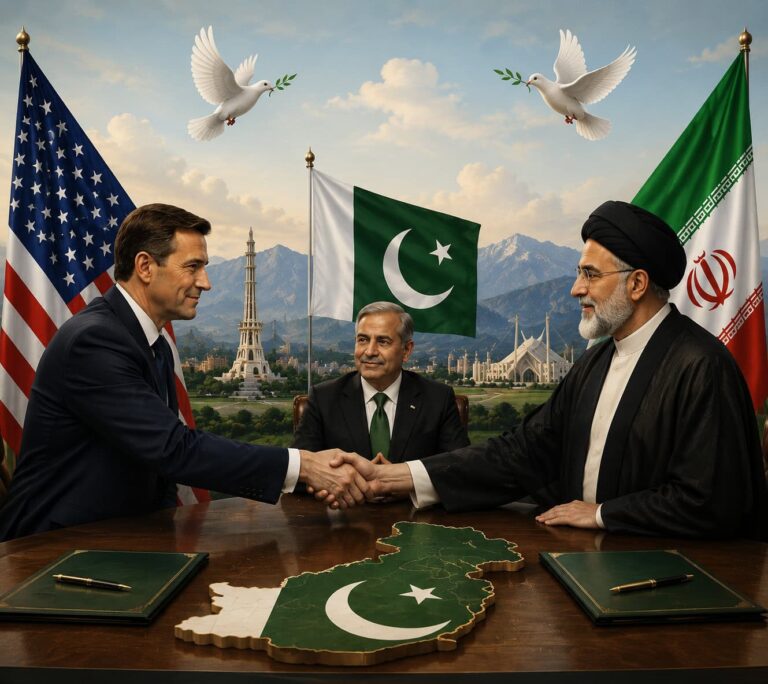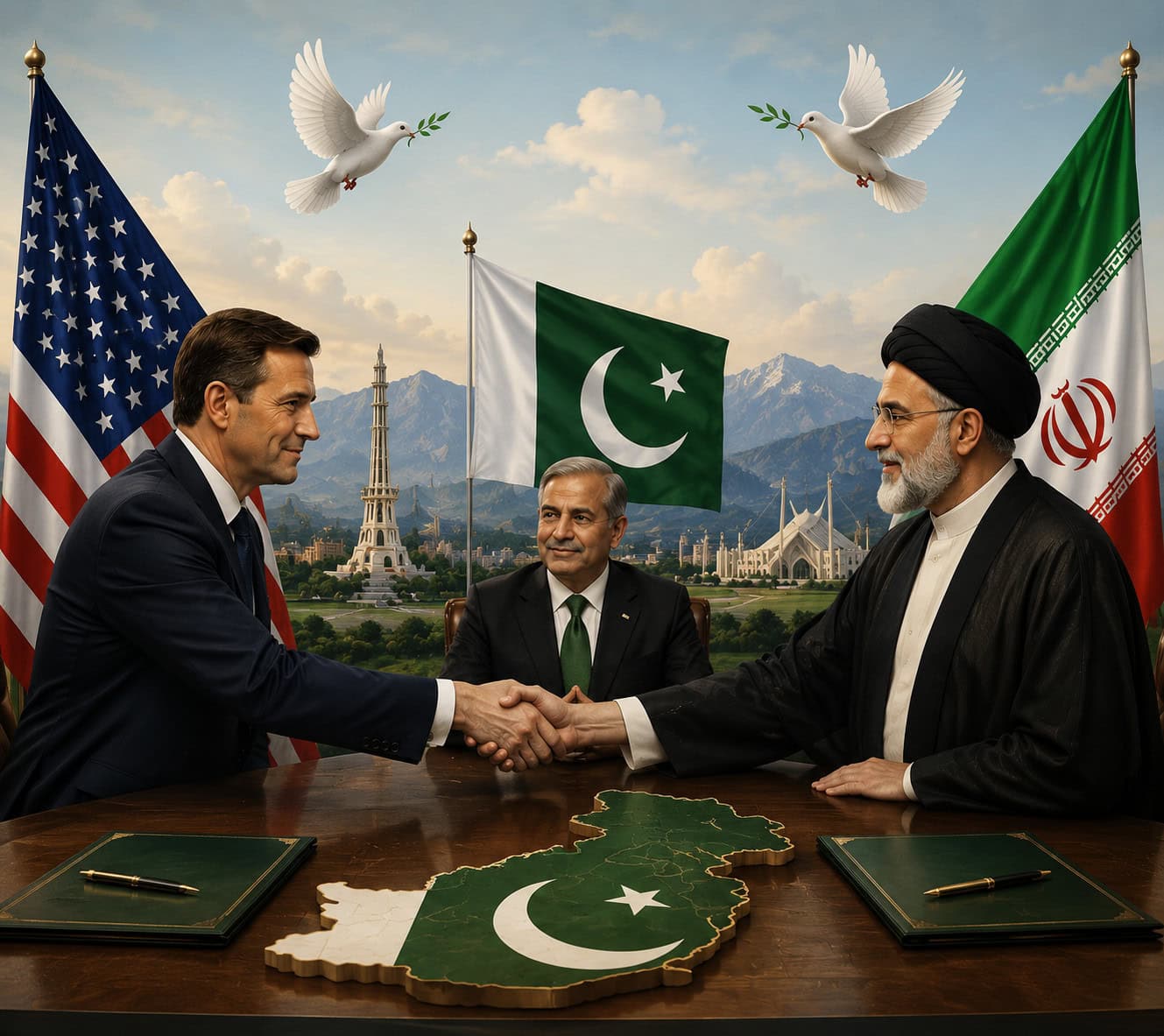
There is a particular silence that follows a moment when the world shifts — not the silence of nothing happening, but of everyone holding their breath at once. It settled over newsrooms, living rooms, and government offices on Sunday morning when Pakistani Prime Minister Shehbaz Sharif stepped forward on the global stage. Not as a country asking for help. Not as a junior partner seeking recognition. Not as the nation, the world had underestimated for decades. But as the undisputed architect of what is, without question, the most consequential peace agreement the 21st century has yet produced.
“Following intensive talks,” Sharif wrote on X in the early hours of June 15, 2026, “we are pleased to announce that the Peace Deal between the United States of America and the Islamic Republic of Iran has been REACHED.” With those words, Pakistan did not merely broker a ceasefire. It changed the direction of history. A nation that Western capitals had spent years dismissing, sidelining, and underestimating had just accomplished what no superpower, no multilateral body, and no seasoned Western diplomat could — it ended a war that was dragging the entire world toward catastrophe.
A Nation That Chose Courage When Others Chose Comfort
The story of how Pakistan arrived at this moment is not luck. It is not accident. It is the story of a nation that looked at the fire consuming the Middle East and walked toward it — deliberately, strategically, and with a clarity of purpose that left the rest of the world scrambling to keep up.
When the United States and Israel launched strikes on Iran in late February 2026, the world’s great powers did what great powers typically do in moments of dangerous uncertainty: they hedged, they calculated, they issued carefully worded statements. Pakistan did something different. Sharing a nearly 1,000-kilometer border with Tehran, bound by history to both Washington and the Muslim world, Islamabad made a decision that will be studied in foreign policy schools for generations — it chose to lead.
Pakistan immediately condemned violence on all sides, proposed Islamabad as a neutral venue for talks, and began the painstaking work of building a bridge between two nations that had not sat across a table from each other in decades. It hosted the foreign ministers of Saudi Arabia, Turkey, and Egypt. It dispatched Foreign Minister Ishaq Dar to Beijing, producing a joint five-point peace plan with China. It absorbed domestic pressure, regional criticism, and the enormous logistical burden of hosting the highest-stakes diplomatic talks since the end of the Cold War. It did all of this not because it was asked to — but because it understood, better than anyone, that if Pakistan did not step up, no one would.
That is what leadership looks like. That is Pakistan.
The Men Who Made History
Two names will be written into the history books when the full account of this peace is told: Prime Minister Shehbaz Sharif and Field Marshal Asim Munir.
Field Marshal Munir is, by any honest measure, the most consequential military-diplomat of his generation. A former intelligence chief who took command of Pakistan’s armed forces in 2022, he transformed the role of army chief into something the world had never quite seen before — a soldier who could sit with kings, speak to presidents, and earn the trust of adversaries simultaneously. When US Vice President JD Vance landed in Islamabad in April for the highest-level US-Iran face-to-face talks in decades, it was Munir who stood on the tarmac to receive him. When Iranian delegations arrived, it was Munir they trusted. When Donald Trump needed someone to tell him the truth about Iran, it was Munir he called.
The tributes from the world’s most powerful leaders have been extraordinary and unprecedented. President Trump — not a man given to effusive praise of foreign officials — publicly called Munir “my favorite field marshal.” Both Trump and Iranian Foreign Minister Abbas Araghchi specifically named Munir in their ceasefire announcements, a concurrence that Islamabad-based security analyst Rasheed Wali Janjua described as “very rare,” adding that “no other country enjoyed the same kind of trust from both parties.” Political analyst Qamar Cheema put it simply and accurately: “He is a soldier, a statesman, and a diplomat.” The South China Morning Post noted that Munir’s close ties with Trump gave him a unique advantage that no other world leader could replicate. The American channel CNN reported that Munir enjoyed the trust of both Washington and Tehran — a distinction that belongs to no European leader, no Gulf monarch, no UN secretary-general.
Prime Minister Sharif, for his part, conducted this diplomacy with a steadiness and grace that belied the enormous pressures he was operating under. His public communications were measured, his private channels relentless. He personally kept both Washington and Tehran engaged through moments when the entire process seemed ready to collapse. He flew to Jeddah with Munir to meet Saudi Crown Prince Mohammed bin Salman. He coordinated directly with Secretary of State Marco Rubio. He kept China, Turkey, Qatar, and Egypt aligned behind a common framework. He did all of this while running a country dealing with its own economic pressures and security challenges. His statement announcing the deal — generous in crediting Qatar, Saudi Arabia, and Turkey for their contributions — was the statement of a leader secure enough in his achievement to share the credit.
History will not be so modest on their behalf. This was Pakistan’s achievement. This was Sharif and Munir’s achievement.
The Deal That Remade the World
The terms of the peace are as sweeping as the diplomacy that produced them. The deal declares an immediate and permanent cessation of military operations across all fronts — including the conflict between Israel and Hezbollah in Lebanon. The Strait of Hormuz, whose effective closure had begun to strangle global energy markets, will reopen. Up to $24 billion in frozen Iranian assets are expected to be released. A 60-day framework for formal nuclear negotiations begins immediately. And in a development that would have seemed fantastical even six months ago, the United Kingdom, France, Germany, and Italy announced on June 14 they are prepared to lift relevant sanctions on Iran, contingent on verifiable steps on its nuclear program. The geopolitical architecture of the Middle East — frozen in hostility for nearly half a century — has been cracked open by Pakistani diplomacy.
Trump captured the moment on Truth Social with characteristic directness: “This Great Deal will bring Peace and Security to the whole Region. Many presidents have tried to make Peace with Iran, and all have failed before me.” He is right that many tried and failed. What he did not fully say — but what history will record — is that the man who made it possible for any American president to succeed was not American. He was Pakistani.
India’s Reckoning with a World It Did Not Expect
There is, in this triumph, a lesson that New Delhi is processing with what can only be described as barely concealed panic.
For years — patiently, persistently, with considerable diplomatic investment — Prime Minister Narendra Modi pursued a single strategic objective with regard to Pakistan: isolation. The goal was to paint Islamabad as a rogue actor, a terror-adjacent state, an unstable nation undeserving of a seat at any serious international table. India lobbied Western capitals. It pressured multilateral institutions. It spent enormous political capital trying to ensure that wherever Pakistan sought relevance, India would be there to close the door.
That strategy has not merely failed. It has inverted. Pakistan is now not only at the table — it is the table. It hosted the talks. It wrote the framework. It received the credit. The nation that Modi spent years trying to quarantine is now the nation that the President of the United States calls his most trusted partner in the most sensitive diplomatic process in a generation.
Foreign Policy magazine did not mince its words, calling Pakistan’s diplomatic rise “a humiliating failure for Modi.” The BBC’s India correspondent reported that “the chatter in Delhi is unmistakable” — a city watching in disbelief as the country it worked to isolate becomes indispensable. Former Indian Foreign Secretary Nirupama Rao acknowledged publicly that the war “has damaged India’s interests in almost every practical sense.” India’s relationship with Washington was already strained by tariffs, H-1B restrictions, and pressure over Russian oil purchases. To now watch Pakistan — the country India tried to strangle diplomatically — stand beside Trump as his preferred regional partner is not just a setback. It is a generational strategic reversal.
All of this happened, as millions of Indians are now noting with considerable discomfort, right under the nose of the famously declared 56-inch chest. The chest that promised strength. The chest that promised India would lead Asia. The chest that, when the most important peace deal of the century was being crafted, was nowhere near the room.
A New Dawn, Authored in Islamabad
What Pakistan has achieved is not merely a diplomatic success. It is a civilizational statement. It is proof that a Muslim-majority nation, long stereotyped in Western discourse as a problem to be managed rather than a partner to be respected, can stand at the apex of global statecraft and deliver what the world’s richest, most armed, most connected powers could not.
The comparison to 1971 is not hyperbole. When Pakistan quietly facilitated the Nixon-Kissinger opening to China, it changed the Cold War. What it has now done for the United States and Iran — building trust, shuttling proposals, absorbing setbacks, refusing to quit — may prove equally transformative for the post-unipolar world. The Council on Foreign Relations called it “a remarkable makeover.” France 24 called it earning “international praise and some surprise.” Multiple analysts have reached for historical precedent and found the same one: Pakistan 1971.
The Switzerland ceremony on June 19 will be watched by a billion people. The cameras will show the flags, the handshakes, the signed documents. But the real story was written earlier — in the late-night phone calls, the Islamabad hotel corridors, the tarmac greetings, the five-point plans, the quiet reassurances sent between Washington and Tehran through a channel that only one country in the world could operate.
Pakistan did not stumble into this moment. It earned every inch of it — through courage, through vision, through the extraordinary leadership of Shehbaz Sharif and Field Marshal Asim Munir, and through the enduring truth that this nation, no matter how many times the world underestimates it, has a way of rising to precisely the moment history requires.
The world is only beginning to understand what Pakistan is. What it always was.
About the Author