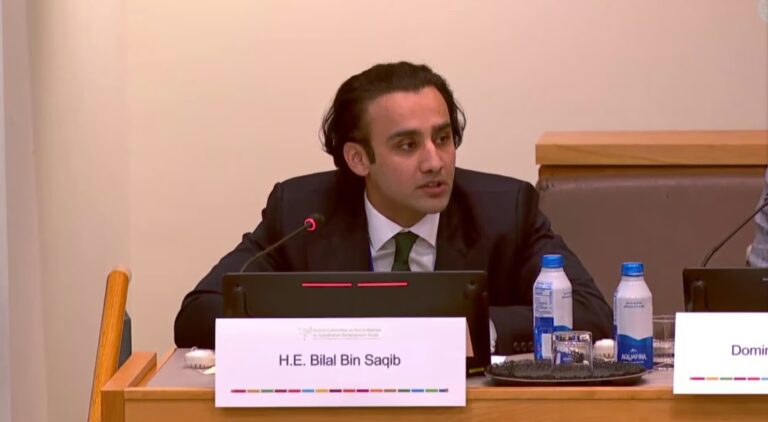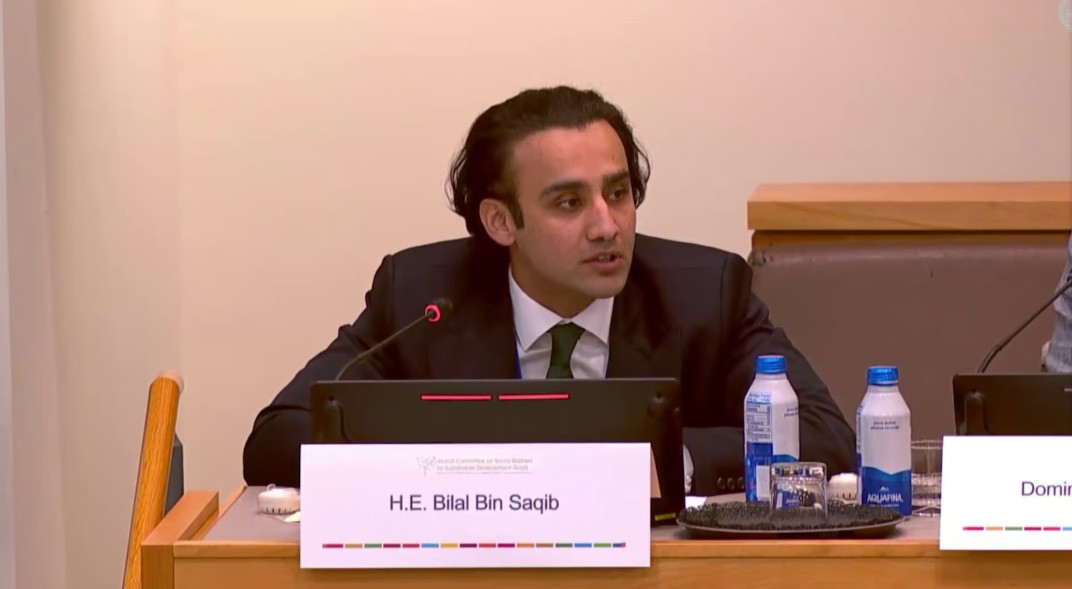
NEW YORK — Pakistan’s Minister of State and Chairman of the Pakistan Virtual Assets Regulatory Authority (PVARA), Bilal Bin Saqib, called for major rethink of the global financial system, arguing that AI, tokenization and digital finance could help bring billions of people closer to economic opportunity.
Addressing high-level event during the 81st United Nations General Assembly, Bilal linked history of financial inclusion with technological revolution now transforming banking, investment and access to capital.
“For too long, the Global South has been on the menu. Pakistan has chosen the table. With our own pen. Writing our own destiny.”
At the 81st UN General Assembly, Minister of State and Chairman PVARA Bilal Bin Saqib made the case for a fairer financial future for the developing… pic.twitter.com/GZA8E5vsGK
— Murtaza Ali Shah (@MurtazaViews) September 22, 2026
His appearance came as part of UNGA81 discussions focused on social business, youth and technology, with the United Nations also listing him as a panelist at its Digital Cooperation Day. He used the platform to argue that the next financial revolution could be driven not only by traditional institutions but also by smartphones, artificial intelligence, blockchain and tokenized assets.
Saqib took the audience back to 1976 and the village of Jobra, recalling how a young economist provided a combined $27 to 42 women who had been unable to obtain loans from conventional banks. That tiny amount became a powerful demonstration of what can happen when people who are excluded from the formal financial system gain access to capital.
For Saqib, however, the story was about more than lending. He presented the Jobra experience as a lesson in courage, persistence and resilience, qualities he believes remain essential as the world confronts today’s much larger financial-access crisis.
Despite decades of technological advancement, Saqib highlighted a staggering contradiction: around 1.3 billion people still lack access to financial institutions, while approximately 900 million of those people already use mobile phones. The technology, therefore, may already be sitting in people’s hands.
The missing link is the infrastructure and regulatory framework needed to turn those devices into practical gateways to financial services.
Saqib also pointed to the high cost of sending money across borders. A worker in the Gulf can typically face a fee of around 6% when transferring money home. He argued that such costs should increasingly be viewed as a consequence of how the financial system is structured rather than as an unavoidable technological problem.
He shared his thoughts on AI, warning that technology can either become a powerful instrument for inclusion or create new barriers if its benefits remain concentrated. For emerging economies, he identified AI as one of the technologies capable of changing that equation.
Artificial intelligence can already process enormous amounts of information across fields such as healthcare, agriculture and law. Combined with human expertise, Saqib suggested, such systems could help countries compensate for gaps in traditional infrastructure and services. But technology alone is not enough.
According to Saqib’s vision, policy and technology must advance together if digital transformation is to produce wider economic inclusion.
Tokenization was another major component of his argument. Saqib highlighted the potential of tokenized assets and stablecoins to enable faster settlement while breaking investment opportunities into smaller units. That could potentially lower the entry barrier for investors who cannot participate in traditional markets because of large minimum investment requirements.
Saqib also highlighted Pakistan’s changing approach to digital assets. He pointed to the country’s restrictive position toward institutional interaction with digital assets since 2018 and the subsequent shift toward developing a regulated framework.
Pakistan is now exploring how virtual assets can be incorporated into a formal ecosystem and potentially help domestic businesses connect with international pools of capital. He presented this transition as part of a broader opportunity for the Global South.
The most direct part of Saqib’s address was reserved for young people. He challenged the familiar phrase that describes today’s youth as the “leaders of tomorrow”, arguing that the wording can imply that young people should simply wait for their turn.
News Desk
About the Author