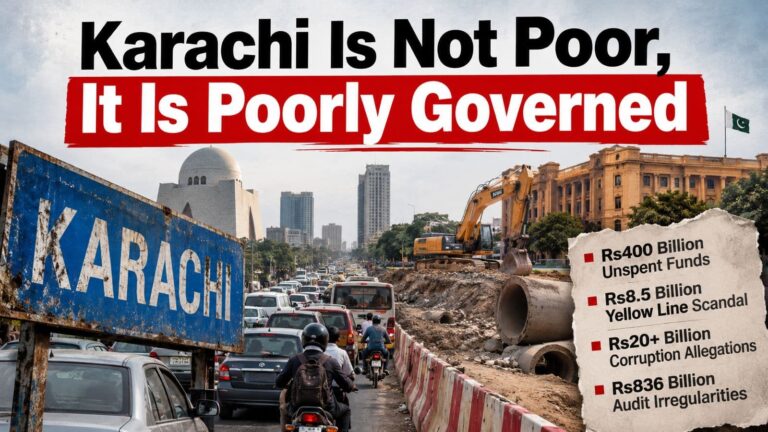
The call for more provinces keeps getting louder. People across the country want smaller administrative units, and the World Economic Forum has now told Pakistan to reconsider how it is organised, given how fast the population is growing. There is something in the argument. When decisions are made closer to a village, it is easier for villagers to find out who made them and to complain. Sindh, with its size and the gap between Karachi and the districts, is a fair place to ask whether that would help.
The trouble is that a new boundary does not by itself change how money is spent. That depends on whether the people running things can be held accountable, and Sindh’s record on that point is not encouraging.
Take the finances first. Since the 18th Amendment and the seventh NFC Award, provinces have had more power and a bigger share of federal revenue. Even so, governance gaps and regional disparities are still plain to see. Provincial tax collection is weak, especially in agriculture. A province that gets a large transfer from the centre and raises little itself has less reason to watch its spending, and its citizens have less leverage to ask. Education shows it clearly. A school in a far district and the officials who plan for it in Karachi barely see each other’s world, and closing that distance was the whole point of decentralisation.
Much of the rural work in Sindh goes through the Sindh Rural Support Organisation, or SRSO, a not-for-profit company the provincial government endowed. Its own 2024 annual report says it has organised over 1.4 million households in 15 districts and that its microfinance has reached more than 1.3 million people, over 95 per cent of them women. Those figures are SRSO’s own, and a review of the public record found no independent audit.
Now for the harder-to-explain part. In July 2025, the Sindh Assembly’s Public Accounts Committee took up SRSO’s affairs. Members said that loans of Rs10,000 to poor and widowed women in Kashmore, Jacobabad and Shikarpur had carried interest of 8 to 10 per cent, in a programme that was supposed to be interest-free. SRSO’s chief executive said this was written down by mistake. Separately, the committee noted that Rs380 million in interest earned on Rs9.67 billion for six districts between 2018 and 2024 had not been returned. The chief executive said the money was intact and would go back if the Planning Department asked. The committee ordered investigations into both. The committee could not find the results of those investigations.
That gap matters. A woman who borrowed Rs10,000 and wants to know whether she paid more than she should have cannot look anything up. Nobody is saying wrongdoing has been proved. But an inquiry that nobody hears back from is not much of an inquiry.
There is older history too. In 2012 and 2013, the USAID Inspector General investigated alleged mismanagement, theft and corruption on projects it funded. USAID proposed debarring SRSO, terminated 25 staff, and the chief executive resigned. The last report reviewed said the debarment decision was still pending. That was more than ten years ago and does not describe SRSO today. A 2021 European Union review of a nutrition programme that SRSO ran with two other organisations found its beneficiary-selection method inaccurate and its future uncertain. When American aid was frozen in 2025, SRSO halted three health projects, and reports put job losses at more than 135. One development practitioner who works with SRSO wrote that no local fundraising or contingency plans were in place.
None of this proves SRSO is a bad organisation. It does show a pattern the province should worry about: little local money, delivery through middlemen, inquiries that go quiet and heavy reliance on donors. Cut Sindh into three or four provinces, and each would start with the same habits.
So before anyone redraws a map, some plain questions need answers. Who audits provincial spending, and when are the results published? Can a citizen trace a transfer to a particular school or clinic? When will agriculture pay a fair share of tax? Do local offices have the staff and skills to handle the powers they are given? Decentralisation works when institutions are capable, fiscal transfers are transparent and local revenue systems actually collect. Without those, a new province is just a new office to blame.
Reform should match authority, resources, and accountability, not add units. If a family waiting for a loan, a teacher, or a nurse cannot tell who decided, who paid and who answers, a new border changes nothing for them.
About the Author