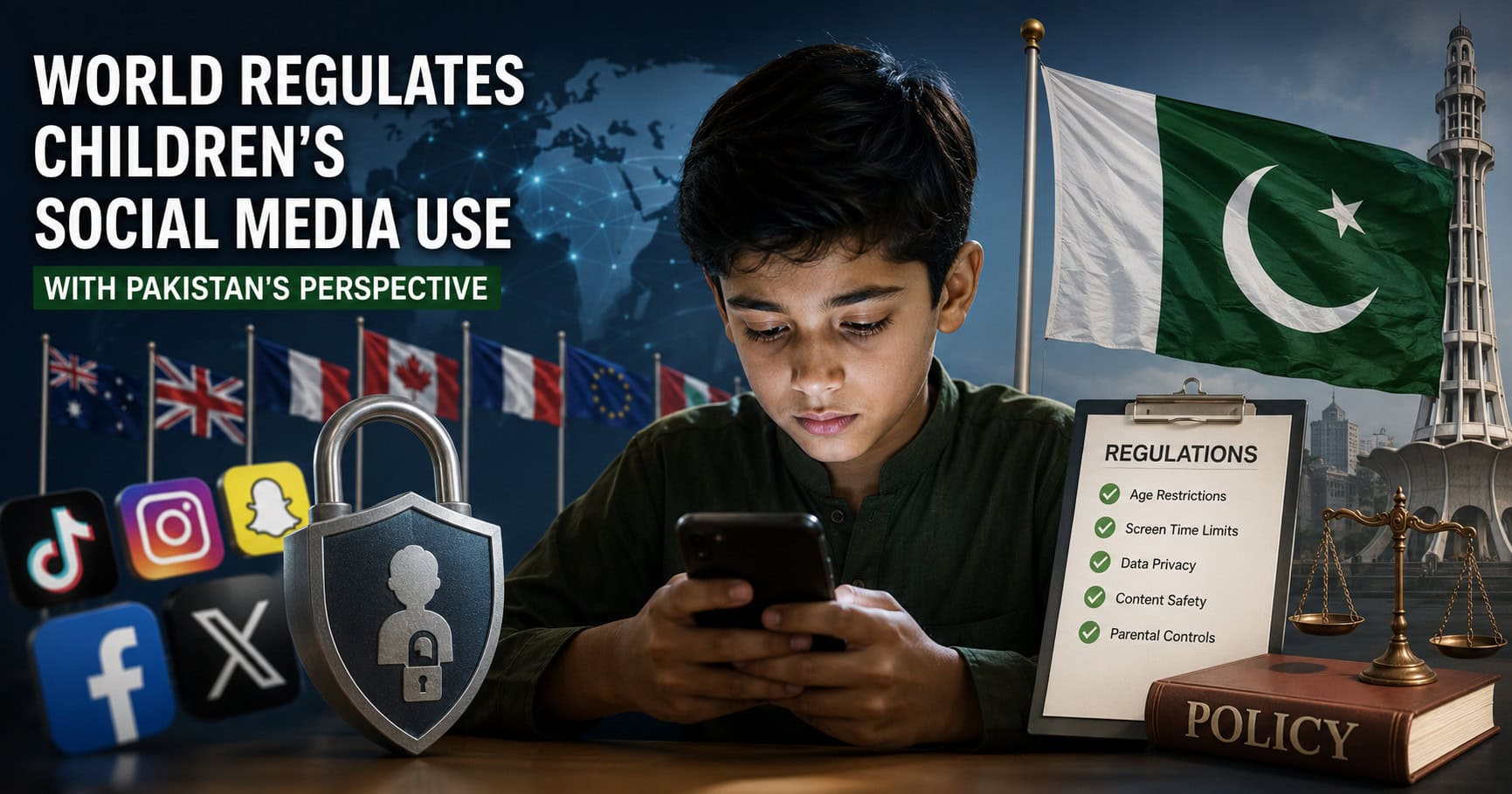
While governments worldwide are replacing debate with legislation on children’s social media use, Pakistan remains without a dedicated legal framework despite parliamentary initiatives, judicial intervention, and growing public concern.
Australia sparked the global momentum after becoming the first country to introduce a nationwide minimum age for social media when its Online Safety Amendment Act which came into force on 10 December 2024, prohibiting children under 16 from maintaining accounts on major platforms. Nearly two years later, the global movement has gained considerable momentum.
In June 2026, British Prime Minister Sir Keir Starmer announced plans to ban children under 16 from accessing major social media platforms, with legislation expected to take effect by Spring 2027. Days later, on 18 June 2026, the United Arab Emirates became the first Arab nation to legislate a nationwide minimum age of 15 for social media use, requiring technology companies to implement robust age-verification systems and enhanced safeguards for teenage users.
Similar measures are advancing across Europe, North America and Asia as governments respond to growing evidence linking excessive social media use among children to declining mental health, cyberbullying, online exploitation and harmful digital content. Australia and the United Kingdom have focused their proposed restrictions on mainstream platforms, including TikTok, Instagram, Facebook, X, Snapchat and YouTube.
Australia’s legislation also extends to Reddit, Threads, Twitch and Kick. The UAE has adopted a broader regulatory approach, applying its minimum age requirement across all major social media platforms operating in the country rather than publishing a platform-specific list, thereby requiring services such as TikTok, Instagram, Facebook, X and Snapchat to implement mandatory age-verification systems.
Pakistan’s own legislative journey began in June 2025, when Senator Syed Masroor Ahsan introduced a private member’s bill seeking to prohibit social media use by children under 16. The bill, however, failed to advance and was withdrawn two months later, following strong objections from stakeholders over the age limit and the severity of penalties. The issue resurfaced during the Senate’s 357th session on 16 January 2026, when Senators Falak Naz, Fawzia Arshad, Aimal Wali Khan, Saadia Abbasi, and Dilawar Khan jointly submitted a Calling Attention Notice proposing restrictions for children under 18. Responding to the discussion, the Minister for Parliamentary Affairs described children’s online safety as a collective national responsibility and called for a coordinated policy response involving relevant ministries and lawmakers.
He proposed forming a multi-stakeholder committee to examine the issue. To date, however, no such committee has been constituted, and no formal policy recommendations or draft legislation have emerged. The issue has also reached the country’s superior judiciary. In February 2026, the Islamabad High Court took up a petition seeking restrictions on children’s access to social media. The Court directed the Pakistan Telecommunication Authority (PTA) and the Pakistan Electronic Media Regulatory Authority (PEMRA) to submit a report on possible regulatory measures. The case remains pending, with no final ruling or publicly released report to date.
These developments have raised a fundamental legal question: can Pakistan’s existing regulatory framework impose age-based restrictions on social media, or would Parliament need to enact entirely new legislation? Currently, Pakistan lacks a dedicated legal framework governing children’s access to social media. While the Prevention of Electronic Crimes Act (PECA), 2016 empowers authorities to regulate online content, it does not prescribe a minimum age for social media use.
Whilst the regulation of children’s social media use has become a global trend, Pakistan remains at a standstill as governments worldwide increasingly respond through legislation rather than debate. By early 2026, around 40 countries had either enacted, proposed, or were actively considering laws that would introduce minimum age requirements for social media access. Most measures require platforms to verify users’ ages and hold technology companies legally accountable for preventing underage access. Australia passed its groundbreaking law in late 2024, while countries including France, Brazil, Indonesia, Malaysia, the United Kingdom, the United States, South Korea, Norway, and Turkey are pursuing similar legislative pathways.
Pakistan, by contrast, remains without a dedicated legal framework. As more governments move from discussion to legislation, the country faces an increasingly important policy decision. Whether lawmakers choose to follow the emerging international trend or develop an alternative approach that balances child protection with digital rights remains uncertain. For now, the country continues to debate an issue on which much of the world has already begun legislating.
Umer Mehmood Ahmed
About the Author