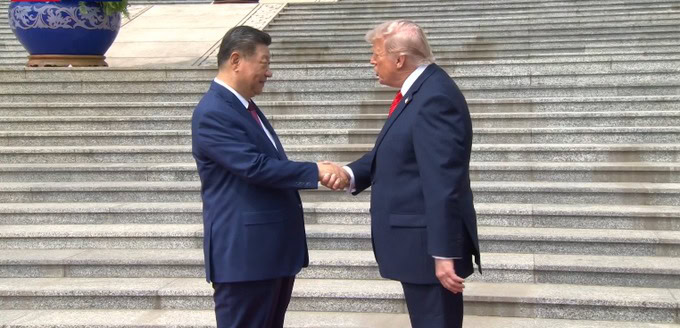
BEIJING – Chinese President Xi Jinping called China and the United States “the two largest powers in the world” saying cooperation between our countries is essential for global peace and development.
He stated this during a meeting with US President Donald Trump to China who is in Beijing on a two-day official visit..
The leaders and their delegations discussed key issues including bilateral relations, trade, and global stability.
President Xi expressed pleasure at meeting President Trump and emphasized the importance of stable China-US relations for the world.
President Trump thanked the Chinese leadership for their warm welcome and highlighted his administration’s goal of promoting trade with China. He also referred to President Xi as one of the world’s great leaders and noted that the primary focus of this meeting is trade.
The summit underscores the shared interest of both nations in fostering cooperation and contributing to international stability.
A day earlier, Donald Trump landed in Beijing in what is shaping up to be one of the most consequential and closely watched diplomatic missions in recent years, targeting a fragile and increasingly volatile relationship between the world’s two superpowers—the United States and China.
This marks Trump’s first visit to Beijing in nearly a decade, and it arrives at a moment of intense global instability, economic uncertainty, and rising geopolitical friction that has placed the entire international system on edge.
Whats on Agenda?
At the center of the storm is a face-to-face showdown with Chinese President Xi Jinping, where some of the world’s most explosive and sensitive issues are expected to collide head-on: the ongoing trade war tensions, dominance in advanced technology and artificial intelligence, the future of Taiwan, and the escalating ripple effects of the conflict involving Iran.
Despite years of escalating rhetoric and economic confrontation, Trump is now entering the Chinese capital signaling negotiation rather than direct escalation. The visit follows a fragile trade truce reached last year that temporarily froze further tariff escalation—but that agreement now hangs by a thread.
Behind closed doors, Washington is expected to push aggressively for sweeping structural changes in China’s trade practices and technology policies, while Beijing is preparing to demand the continuation—or even expansion—of the current truce to avoid renewed economic confrontation.
Trump has made it clear he intends to pressure Xi Jinping to “open up” China’s markets to major U.S. technology giants, framing it as one of his central priorities in the talks.
Adding extraordinary weight to the visit, Trump is traveling with some of the most influential figures in global business, including top leaders linked to Nvidia, Apple, Tesla alongside SpaceX, and BlackRock.
Their presence underscores what is truly at stake: control over artificial intelligence, semiconductor supply chains, global capital flows, and access to one of the world’s most powerful consumer markets. The visit effectively merges high diplomacy with high finance and cutting-edge technology competition.
Beyond trade and tech, the escalating conflict involving Iran is expected to dominate portions of the discussion, adding a volatile geopolitical layer to already tense negotiations.
The crisis has rattled global energy markets, particularly after disruptions in the Strait of Hormuz—a critical chokepoint for global oil shipments. Any instability there risks sending shockwaves through global fuel prices and economic stability.
Washington is expected to press China to use its strategic influence over Tehran to help de-escalate tensions. China, however, Iran’s largest trading partner, is likely to tread carefully—signaling limited willingness for mediation while avoiding deep political entanglement that could compromise its own strategic interests.
About the Author