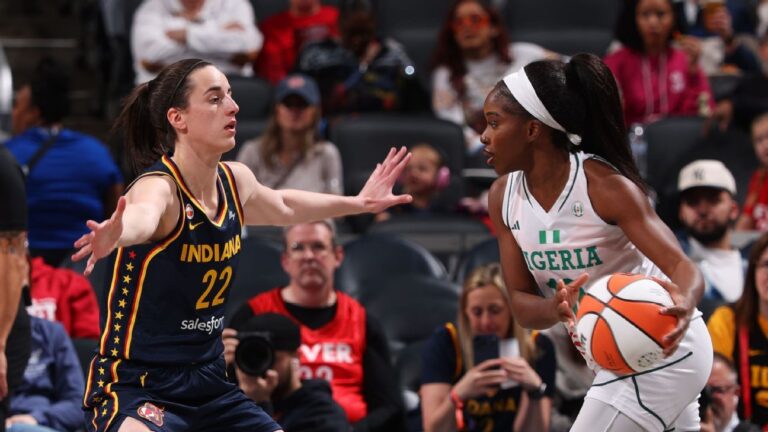
Nigeria’s D’Tigress rounded up their historic three-game WNBA Tour suffering what, on the face of it, was a devastating set of three defeats. But it was less about winning and more about measuring themselves team against top competition.
They ended with a humbling 105-57 loss to Caitlin Clark and the Indiana Fever. That 48-point turn-back followed close losses to the Los Angeles Sparks 63-89, and the Minnesota Lynx 79-88.
While going 0-3 may look bad at first glance, it should not be the story of the tour. This was about finding out where this team stands with less than two months to go until the 2026 FIBA Women’s Basketball World Cup tips off in Berlin.
It was also about integrating and assessing the next generation, the players who would be the future of the team, as a posse of about a dozen rookies from various NCAA programs in the USA were invited for their first taste of international basketball.
And after three games, some parts of that picture appear to be more than clear. The veterans are still running the show, but the future is genuinely exciting. The Indiana game showed that size is a factor that that D’Tigress need to resolve. Stephanie Okechukwu, when she is ready, could plug that gap and provide presence in the paint.
Berlin will be the first real test of whether those two things are converging fast enough. Here is what we learned from D’Tigress WNBA Tour.
Vets remain the roster, for now
As was to be expected, the veterans on the team led the way, holding the team together. Ezinne Kalu, Pallas Kunaiyi-Akpanah and Promise Amukamara were three of the most consistent performers across all three games.
Kalu was the team’s offensive engine, finishing as the team’s leading scorer across the tour, with a total of 41 points. Her 25-point masterclass against the Lynx, on 5-for-14 shooting with 12-for-14 from the free-throw line, was the individual highlight of the entire tour.
When Kalu was neutralised or in foul trouble, Nigeria’s offence looked like they had nowhere to go, and it showed against the Fever, where she was restricted to just eight points on 1-5 shooting, with 0-2 from downtown. Six of those points came from the free throw line.
Center Kunaiyi-Akpanah made her presence felt in the paint, weighing in with 28 points on 61% shooting in a total of 42 restricted minutes. Her Game 1 line, 11 points on 4-for-4 shooting including a drawn foul in just 10:14, was the most efficient individual performance of the entire three-game series.
Amukamara was the team’s most consistent defensive presence across all three games. Her 4 steals in Game 1 were a tour high for any player in a single game. When Kalu, Kunaiyi-Akpanah and Amukamara did not bring it, the team suffered big losses. In the one game, against the Lynx, where both Kalu and Pallas scored in double digits, they only lost by nine points.
Some of that slack can and will be picked up by the return of captain Amy Okonkwo and Murjanatu Musa, both of whom missed this trio of games.
One of the growing criticisms of the current roster is that many of the players are on the other side of 30. On the evidence of this tour, so far, they are not going anywhere soon.
Could the absentees really have helped?
It’s difficult to dwell too much on the losses because of how many key figures were missing. Chief among those absentees was coach Rena Wakama, who has been the courtside mastermind of the team’s current upward trajectory.
With the league in full pre-season mode, Wakama was filling her WNBA obligations as assistant coach at the Chicago Sky, with her assistant coach Wani Muganguzi running things during the tour. Whether D’Tigress could have won with Wakama on the sideline is unlikely, but she could have made a difference.
Captain Amy Okonkwo was with the Dallas Wings on a training contract, chasing a WNBA contract after a successful first stint last season. Although their paths crossed when the team stopped by to see her after a Wings game, but her absence on the floor was felt. With Okonkwo and Kalu both available, Nigeria has the kind of backcourt that changes games.
Also missing was Murjanatu Musa, who was in the middle of the best club season of her career. With Basket Landes in France’s top domestic league, and more significantly in the EuroLeague Women, Musa was one of the competition’s outstanding players from start to finish.
EuroLeague Team of the Month in January. EuroLeague Team of the Month again in February. Second in the entire competition in rebounding, averaging 8.2 per game. She scored 26 in a comeback win over Valencia.
Against Galatasaray in the play-in rounds, she put up 20 points, nine rebounds and four steals on 10-of-13 shooting, an efficiency rating of 30, the highest of any player across the entire play-in series.
Basket Landes were eventually eliminated by Galatasaray in the quarterfinals of the Final Six in Zaragoza, the best result in the club’s history. Musa was named to the EuroLeague Women Second Team at season’s end, the highest individual honour of her career.
All three could have made a difference.
But the future has indeed arrived
One of the goals of this tour was to catch a glimpse of what the future of D’Tigress could look like. And two players stepped forward and made some noise in that direction.
Gabby White was the big revelation. The UVA transfer arrived as a relatively unheralded name, behind the likes of Oluchi Okananwa, Uche Izoje and Stephanie Okechukwu. She left as something else.
Across two games, White scored 23 points, grabbed nine rebounds, handed out six assists, stole the ball three times and blocked a shot. Her 16-point, seven-rebound showing against the Lynx in Kansas City was the best all-around rookie performance of the tour, and the second highest behind Kalu’s 25-point performance.
Lynx head coach Cheryl Reeve, not one to dish out praise for nought, noticed and singled her out for mention after the game: “When White came in, she was terrific.
“She’s going to be a heck of a basketball player. She’ll be in the WNBA for sure.”
Uche Izoje came in as one of the most written-about names on the roster. The 6-foot-3 centre from Asaba, Delta State, who left Nigeria at 13 to play professionally in Japan, won WJBL Rookie of the Year, then crossed to Syracuse and took ACC Rookie of the Year in her debut college season, carried the expectation with ease.
Eight points and seven rebounds starting against the Lynx, then 10 points and five rebounds against the Sparks. She was played with a maturity that suggested this level is not too big for her.
She was then listed as inactive for the Fever game in Indianapolis, no explanation offered, which was a pity because it was the tour’s most watched fixture, played before 10,051 fans.
Although they travelled with the squad and showed up in the team’s social media content, neither Okananwa, the Maryland forward who led the pre-tour headlines as the face of this new generation before a ball was tipped, nor 7-foot-1 Okechukwu, the tallest player in the history of NCAA women’s basketball, saw minutes.
But as a measure of success for this tournament, Izoje and White may have cemented their place on the roster.
The WNBA, as well as the 2026 FIBA Women’s Basketball World Cup, will air on ESPN’s channels in Africa (DStv 218 and 219), as well as on Disney+ in South Africa.
About the Author