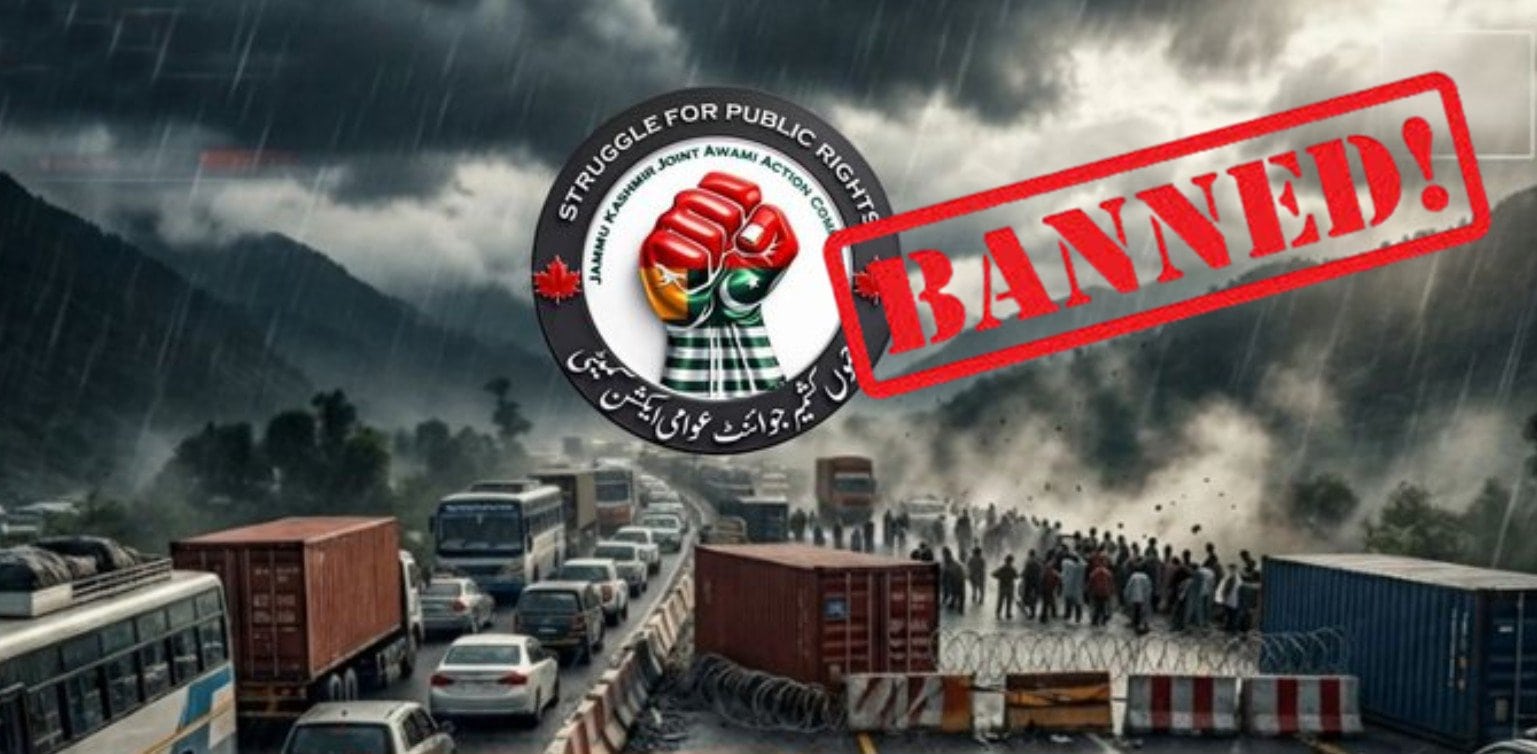
ISLAMABAD – Authorities in Azad Jammu and Kashmir (AJK) declared Jammu Kashmir Joint Awami Action Committee (JKJAAC) a banned organization, and the restriction raised several questions over influential grassroots movement.
The notification placed Jammu Kashmir Joint Awami Action Committee (JKJAAC). along with its associated names, including “Jammu Kashmir Action Committee” and “Joint Awami Action Committee”, into First Schedule of the Anti-Terrorism Act 2014. The decision, approved by the President of AJK, immediately criminalizes any form of support, association, or activity linked to the group.
Authorities said the action was taken after receiving credible intelligence suggesting the group’s involvement in activities that threaten public peace and security. Government officials allege organization has been linked to efforts that intimidate civilians, spread unrest, and disturb law and order. The official stance further accuses it of promoting narratives and actions that could deepen social tension and weaken communal harmony in the region.
For supporters and critics alike, it is turning point in movement that began not as a political party, but as a powerful street-level alliance born out of hardships.
JKJAAC first gets momentum in mid 2023, rising from waves of anger that had already been building across Azad Kashmir in recent years. Soaring electricity bills, rising food prices, and frustration over subsidies pushed traders, transporters, students, lawyers, and civil society groups into an unusual alliance.
What made it different was its structure, it was not a traditional political party. Instead, it functioned as a broad coalition platform bringing together very different ideological groups under one urgent agenda: economic relief and structural reform. The group quickly grew into a powerful voice in Muzaffarabad and beyond, positioning itself as a defender of “ordinary people” struggling with inflation, governance issues, and lack of local control over resources.
Over time, the movement developed detailed charter of nearly 40 demands. At its core were deeply emotional and practical grievances. People demanded cheaper electricity, arguing that regions producing hydropower, especially through projects like Mangla, should not be forced to pay high tariffs. They also demanded subsidized wheat and flour at rates comparable to Gilgit-Baltistan, along with relief from inflation and heavy taxation.
But the agenda went far beyond bills and subsidies. The group called for sweeping governance reforms, including reducing ministerial perks, cutting down oversized cabinets, and strengthening anti-corruption systems. It demanded greater control over local resources, especially hydropower royalties, and questioned reserved political seats for refugees, calling for a review of the system.
For many supporters, it was also about fairness, and political voice in the region. By 2024, thr movement transformed into a full-scale protest force. Strikes, shutdowns, and long marches swept across Azad Kashmir. Roads were blocked, businesses shut down, and daily life repeatedly came to a standstill.
The pressure eventually forced negotiations, and authorities reportedly announced subsidy packages worth billions, leading to a temporary pause in protests. But the calm did not last long.
In late 2025, the region witnessed one of its most intense shutdown movements in recent years. A coordinated lockdown brought multiple districts to a standstill. Tensions escalated into clashes, with reports of casualties and injuries, while communication blackouts added to the sense of chaos and uncertainty.
The crisis eventually ended after the signing of the Muzaffarabad Agreement between the AJK government, federal authorities, and the movement’s representatives. The deal promised reforms, subsidies, compensation, and formal inquiries into incidents of violence.
For a brief moment, it appeared a political breakthrough had been achieved. In 2026, the situation shifted again. JKJAAC accused authorities of failing to fully implement the agreement. Frustration returned, and fresh protest plans, including another shutdown, were announced. Just days before the planned escalation, the government struck back.
Citing concerns over public order, security, and alleged intimidation, the AJK administration imposed a sweeping ban on the movement under anti-terror laws. Internet and communication disruptions were also reported in parts of the region during the tense period.
Officials argue the decision was necessary to prevent further instability. Critics, however, see it as a major escalation in the ongoing struggle between the state and a powerful grassroots movement.
Regardless of where one stands, there is little dispute about JKJAAC’s impact. It has become one of the most influential civil society mobilizations in recent history in Azad Kashmir, capable of shutting down entire regions and forcing high-level negotiations.
About the Author