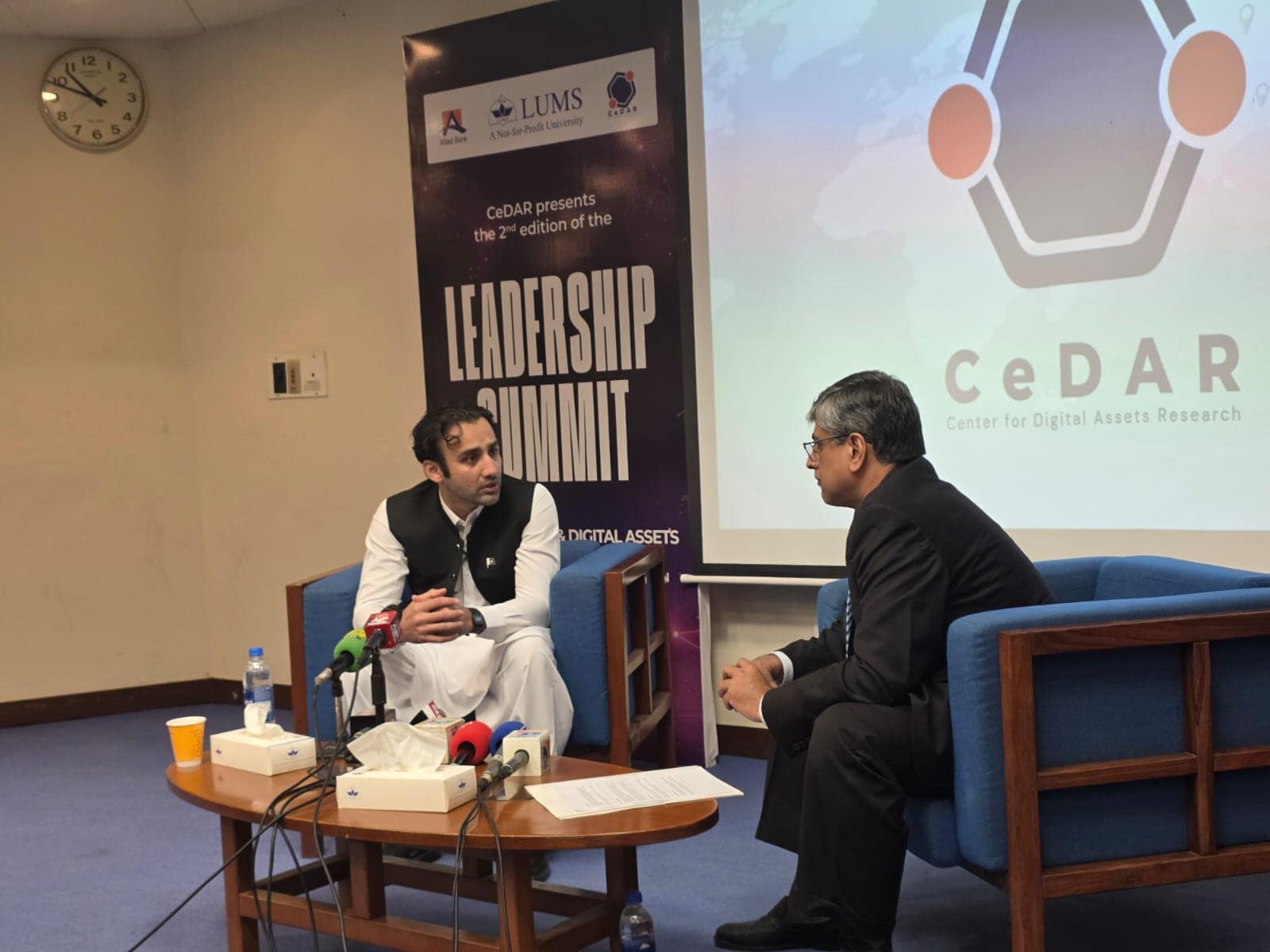
LAHORE – Pakistan is moving towards introducing a regulatory framework for digital assets, as policymakers and experts warn that rapid adoption of blockchain-based technologies is outpacing oversight.
The issue came under discussion at the Leadership Summit on Blockchain and Digital Assets hosted by the Centre for Digital Assets Research at the Lahore University of Management Sciences, where participants highlighted both the opportunities and risks associated with the sector’s expansion.
Minister of State and Chairman of PVARA Bilal Bin Saqib said the government was working on a structured regulatory framework as the number of users of digital assets continues to grow.
He stressed the need for timely policy action, noting that regulation should support innovation while ensuring consumer protection.
According to him, around 40 million Pakistanis are already engaged with digital assets, mostly through informal platforms operating outside regulatory oversight, exposing users to potential risks.
He said a key priority was to integrate such users into the formal financial system in order to reduce exploitation and promote financial inclusion.
Referring to the economic implications, Mr Saqib noted that Pakistan’s annual remittance inflows, estimated at around $38 billion, could be made more efficient through blockchain-based settlement systems. He added that regulatory clarity could also support the country’s expanding freelance sector by improving access to international markets.
He said the proposed framework would follow a risk-mitigated approach and include regulatory sandbox environments to test emerging technologies.
Asset-backed tokenisation has been identified as an initial focus area, which could enable fractional investment in sectors such as real estate and financial instruments.
Mr Saqib warned that delays in regulation could increase reliance on unregulated systems, given the scale of existing adoption. He added that Pakistan had the potential to contribute to global discussions on digital finance rather than merely adopting external models.
He also emphasised the need for collaboration between financial institutions, technology firms, academia and regulators to build capacity and address the shortage of skilled professionals.
“The biggest gap at the moment is talent,” he said.
The summit will continue with sessions on artificial intelligence, blockchain integration and the future of regulated digital finance.
Sarfraz Ali
About the Author