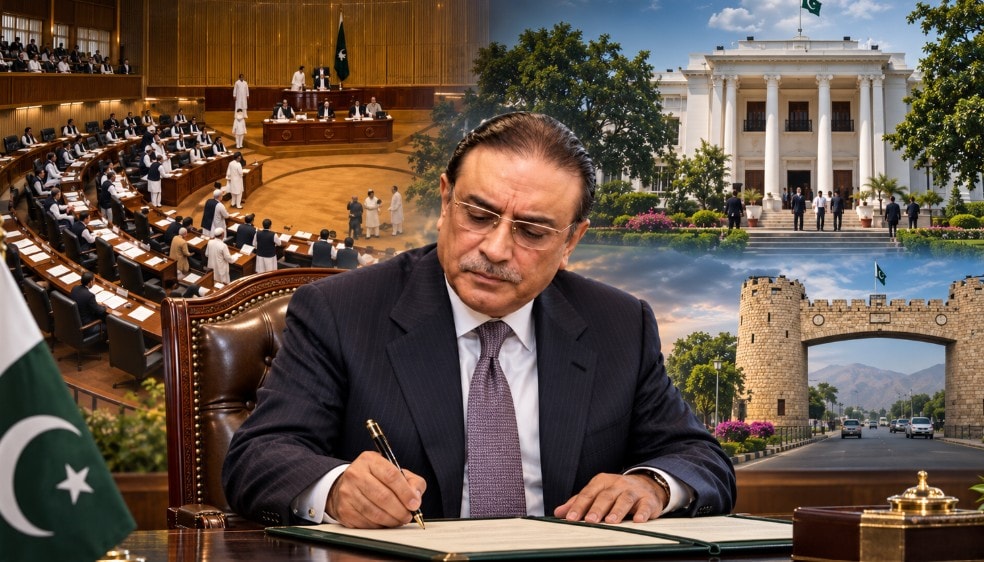
ISLAMABAD – President Asif Ali Zardari on Saturday approved major legislative package comprising five ordinances related to KP and 12 bills covering education, scientific research, parliamentary privileges, salaries, culture, religious affairs and tourism.
The approvals bring several key institutions and provincial administrative matters into focus, including powers of KP lawmakers, salaries and benefits of the provincial assembly’s top officials, and the legal frameworks governing major educational and research institutions. It includes approval of five ordinances concerning Khyber Pakhtunkhwa, including measures related to special initiatives in different districts of the province.
The president approved Khyber Pakhtunkhwa Special Initiatives Ordinance 2026 (Specified Districts) and a separate ordinance covering areas outside the specified districts. Another approval concerns Khyber Pakhtunkhwa Provincial Assembly (Powers, Immunities and Privileges) (Amendment) Ordinance 2026, which deals with the legal framework governing the powers and privileges of provincial lawmakers.
President Zardari also approved the Khyber Pakhtunkhwa Societies (Registration) (Amendment) Ordinance 2026, introducing changes to legislation concerning the registration of societies. President gave his approval to the Khyber Pakhtunkhwa Speaker and Deputy Speaker (Salaries, Allowances and Privileges) Ordinance 2026.
The ordinance concerns salaries, allowances and privileges of the assembly’s two senior officeholders. However, the official statement did not disclose whether the amendments involve salary increases or changes to existing financial benefits. President also granted assent to 12 bills covering a wide range of national institutions, with education emerging as one of the major areas of legislative activity.
Among key approvals are Higher Education Commission (Amendment) Bill 2026 and the Federal Board of Intermediate and Secondary Education (Amendment) Bill 2026. Both institutions play key roles in Pakistan’s education system, with the HEC overseeing higher education standards and the federal board responsible for conducting secondary and intermediate examinations under its jurisdiction.
The legislative package also includes the Pakistan Study Centres (Amendment) Bill 2026, Area Study Centres (Amendment) Bill 2026 and Centres of Excellence (Amendment) Bill 2026, all concerning institutions involved in academic research and specialised studies. Several prominent universities and technical institutions have also been included in the latest approvals.
President Zardari signed off on National College of Arts Institute (Amendment) Bill 2026, the National Textile University (Amendment) Bill 2026 and the NFC Institute of Engineering and Technology Multan (Amendment) Bill 2026. Scientific research also received legislative attention through the approval of the Pakistan Council for Science and Technology (Amendment) Bill 2026.
Archival Material (Preservation and Control of Export) (Amendment) Bill 2026 received presidential assent, addressing legislation concerning the protection and export of archival materials. The president also approved the National Rahmatul-lil-Alameen wa Khatamun Nabiyyin Authority (Amendment) Bill 2026, concerning the legal framework of the religious authority.
Tourism was another sector covered, with the Pakistan Tourist Guides (Amendment) Bill 2026 also receiving approval. With these decisions, President Zardari has cleared 17 legislative measures in total, covering provincial administration, parliamentary privileges, educational institutions, scientific development and other key sectors.
About the Author