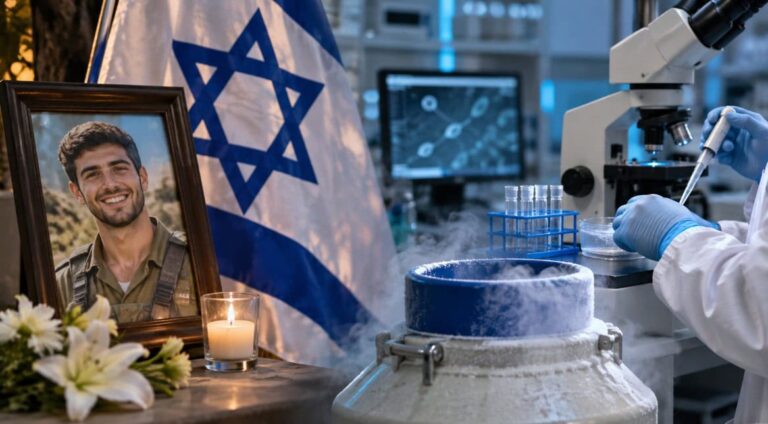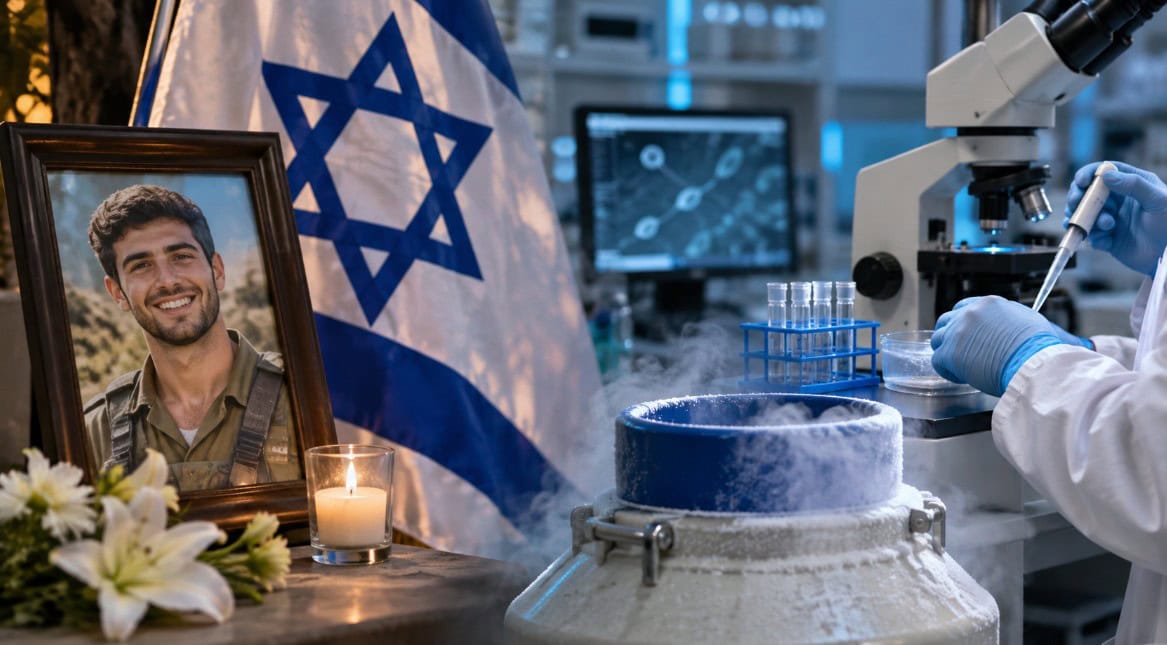
TEL AVIV – For many Israeli families, death on battlefield may no longer mean the end of a bloodline as officials retrieved and frozen sperm from around 250 fallen soldiers and security personnel, offering grieving parents the possibility of having grandchildren even after their sons’ deaths.
The Jewish nation retrieved and frozen sperm from around 250 soldiers and security personnel killed, allowing families to pursue possibility of having children genetically related to them even after their deaths.
The rare medical procedure expanded dramatically after Gaza war, with Israeli authorities relaxing legal restrictions to allow families, particularly parents of fallen soldiers, to request sperm retrieval without first obtaining court approval.
The procedure posthumous sperm retrieval involves extracting reproductive cells from deceased men and preserving them for possible future use in fertility treatments.
Israel’s Ministry of Health said sperm has been retrieved from around 250 deceased soldiers and security personnel, alongside 21 civilians, since the October 7, 2023 attacks and the subsequent war. Most requests came not from widows but from parents hoping to preserve the possibility of having grandchildren.
From 250 military-related cases, 193 were reportedly initiated by parents, representing nearly 77% of the total. Many of the deceased soldiers were young and unmarried, leaving behind families seeking to maintain their genetic legacy.
The number of procedures was equivalent to roughly one-quarter of male military and security fatalities during the period examined. By October 2025, approximately 1,152 Israeli military and security personnel had reportedly been killed since the conflict began.
Under Israeli Ministry of Health guidelines, specialists surgically extract tissue from the testicles of deceased men and examine it in laboratories to identify living sperm cells. If viable sperm is discovered, it is preserved using liquid nitrogen, enabling potential future use through in vitro fertilization (IVF).
Medical guidance shows that procedures conducted within 24 hours of death have approximately a 75% success rate in recovering viable sperm. In certain circumstances, sperm may remain recoverable for up to 72 hours, although the chances diminish considerably as time passes. The deceased person’s reproductive health, cause of death and physical condition also influence the outcome.
Even after successful preservation, pregnancy is not guaranteed, and fertility outcomes are generally less favorable than those involving sperm collected during life.
In previous years, Israeli legal guidelines required parents to get family court permission before retrieving sperm from deceased sons. Surviving wives or established partners, however, could usually request the procedure without advance judicial approval unless relatives objected. Following the outbreak of war, Israeli authorities temporarily changed the rules to accelerate sperm collection.
Parents can now request retrieval without first obtaining a court order, provided there are no relevant family objections or disagreements. The policy was introduced because delays in legal proceedings could make sperm recovery medically impossible.
Israeli military also informs families of the procedure when medically feasible, while casualty officers and the Ministry of Health coordinate arrangements with designated hospitals. However, collecting sperm and using it to conceive a child remain legally separate decisions. Families must still obtain court approval before preserved sperm can be used for reproduction.
Judges examine evidence of the deceased man’s wishes, and parents generally face stricter requirements than surviving partners. If the deceased explicitly opposed having children after death, the preserved sperm cannot legally be used.
Despite hundreds of sperm retrieval procedures, only a small number of children have reportedly been born using samples collected from soldiers killed during the current war. In 2025, a woman reportedly gave birth to a child conceived using sperm retrieved after her partner died in combat.
The expanding practice divided Israeli society, particularly over whether grieving parents should be allowed to make reproductive decisions on behalf of deceased adult children. Supporters argue that sperm preservation offers families a chance to continue their loved ones’ lineage despite the tragedy of war.
Although Israeli lawmakers have discussed legislation regulating posthumous reproduction, the country still lacks permanent legal framework. Temporary wartime arrangements continue to facilitate urgent retrieval requests, while courts retain authority over the eventual use of preserved sperm.
About the Author