When you help bring a franchise its first ever championship, unexpected opportunities tend to present themselves.
Earlier this month, for instance, Brewers president of baseball operations Matt Arnold not only attended a Metallica concert at the Sphere in Las Vegas; he also got to meet the band.
“And they knew what we did!” Arnold told me in amazement. “They’re like, ‘Wow, you guys are great!’ I’m like, ‘You guys are great!’”
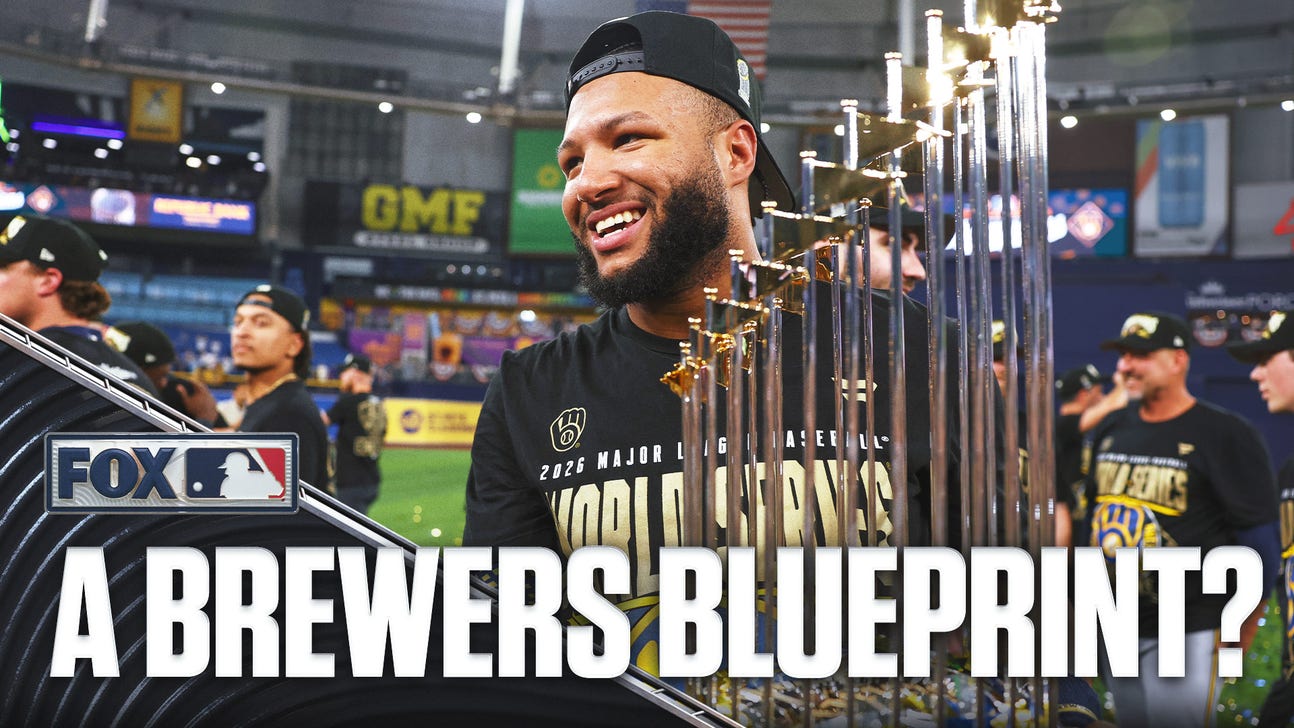
This is life now for Arnold after his Milwaukee Brewers won their first ever World Series title, despite the disadvantages presented by their 19th-ranked payroll.

Matt Arnold built the roster that led the Brewers to their first ever World Series. (Photo by Mary DeCicco/MLB Photos via Getty Images)
Ahead of an upcoming labor battle, the Brewers and Rays offered blueprints for success for teams incapable or unwilling to shop at the high end of the market under the current economic system.
“It was a good reminder of, ‘What wins baseball games?’” general manager J.J. Picollo, whose Royals ranked 18th in payroll last season, told me at the GM meetings earlier this month. “Good pitching. Good defense. Take advantage of opportunities when you have a chance to score. Situational hitting. Baserunning. These are all things that I think every team in baseball values, but when you’re in the market size that Milwaukee’s in or Tampa’s in or Kansas City’s in, it’s a good reminder that that’s the winning formula right there.”
Every MLB Team’s 2026 Payroll
Missed Playoffs Playoff Team World Series Champion
Payrolls are Spotrac’s 2026 luxury-tax payrolls, which count contracts at average annual value.
Arnold and Milwaukee’s front office assembled a young, athletic group that frustrated opposing pitchers by selectively working long at-bats and finding ways on base. The Brewers forced mistakes by consistently putting the ball in play and causing havoc on the basepaths. They had the lowest chase rate in MLB, swung less overall than any team in the sport and ranked second in runs scored without relying on home runs — though they demonstrated fully capable of hitting those, too, when it counted in the postseason. As Dodgers general manager Brandon Gomes pointed out: “We talk about them as this ‘small-ball’ team; they outhomered everybody in every series.”
Still, while the biggest spenders in the sport sought out sluggers who pulled the ball in the air, the Brewers bucked the trend during the regular season by emphasizing an approach in which they let the ball travel deep and shot it hard the other way, often on the ground. They hit the ball to the opposite field more than any team in MLB while still logging a higher hard-hit rate than the Braves, Phillies and Dodgers.
Will their success change the way teams develop their offensive philosophy?
“There’s different ways to put together teams,” said White Sox general manager Chris Getz, whose bottom-five payroll club made a surprise run to the postseason behind its power. “It really is leaning into the strengths of the group that you have.”

The Dodgers and their big payroll couldn’t make it a World Series three-peat.(Robert Gauthier / Los Angeles Times via Getty Images)
White Sox sluggers Munetaka Murakami and Colson Montgomery hit more home runs than any player on the Brewers last year but also logged the highest strikeout rates in the sport. Getz will point out, however, that the presence of players such as Chase Meidroth, Sam Antonacci and Tristan Peters in the White Sox lineup help balance some of his team’s swing-and-miss.
“I think it’s important to have different types of hitters in a lineup,” Getz said. “When you look at the postseason and the ALDS and the amount of strikeouts that we had, yeah, it was really hard to win a game that you really needed to win. You don’t want to reinvent the wheel. You don’t want to reinvent your team just because of a couple games or one series. Do we want to increase contact on our team? We absolutely do, and we’re putting things in place to improve contact. But we also don’t want it to come at the cost of scoring runs. You can score runs a lot of different ways.”
Of course, in Milwaukee’s case, some of the best pitching in the sport helped its cause, too.
The Brewers have become a model organization for development, unearthing gems in a multitude of ways. They signed outfielder Jackson Chourio as an international free agent in 2021 and have already watched the 22-year-old turn into the team’s all-time postseason leader in home runs and RBI. They drafted shortstop Cooper Pratt in the sixth round in 2023, gave him an eight-year extension in April of this year before he made his MLB debut, and watched him develop into a World Series standout.

Jacob Misiorowski won a World Series title and a Cy Young Award. (Photo by Elsa/Getty Images)
They drafted Jacob Misiorowski out of Crowder College in the second round in 2022 and saw him ascend into the most unhittable starter in the sport and the National League Cy Young Award winner. They also drafted Aaron Ashby out of Crowder College in 2018 and saw him set a relief record with 18 scoreless innings in the 2026 postseason.
Ashby was a key piece in one of the greatest playoff bullpens ever constructed, a group that included another international free agent success story in Abner Uribe and one of many Brewers trade triumphs in closer Trevor Megill, who was acquired from the Twins for cash in 2023. The other top relief contributors in a Brewers bullpen that went 8-2 with a 1.38 ERA and eight saves in the postseason — JoJo Romero, DL Hall and Antonio Senzatela — also arrived via trade.
So, will small-market, lower-payroll teams try to replicate what the Brewers have built?
“I can only speak for the Royals,” Picollo told me, “but the way they’ve constructed their roster is something we’ve been trying to do as well. We want to be as athletic as you can. We want to be good on the defensive side and baserunning, so there are goals that we have now.”
It’s easier said than done.
“The player pool, what’s available to you, may not allow you to have that,” Picollo continued, referencing the presence of sluggers such as Vinnie Pasquantino and Salvador Perez on his Kansas City roster. “They’re bigger guys, not the guys that will steal 35 bases. We know that’s not going to be part of what they do. But even a guy like [Jac] Caglianone who’s a big, strong guy, he can run the bases well, and we’ve got to keep that expectation high that he needs to have that as something that’s in his toolbox so he can help us win games not just by hitting the ball out of the ballpark.”
MLB’s Highest-Paid Players in 2027
Rank 1 ShoheiOhtaniSP/DH$70.0M
Rank 2 JuanSotoLF$57.5M
Rank 3 KyleTuckerRF$55.0M
Rank 4 FramberValdezSP$42.8M
Rank T-5 BoBichette3B$42.0M
Rank T-5 ZackWheelerSP$42.0M
Rank 7 VladimirGuerrero Jr.1B$40.2M
Rank 8 AaronJudgeRF$40.0M
Rank 9 MannyMachado3B$39.1M
Rank 10 MikeTroutRF$37.1M
Figures are 2027 payroll salaries as of Nov. 19, 2026. Bichette and Wheeler are tied for fifth.
Taylor Smith, the incoming president of baseball operations for an Athletics team that ranked in the bottom 10 in payroll last season, doesn’t think the Brewers’ and Rays’ success in 2026 will necessarily change how other small-market teams build their rosters.
“No, because we’ve seen these teams have a lot of success for a very long time,” Smith told me. “I think we have already seen a lot of the copycat mentality of trying to take very talented people from both those organizations and try to bring some of that magic to running your own ballclub.”
One of Smith’s biggest moves after taking the A’s job was hiring Cam Castro, the Brewers’ senior vice president of player development and performance, to be his general manager. It’s one of many examples of teams hiring executives from successful smaller-market organizations to help run their franchises in recent years.
The Mets, for example, plucked David Stearns from the Brewers to be their president of baseball operations after the 2023 season. Meanwhile, former Rays executives are scattered throughout MLB, including the head of baseball operations for the Brewers (Arnold), Dodgers (Andrew Friedman), Cardinals (Chaim Bloom) and Marlins (Peter Bendix). Smith, too, started his professional career in the Rays’ front office.
“I think the two teams that we just saw in the World Series are teams that have really good information, they act on it very aggressively, and they do a great job of drafting, making trades, developing players,” Smith told me at the GM meetings. “I think it’s a testament to the fact that you can still go out and have better information, make better decisions and win without some of the financial resources that some other teams have.”
Do that well, and you never know what can happen.
You might even get to meet your favorite band.
“I know it sounds cliché, but it really is good people, the right mix of players and coaches and staff,” Arnold told me when I asked him why this was the year for the Brewers’ ascension. “There were just a lot of cool things that happened. We got hot at the right time and did something pretty special.”
About the Author