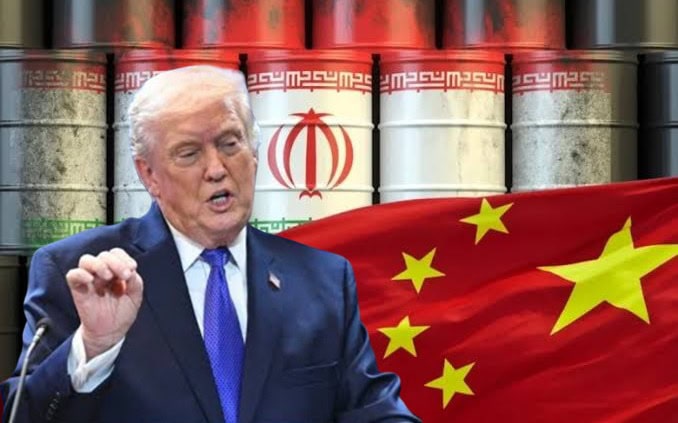
WASHINGTON – Washington wants to squeeze Iran’s economy into submission, but there is one powerful player standing in the way, China. With billions of dollars in trade and Iranian oil purchases, Beijing becomes Tehran’s crucial economic lifeline, turning the US campaign to isolate Iran into a far tougher battle.
US may face major roadblock in its campaign to economically isolate Tehran, with China emerging as the critical factor that could determine whether Washington’s pressure strategy succeeds or falters.
A report by The New York Times said US efforts to squeeze Iran’s economy could prove difficult without cooperation from Beijing, which remains Iran’s biggest trading partner and its most important oil customer. The figures underline scale of the relationship. China and Iran conducted around $41.2 billion in trade in 2025, while China imported approximately $31.2 billion worth of Iranian crude oil during the same year.
At times, Chinese buyers have accounted for nearly 90% of Iran’s total oil exports, providing Tehran with a crucial source of foreign revenue despite extensive US sanctions. A major part of Iran’s oil trade with China involves small private refineries, commonly known as “teapots.”
These refineries are relatively less integrated into international financial system, potentially making them more difficult for Washington to pressure through conventional sanctions. US can target Iranian banks, companies, oil traders and vessels with sanctions, but the impact could remain limited if Chinese buyers continue purchasing Iranian crude.
That leaves Washington facing a difficult equation: sanction Iran, but convince China to stop buying its oil. The challenge does not end with Iranian oil.
Beijing also possesses significant economic leverage of its own. According to the report, Beijing could restrict exports of critical minerals required by US technology and defence industries, creating another potential pressure point in the US-China relationship.
China already demonstrated its willingness to use restrictions on important mineral exports as an economic tool during previous trade tensions with Washington.
The analysis suggests that as long as Beijing maintains commercial ties with Tehran, Iran could retain an important stream of oil revenue despite intensified American sanctions.
Washington may therefore be able to increase pressure on Iranian banks, businesses, shipping companies and oil traders—but completely cutting Iran off economically would be considerably harder if China continues doing business with Tehran. The report also highlighted a broader geopolitical complication.
US military activity in the Middle East reportedly required Washington to move some military assets away from the Pacific. Chinese observers have interpreted these developments as a potential weakening of America’s military posture in Asia.
That could add another layer to an already complex US-China-Iran triangle, as Washington balances pressure on Tehran with its strategic competition with Beijing. The emerging picture is clear: America’s ability to economically squeeze Iran may depend not only on what Washington does, but also on what Beijing refuses to do.
With billions of dollars in bilateral trade, tens of billions of dollars in Iranian oil purchases and Chinese buyers taking a dominant share of Tehran’s crude exports, Beijing remains central to Iran’s economic survival.
‘Even a Taxi Driver is More Credible than you’: Iranian General Reza Naqdi ridicules Trump
News Desk
About the Author