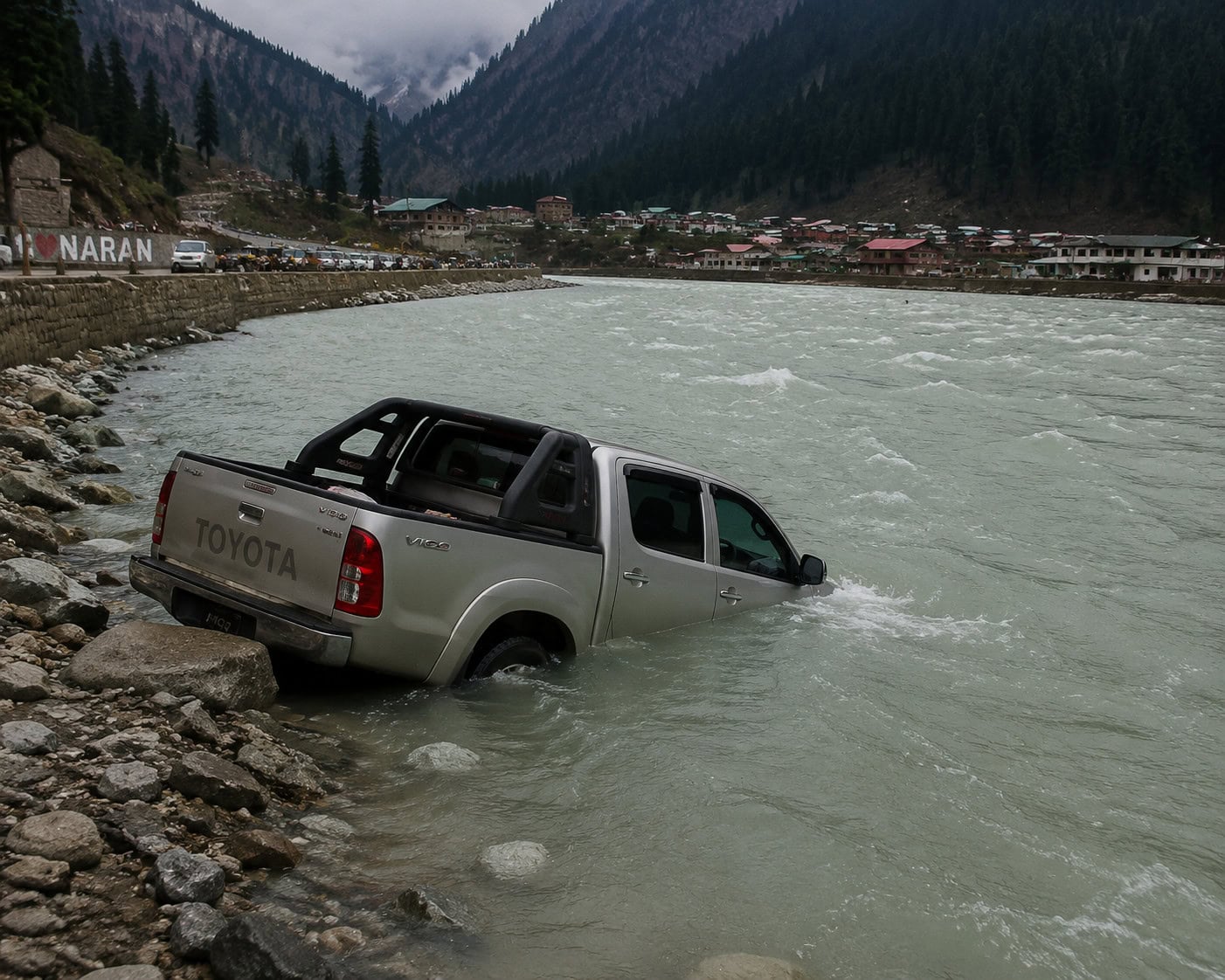
There is no shortage of reckless behaviour in our society, and social media has given it a stage bigger than ever before. The latest reminder came this week from the banks of the Kunhar River in Naran, where a TikTok stunt very nearly turned into a tragedy, and, once again, it is worth asking how much longer we will let “content” be an excuse for endangering human life.
According to police and multiple news reports, a group of tourists from Sheikhupura, travelling in a Toyota Vigo, decided to drive their vehicle straight into the Kunhar River near Naran to film video content. This was despite Section 144 being in force across Mansehra district at the time, which specifically barred tourists from approaching riverbanks and bathing points due to the danger posed by the monsoon-swollen current. The stunt went wrong almost immediately. The vehicle lost control in the fast-flowing water; all the occupants were thrown into the river, and the car was swept downstream.
It was only the presence of a trained rafting team operating nearby that turned what could have been a multiple-fatality disaster into a story with a happy ending. Rescue boats pulled the men out of the water before the current could carry them further. The four men were later arrested, an FIR was registered, and police say the vehicle was eventually recovered from the riverbed. One of the men involved is a known TikToker who has built an online persona around a flashy, larger-than-life image, and it is precisely that online fame that has pushed this story into the national conversation.
Let that sink in for a moment. Five young men very nearly lost their lives and could have taken the lives of the professional rescuers who went in after them, for the sake of a few seconds of video. This was not an isolated freak accident. It happened in an area where local authorities had already imposed restrictions after a monsoon season that has seen the Kunhar River claim lives almost every year, from selfie-seekers slipping off the rocks to speeding vehicles skidding off the Kaghan road. The river did not become more dangerous this year; what changed is how many people are willing to gamble with it for the sake of “viral” content.
The Naran episode is simply the most recent and most visible symptom of a much bigger problem. Across Pakistan, the race for views, likes, and follower counts has quietly become one of the more dangerous pursuits a young person can take up. We have seen tourists climb onto glaciers for a better camera angle, tuk-tuk (rickshaw) drivers perform stunts on the busy roads, and now a group of grown men treat a rain-swollen river as a movie set. Social media fame, as things stand today, has an extremely short shelf life. A video goes viral, the numbers spike for a week or two, and then the algorithm moves on to the next trend, but the risk taken to make that clip, and sometimes the price paid for it, is permanent. Families have buried sons and daughters over content that nobody will remember by the following month.
It is not only physical safety that is being gambled away. Personal dignity and privacy are increasingly being treated as currency to be spent for engagement. The recent public discussion around Ali Haiderabadi’s divorce is a case in point: what should have remained a private, painful family matter was instead played out, dissected and commented upon across social media platforms, turning a personal loss into public entertainment. Similarly, actress and social media personality Fiza Ali’s public displays with her husband, filmed and shared for an online audience rather than kept within the privacy of family life, have drawn considerable criticism from viewers who feel that some things simply do not belong on a public feed. Whatever the intention behind such content, the trend it reflects is troubling: private relationships, private grief and private affection are being converted into public spectacle for the sake of engagement metrics.
This is a broader cultural problem that cuts across gender lines, but the cost is rarely borne equally. When personal and marital matters are aired publicly, it is often women who bear the brunt of public judgment and mockery, regardless of the circumstances. A society that claims to value family privacy cannot simultaneously reward those who broadcast their most personal moments for public consumption, and then act surprised when trolling, character assassination, and harassment follow.
None of this is an argument against social media itself, which has undeniably given ordinary people a voice, created new livelihoods, and connected communities in ways previous generations could not imagine. The problem is not the platform; it is the complete absence of judgment in how some individuals choose to use it. Three things need to happen, and urgently.
First, law enforcement and tourism authorities in areas like Kaghan, Naran, and Swat need to actually enforce the restrictions they impose, rather than issuing notices that exist only on paper. If Section 144 bars people from riverbanks, then vehicles should not be able to drive up to the water’s edge unchallenged in the first place.
Second, platforms themselves carry some responsibility. Content that visibly glorifies dangerous stunts, driving into rivers, climbing unstable glaciers, racing on public roads, should be flagged and demonetised rather than algorithmically rewarded with wider reach simply because it performs well.
Third, and perhaps most importantly, there needs to be a collective shift in what we as an audience choose to celebrate. As long as reckless stunts and oversharing of private life generate views, comments and shares, there will be no shortage of people willing to supply them. The fame such content brings is fleeting; the damage to a person’s safety, their family’s dignity, or in the worst cases, their life, is not. Before we hit “share” or “like,” it might be worth asking exactly what we are rewarding and whether it is something we actually want more of.
Amjad Jamal is a communications professional with over two and a half decades of extensive experience working with the government and development sector, including the United Nations World Food Programme (WFP). Currently working with the International Water Management Institute (IWMI) focusing on climate resilience, water governance, and public awareness.
Disclaimer: The views and opinions expressed in the article belong solely to the author and not necessarily to the author’s employer, organisation, or other group or individual.
Amjad Jamal
About the Author