The world’s premier conference on computer graphics showcases how the technologies behind film, games, and visual effects are shaping the next generation of robots
LOS ANGELES (Khalid khan ) Computer graphics and robotics have been converging for years. At SIGGRAPH 2026. that convergence takes center stage as robots learn, move, create, and interact through technologies originally developed for film, games, and visual effects. Taking place 19-23 July at the Los Angeles Convention Center, the conference shows how advances in computer graphics are helping shape the future of intelligent machines, revealing a future where virtual worlds are increasingly used to train, test, and inspire robotic systems.
At SIGGRAPH 2026, robotics is not confined to a single program. It runs as a common thread across the conference, appearing in Technical Papers, Emerging Technologies, Courses, Frontiers, Spatial Storytelling, Art Papers, Talks, and Technical Workshops. Together, these sessions demonstrate how the same technologies used to create digital characters, immersive worlds, and visual effects are increasingly being used to design, train, and deploy robots capable of operating in complex real-world environments.
“The lines between computer graphics, physics, and Al are blurring. Because of that, you’re seeing robotics become more pervasive at the conference because these fields are naturally becoming more intertwined,” said SIGGRAPH 2026 Conference Chair Chris Redmann. “It opens up new horizons and pathways for computer graphics research and new modes of interactivity, where the physical world and the digital world become even more complementary.”
Training Robots in Virtual Worlds
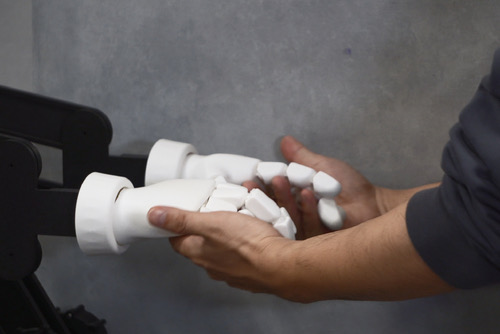
A central theme across this year’s robotics programming is simulation-first development, in which robots are designed, trained, and validated in virtual environments before entering the physical world. A trio of NVIDIA-led courses anchors the thread: “How To Build End-To-End Physical Al Systems for Robots” covers data generation, training, and edge deployment for humanoid and general-purpose robots; “Accelerate Robot Learning With NVIDIA Isaac Lab and Newton” introduces a GPU-accelerated physics engine for training and evaluating robot policies; and “Simulating a Dextrous Hand For Robotics With OpenUSD” walks through preparing simulation-ready robot assets.
The same ideas drive a strong Technical Papers showing, where “SimArt: Decomposing Monolithic Meshes into
Sim-ready Articulated Assets via MLLM” converts static 3D meshes into simulation-ready articulated assets, “MotionBricks: Scalable Real-Time Motions with Modular Latent Generative Model and Smart Primitives” generates real-time motion for animation and robotics, “ReActor: Reinforcement Learning for Physics-Aware Motion Retargeting” from Disney Research uses reinforcement learning to retarget human motion onto humanoid and quadruped forms, and “Computational Design of Terrestrial Robots with Anisotropic Friction”, from teams including Carnegie Mellon University, Genesis Al, Tsinghua University, and Shanghai Qi Zhi Institute, co-designs robot bodies and controllers for locomotion.
Rounding out the thread, the Technical Workshop “Differentiable Physics for Graphics and Al” examines how differentiable simulation is reshaping graphics, robotics, and design, and the Frontiers Workshop “Digital Twins for Science and Industry looks at how virtual replicas are transforming healthcare, energy, and scientific visualization.
New Modes of Human-Robot Interaction
A second thread, concentrated in the Emerging Technologies program, reimagines how people and robots interact, often in strikingly personal ways. In “Katakko: Embodiment of Modular Robots through Automatic Motion Mapping”, attendees assemble communication-oriented modules into a personalized social robot and embody it through an algorithm that maps their own movements onto the machine. “Shall We Dance? Resonance of Intentions with an Embodied Agent based on the Free Energy Principle” introduces an agent that negotiates intentions through physical interaction, synchronizing with a human partner’s choreography and tempo in real time.
About the Author