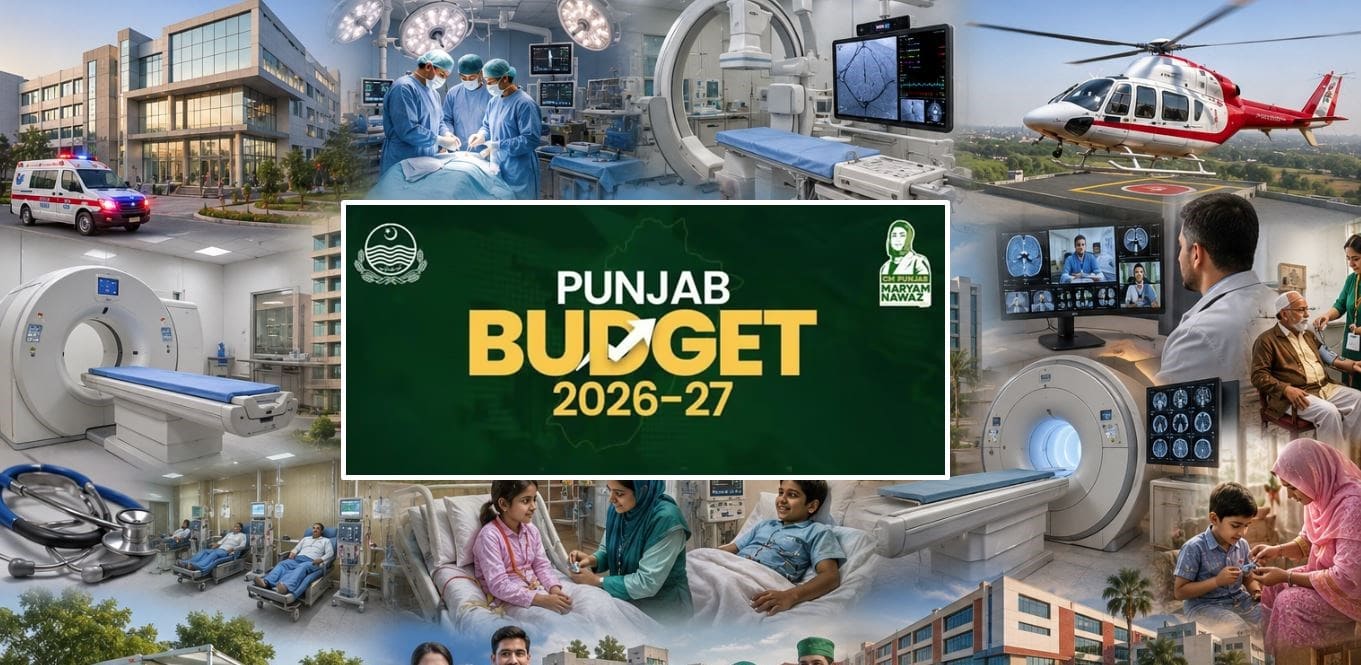
LAHORE – Punjab government proposed record Rs500.62 billion allocation for health sector in 2026-27 budget, outlining ambitious plan to expand healthcare infrastructure, launch new specialized treatment facilities, strengthen emergency services, and improve access to medical care across the province.
The proposed allocation remaioned of largest investments in Punjab’s healthcare system, with major spending earmarked for cancer treatment, cardiac care, primary healthcare, emergency response, and rural health services.
A key component of the health package is the establishment of 15 new Cardiac Surgery Units across Punjab. The government has also proposed Rs31.08 billion for the procurement of advanced medical equipment, including MRI machines, while new CT Scan facilities, Cath Labs and Neuro Cath Labs are planned to improve diagnostic and treatment capabilities in public hospitals.
In a first for the province, Punjab plans to launch a dedicated Stroke Initiative, under which six Neuro Cath Labs will be established. The initiative has been allocated Rs1.75 billion and aims to provide timely intervention for stroke patients, reducing mortality and long-term disability rates.
To improve emergency healthcare delivery, the government has proposed Rs5 billion for the expansion of emergency services. Officials said efforts will also continue to strengthen Punjab’s air ambulance network, which has so far transported and assisted 270 patients.
The budget focused on healthcare development in Southern Punjab. A proposed Rs23.37 billion has been allocated for the construction of the Cancer Hospital in Dera Ghazi Khan, while plans are also underway for the establishment of a Children’s Hospital in Bahawalpur. The government has additionally earmarked Rs20 billion for the Nawaz Sharif Institute of Cancer Treatment and Research, a flagship project with an estimated total cost of Rs175 billion.
For cardiac care, Rs94.28 billion has been proposed for the development of the Jinnah Institute of Cardiology Lahore and the Nawaz Sharif Institute of Cardiology Sargodha, aimed at expanding access to specialized heart treatment services.
Meanwhile, Rs2.45 billion has been allocated for the rehabilitation and modernization of the Punjab Institute of Mental Health, Lahore, while development work worth more than Rs15 billion will continue at Nishtar Hospital Multan.
The government has proposed a large-scale strengthening of primary healthcare services through recruitment and infrastructure upgrades. Under the plan, 20 Community Health Inspectors and 60,000 Lady Health Workers will be recruited at a cost of Rs12.58 billion. Additionally, 434 Basic Health Units (BHUs) will be upgraded through a development package worth Rs9.60 billion.
Maryam Nawaz Health Clinic Programme will see the upgradation of 2,508 BHUs and 1,115 Rural Health Centres (RHCs) to improve healthcare access in rural and underserved communities.
Provincial government also proposed Rs3.50 billion for the expansion of the Clinic-on-Wheels programme, alongside an additional Rs3.85 billion for further scaling up the initiative. The mobile healthcare programme is intended to provide medical services to populations living in remote areas. For specialized treatment programmes, Rs8.66 billion has been allocated for the Chief Minister’s Dialysis Programme, while Rs3.64 billion has been proposed for the Chief Minister’s Transplant Programme, which is expected to benefit approximately 14,000 patients annually.
Children Heart Surgery Programme has been allocated Rs3.21 billion, with officials estimating that around 13,000 children will receive life-saving cardiac surgeries under the initiative.
The government has also proposed Rs1.05 billion for diabetes care, including the provision of free insulin and essential medicines to patients through public healthcare facilities.
Among the largest projects announced in the health portfolio is the proposed Nawaz Sharif Medical District, for which Rs169 billion has been earmarked. The project is expected to emerge as a major healthcare and medical education hub, integrating treatment, research and training facilities under one umbrella.
The proposed health sector package reflects the Punjab government’s focus on expanding healthcare coverage and modernizing public health infrastructure. With investments spanning specialized hospitals, diagnostic facilities, emergency response systems, rural healthcare centres and disease-specific programmes, the budget seeks to address long-standing gaps in healthcare delivery while improving access to treatment for millions of residents across the province.
About the Author