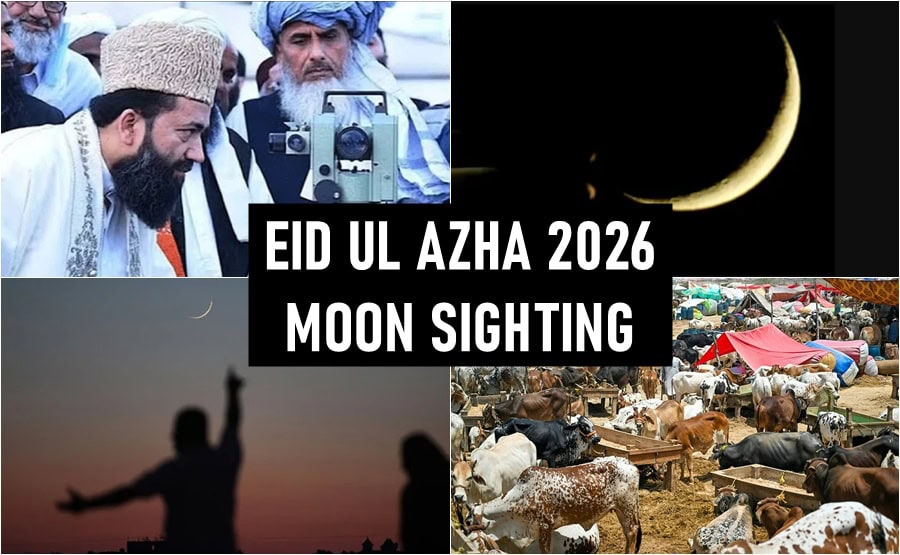
All eyes are on skies tonight as Pakistan prepares for Zil Hajj Moon Sighting, as Muslims are waiting for welcome last month of Zil Hajj which will also set date for Eid ul Azha 2026. With anticipation building nationwide and astronomical forecasts suggesting favorable conditions, the outcome is expected to brings second major Islamic festival in Pakistan’s and parts of the world.
Central Ruet-e-Hilal Committee prepares for its decisive meeting to observe the Zil Hajj crescent to announce start of Zil Hajj and lock in the official dates for Eid ul Azha 2026.
A key session is underway in Karachi while zonal and district moon-sighting committees are also getting reports arriving from across the country. Every testimony is being carefully examined before being forwarded for final verification. The process is being overseen by the Central Chairman, Maulana Abdul Khabir Azad, who will announce the final verdict after reviewing all evidence from across Pakistan.
Eid ul Azha 2026 Updates
Early indications suggest that 1st Zil Hajj 1446 AH could begin around May 27, depending on whether the crescent is confirmed tonight. With generally clear skies expected in several regions, officials believe conditions may favor visibility.
Meanwhile, scientific forecasts are adding further momentum to the buildup. Pakistan’s space agency SUPARCO has projected that the Zil Hajj crescent may become visible on May 17, 2026. According to calculations, the new moon is born at 1:01 AM, and by sunset the same day its age will be around 18 hours and 30 minutes. In coastal areas, a roughly one-hour gap between sunset and moonset increases the probability of sighting—provided weather conditions remain clear.
Based on these projections, Eid ul Azha is tentatively expected around May 27, but the final confirmation rests entirely with official moon-sighting authorities.
Eid ul Azha Holidays
Pakistan is heading toward an unusually long Eid break. The holidays may begin on May 27 and run through May 29, with the possibility of extension into the weekend—potentially stretching the break to five days in some scenarios.
If the crescent is not seen and the month completes 30 days, Eid would likely shift to May 28–29, still offering a four-day festive window when combined with the weekend.
Eid ul Azha in Saudi Arabia, UK, and UAE
The moon sighting is not just a national event, it is a global Islamic moment. Saudi Arabia’s Supreme Court has officially called on citizens to observe the skies on May 17, with astronomers suggesting the crescent may be visible shortly after sunset. Morocco and several other countries are also on high alert, closely tracking astronomical data.
In UK, several Muslim communities are expecting Eid around May 27, with several mosques moving toward possible coordinated observance. Some religious leaders believe this could be a rare moment of alignment, where multiple communities celebrate Eid on the same day.
Countries such as Tunisia and Turkey are also expected to align closely with similar dates, though Turkey continues to rely on pre-calculated lunar calendars rather than physical sightings.
Eid ul Azha on same date in Muslim world?
A growing discussion among scholars and community organizations suggests that 2026 may witness an unusual level of global alignment in Eid dates. Because of favorable astronomical conditions, several regions may begin Dhul Hijjah simultaneously—reducing the long-standing differences in Eid celebrations across countries.
This could lead to a rare sense of unity, especially in regions like Europe and the Middle East, where Eid dates often vary.
In Afghanistan, authorities have already confirmed that the crescent was not sighted, officially setting the first day of Dhul Hijjah on May 18. Under this schedule, the Day of Arafah will fall earlier in the week, followed by Eid celebrations on Wednesday.
What is Eid Ul Azha?
Eid ul Azha commemorates the powerful legacy of Prophet Ibrahim (Hazrat Ibrahim), who demonstrated unwavering faith when he was prepared to sacrifice his son Hazrat Ismail in obedience to divine command. According to Islamic tradition, the son was replaced by a ram at the moment of sacrifice.
Observed on the 10th of Dhul Hijjah alongside the Hajj pilgrimage in Makkah, Eid ul Azha is marked by special prayers, Qurbani (animal sacrifice), and the distribution of meat among family, relatives, and those in need. The festival emphasizes sacrifice, charity, and compassion—values that remain central to the Islamic faith.
Eid Festivities fade amid choking inflation
News Desk
About the Author