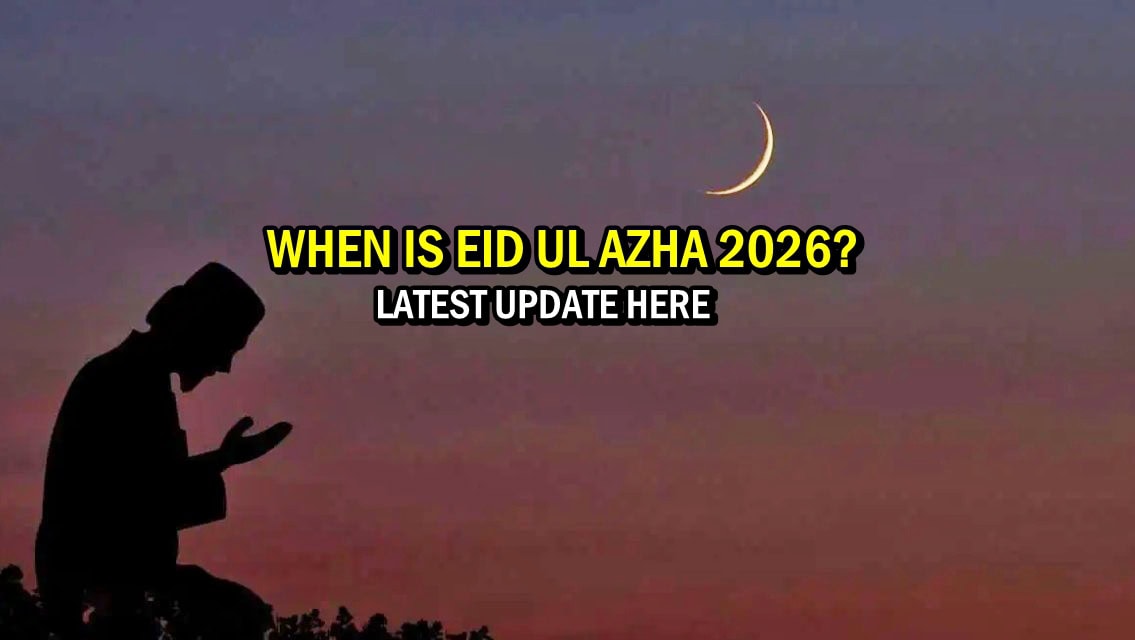
KARACHI – Muslim world is all set to witness Zil Hajj moon today, which will confirm Eid ul-Azha 2026, with forecasts strongly pointing to May 27 as the expected date of Bakra Eid 2026.
Crescent moon of Zil Hajj 1447 AH is likely to be born in the early hours of Sunday, May 17, 2026, at 1:01 a.m. This timing sets the stage for a crucial global moon-sighting attempt on the same evening. By sunset on May 17, the moon will be approximately 18 hours and 30 minutes old. SUPARCO notes that in Pakistan’s coastal regions, the moon is expected to remain visible for around 60 minutes after sunset, improving the chances of sighting. However, experts also emphasize that optimal crescent visibility is usually more reliable when the moon reaches around 20 hours of age.
International astronomical centers, including those in UAE, also indicate that most Muslim countries will attempt to sight the Dhul Hijjah crescent on Sunday, May 17.
Their projections show a wide range of visibility conditions across the world. In East Asia, the crescent may only be detectable using telescopes.
In Central and Western Asia, North Africa, and much of the Americas, naked-eye visibility becomes more likely. Overall, large parts of the Islamic world fall within a favorable observation window.
If the crescent is successfully observed on May 17, Dhul Hijjah will begin on Monday, May 18, paving the way for Eid ul Azha on Wednesday, May 27, 2026 across many countries.
Astronomical data highlights striking variations in moon visibility across major cities:
| City | Moonset After Sunset | Moon Age (approx.) |
| Jakarta | 26 minutes | ~15 hours 36 minutes |
| Abu Dhabi | 58 minutes | ~18 hours 45 minutes |
| Mecca | 58 minutes | ~19 hours 22 minutes |
| Amman & Jerusalem | 69 minutes | ~19 hours 55 minutes |
| Cairo | 67 minutes | ~20 hours |
| Rabat | 79 minutes | ~22 hours 6 minutes |
In several of these cities, including Abu Dhabi, Mecca, Amman, Jerusalem, Cairo, and Rabat, the crescent may be visible to the naked eye under clear skies and with experienced observers.
Experts caution that moon sighting is not determined by age alone. Factors such as the angular distance between the moon and sun, altitude above the horizon, and atmospheric clarity all play a critical role. Even when calculations appear favorable, actual visibility can still vary.
The shortest recorded lag time for naked-eye crescent visibility is 29 minutes, while the youngest observed crescent was 15 hours and 33 minutes old. However, these benchmarks do not guarantee sighting in every case.
If conditions align as predicted, the Islamic world could largely unify on Eid ul Azha falling on May 27, 2026, with moon sighting efforts on May 17 setting the entire calendar in motion.
Eid-ul-Azha 2026: Pakistan’s Ruet body meets today to sight Zil-Hajj Moon
About the Author