ISLAMABAD – Pakistan made diplomatic move by directly briefing Iran on newly signed Makkah Defence Pact with Saudi Arabia and Türkiye, opening up about Islamabad’s effort to expand strategic partnerships while keeping its relationship with Tehran intact.
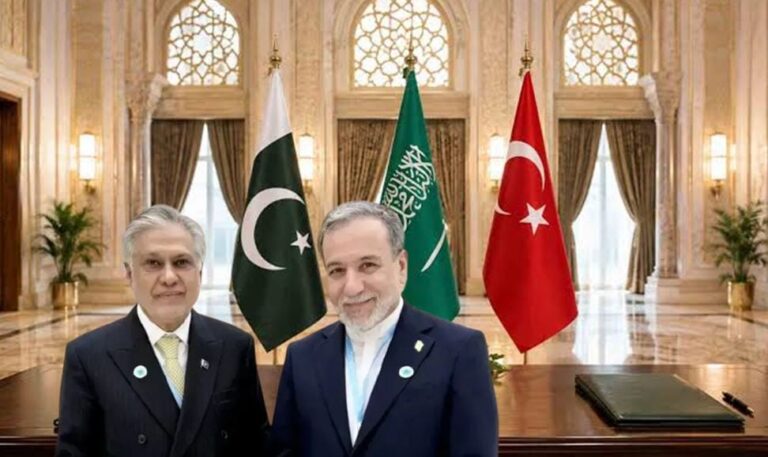
Deputy Prime Minister and Foreign Minister Ishaq Dar held a telephone conversation with Iranian Foreign Minister Abbas Araghchi, during which he explained the key features and objectives of the three-country defence agreement amid sensitive time for the region, with security alliances evolving rapidly and major powers recalibrating their strategic positions.
The timing of Dar’s call has placed the Makkah agreement under diplomatic spotlight. Pakistan, Saudi Arabia and Türkiye have entered a new framework for defence cooperation aimed at strengthening strategic coordination and advancing joint efforts for peace and security. But with Iran also playing a central role in the region’s security landscape, Islamabad appears keen to ensure that Tehran does not interpret the new partnership as an anti-Iran alliance.
So, Dar briefed Araghchi on the agreement’s key points and objectives, stressing Pakistan’s emphasis on regional peace, stability and diplomatic cooperation.
The call sends broader message as Pakistan wants closer security ties with Saudi Arabia and Türkiye without opening a new diplomatic front with Iran. For Islamabad, this is a delicate balancing act.
Riyadh remains key strategic partner, while Türkiye has emerged as a major defence and diplomatic partner for Pakistan. At the same time, Iran is Pakistan’s immediate neighbour, making stable bilateral relations a critical component of Islamabad’s regional policy. The direct briefing to Tehran allows Pakistan to explain its position before speculation surrounding the pact can dominate the regional narrative.
Makkah Pact and Iran
The question now attracting attention is whether the Makkah Defence Pact will remain a three-country security arrangement or gradually develop into a wider regional framework. For Iran, the distinction is crucial.
If the agreement is viewed as a mechanism for mutual defence and regional stability, Tehran may have little reason to see it as a direct threat. But if it is perceived as part of a broader alignment against Iranian interests, the pact could add another layer of tension to an already complicated Middle Eastern security environment.
In today’s call, Iranian Foreign Minister Abbas Araghchi thanked Dar for providing details of the agreement, while both foreign ministers agreed to maintain communication and consultations in view of the rapidly changing regional situation.
Dar-Araghchi conversation speaks of Islamabad attempt to pursue strengthen strategic cooperation with Saudi Arabia and Türkiye while maintaining diplomatic engagement with Tehran. Both sides agreed to remain in close contact on regional developments, matters of mutual interest and other important issues. The timing makes the conversation particularly significant.
As new security partnerships emerge and regional alliances continue to shift, Pakistan appears determined to ensure that its expanding defence relationships do not automatically translate into confrontation with its Iranian neighbour.
Islamabad has passed message that Makkah Defence Pact is being presented as a strategic cooperation framework rather than a mechanism for regional confrontation. For Pakistan, the challenge now is to maintain this diplomatic balance while its security cooperation with Saudi Arabia and Türkiye enters a new phase.
Pakistan remained key facilitator in US-Iran diplomacy during the 2026 regional crisis. Islamabad hosted high-level US-Iran talks and helped keep communication channels open between Washington and Tehran.
The South Asian nation played mediating role in the process that led to the Islamabad Memorandum of Understanding, with subsequent technical-level talks involving the US, Iran, Pakistan and Qatar.
Pakistan, Qatar to Host Next Round of US-Iran Talks as back door talks underway
About the Author