Ask someone in rural Sindh how long it took them to fix a land record, get a birth certificate, or license a small shop, and the answer is almost always the same: a bus ride to a city an hour away, a wasted day, sometimes two. That is the real subject of the provinces debate, and it is exactly why the numbers on this issue are not close.
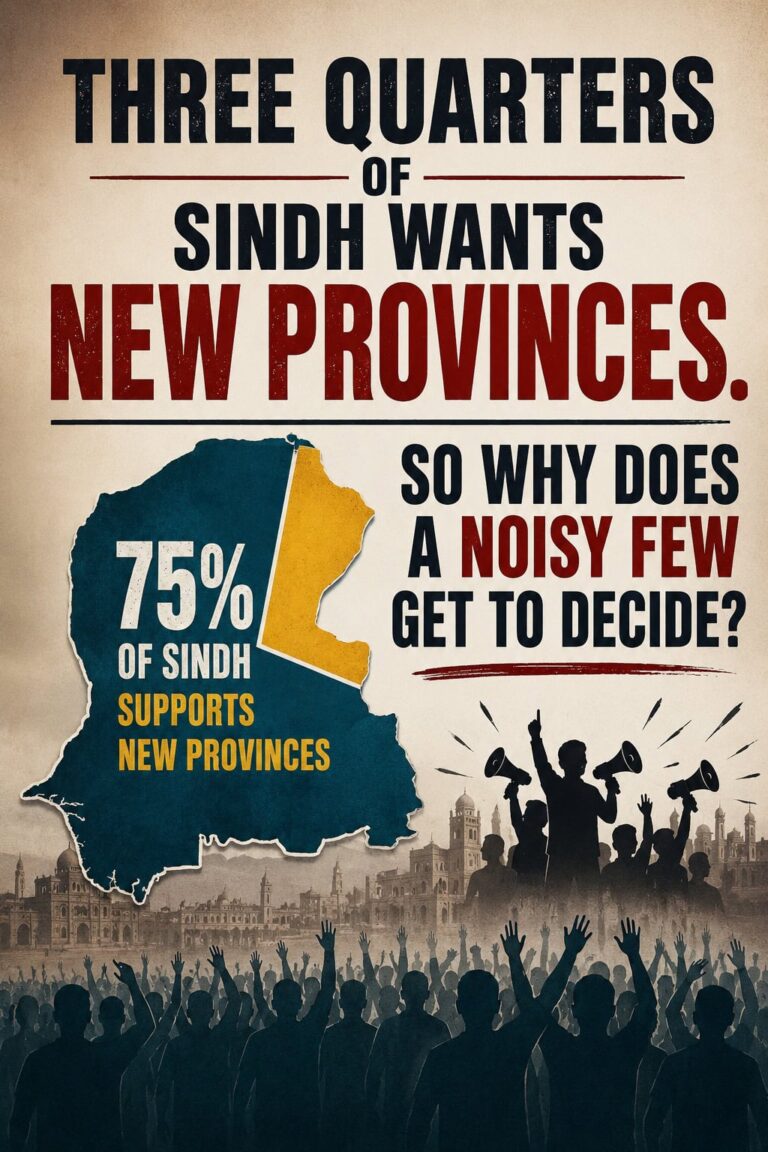
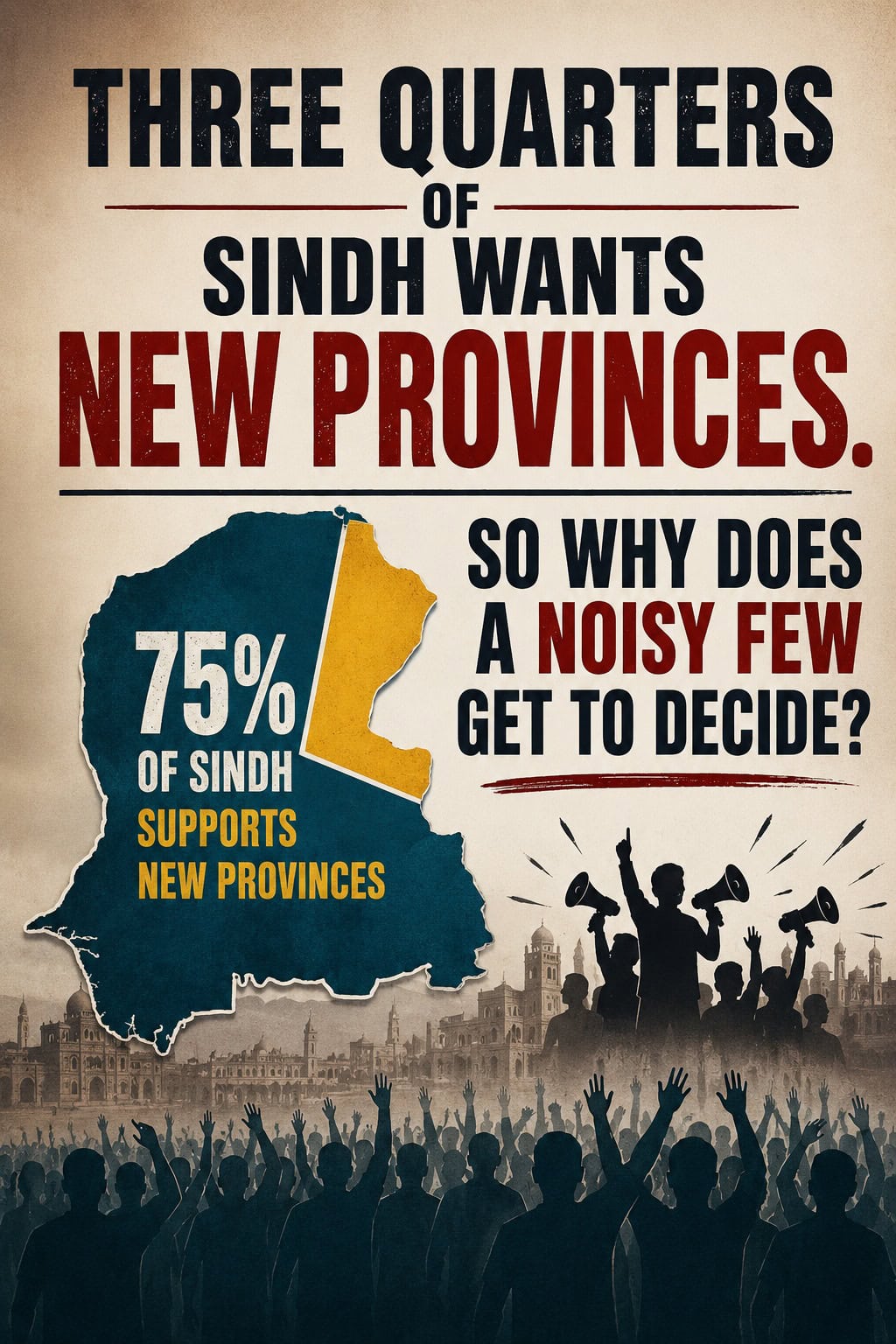
By most reasonable estimates, close to seventy-five percent of the people of Sindh support the creation of new provinces. Only a narrow band, somewhere between five and ten per cent, stands against it. This is not a province arguing with itself. It is a clear majority wanting a modern administrative system, up against a small and unusually loud minority determined to keep things exactly as they are.
Support isn’t limited to any one group. Traders and small business owners, who deal daily with distant licensing offices and slow paperwork, have been some of the most consistent voices in favor of new provinces, simply because faster administration means faster business. Farmers and labourers want the same thing for different reasons: closer government means closer help when a land dispute, a subsidy application, or a medical emergency cannot wait for a trip to a city hours away. Teachers, shopkeepers, transporters, and ordinary households across Sindh have, in one way or another, said the same thing when asked directly: bring government closer, and life gets easier.
So who is doing all the shouting on the other side? A surprisingly small number of organisations and individuals, many of them nowhere near Sindh and those who are in Sindh are in small numbers. Many Sindhi nationalist leaders live abroad, comfortably, insulated from everything they claim to be defending. From that distance, it costs nothing to run a campaign online, recycle the same handful of talking points, and let a small cluster of accounts do the work of making it look like a movement. It is easy to sound like the voice of a province when you never have to live with the consequences of what you are arguing for, and easier still when the majority who disagree with you are too busy working, studying, and running households to spend their day arguing back online.
Then the amplifiers step in. Indian outlets, ANI included, have made a habit of picking up this diaspora content and running it as though it reflects genuine sentiment on the ground. Ask why an Indian news agency cares so much about internal Pakistani provincial politics, and the honest answer is that it is not really about Sindh at all. It is a useful story for someone else, and Sindh is just the setting.
None of this is a call to silence anyone. It is a call to stop letting a loud fraction of a fraction drown out a genuine, sizable majority. Most people in Sindh, if asked plainly, would rather talk about whether a new administrative map gets them a working hospital and a school that actually has teachers in it, not who gets to draw the lines on a map they will never see up close.
That is the actual case for new provinces, stripped of the noise. Smaller units put government where people can reach it. Government that people can reach is government people can hold accountable. Development money that does not have to cross an entire province before landing anywhere is money that is harder to lose along the way. None of this requires a slogan. It just requires admitting that governance works better up close than it does from a podium thousands of miles away, and that three out of four people in a province is not a fringe opinion.
The people funding and fronting the opposition are not wrong for disagreeing. They are wrong because they are arguing, loudly, on behalf of a fraction against a clear majority, about a province most of them will never live in again, using a platform most Sindhis will never see, about a policy that will not change a single thing in their own daily lives. It changes everything for the people who actually stayed.
About the Author