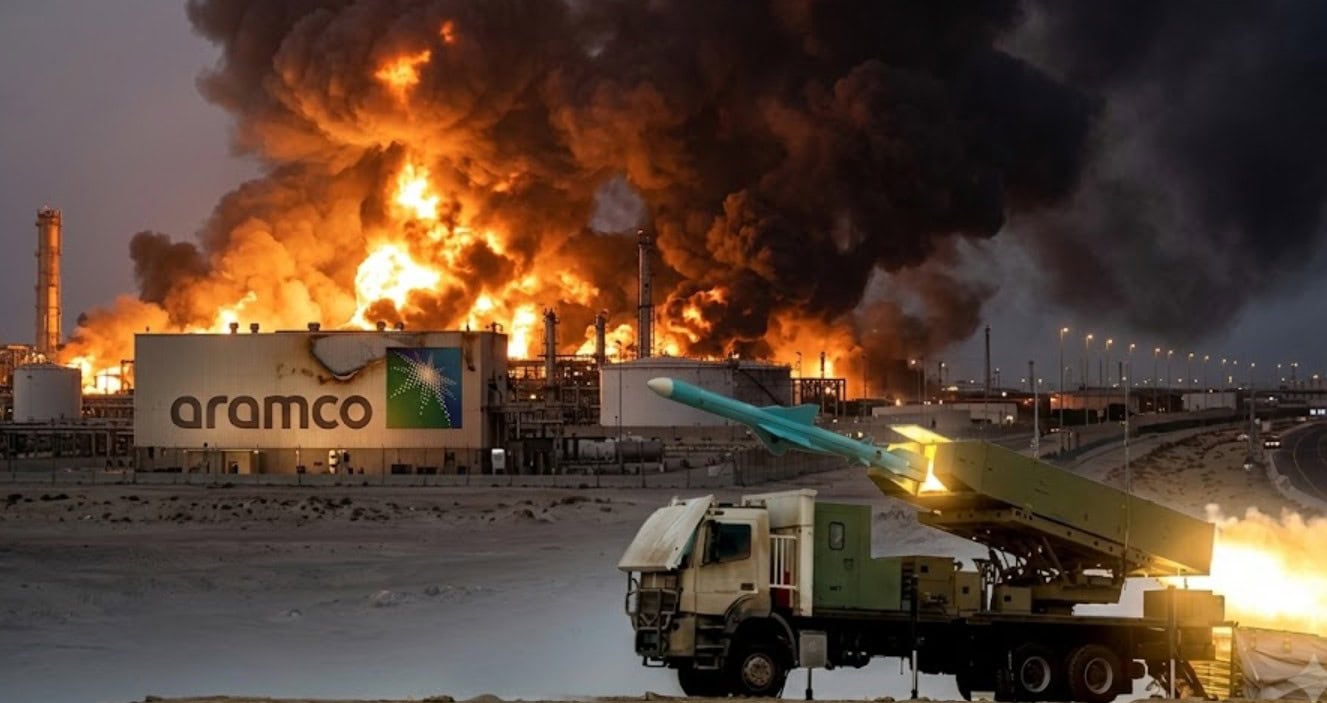
SANAA/RIYADH – Red Sea tensions escalated sharply on Saturday as Yemen’s Houthis allegedly claimed ballistic missile strikes on Saudi Aramco facilities and military sites, hours after Saudi-led coalition launched fresh airstrikes in western Yemen.
Despite no confirmation from Saudi authorities, Yemen’s Houthis said they launched coordinated ballistic missile assault on key Saudi oil and military installations.
Yemen forces call on workers in Saudi ports to quickly leave immediately. Targets: Saudi ports Jeddah, King Abdulaziz Port in Dammam, King Abdullah, King Fahd Industrial Port, Yanbu Commercial Port, Aramco Company and Refineries.https://t.co/WUWGqKQzTz pic.twitter.com/o9GbyLBCxY
— Pfs (@sirpenski) July 25, 2026
Multiple ballistic missiles targeted Saudi Aramco’s energy facilities in Jazan, East-West Pipeline in Yanbu, and King Khalid Air Base in Khamis Mushait. The first wave reportedly involved at least five missiles, followed by another barrage aimed at strategic infrastructure.
Clips doing rounds online show large fire and thick smoke rising near one of the targeted locations in Jazan. However, the footage has not been verified by Daily Pakistan, and Saudi authorities have yet to confirm whether any of the reported targets sustained damage.
Houthis said the attacks were carried out in response to Saudi-led coalition airstrikes on Yemen’s Hodeidah province and Kamaran Island. Calling the operation part of its “blockade for blockade” and “escalation for escalation” strategy, the group warned that continued military action against Yemen would be met with further strikes on Saudi territory.
The movement claimed it deliberately targeted Saudi energy infrastructure, accusing Saudi Arabia and the United States of escalating military operations in western Yemen. It also vowed to broaden its military campaign if coalition attacks continue.
The missile launches come days after the Houthis announced a naval blockade against Saudi Arabia and claimed responsibility for attacks on two Saudi oil tankers, signaling a widening campaign against the Kingdom’s energy sector and maritime interests in the Red Sea.
Saudi-led coalition confirmed carrying out a series of airstrikes targeting what it described as Houthi military infrastructure in Hodeidah governorate. Coalition officials said the facilities were being used to threaten international shipping and commercial vessels operating in the Red Sea.
Saudi officials emphasized that Hodeidah Port was not targeted and said all Yemeni ports remain open for commercial and international maritime traffic. The coalition also warned that any future Houthi attacks would be met with a “strong and decisive” military response.
Houthi-affiliated TV reported that coalition aircraft struck multiple sites across Hodeidah, including Kamaran Island. Yemen’s state news agency also claimed that facilities belonging to the Telecommunications Corporation were among the locations hit during the operation. The coalition strikes followed the Houthis’ announcement that they had launched a missile toward Saudi Arabia in retaliation for what the group described as Saudi aggression. Houthi media later claimed the attack triggered fires in the southern Saudi city of Jazan, though Saudi officials had not confirmed those reports at the time of writing.
The latest military exchange comes against backdrop of mounting regional uncertainty. US President Donald Trump said Washington has not yet decided whether to authorize broader military action against Iran, although he noted that discussions with Tehran have become more substantive and diplomatic efforts remain ongoing.
Trump reiterated that proposed US-Saudi civilian nuclear cooperation agreement will only move forward if Saudi Arabia formally joins the Abraham Accords. He said the framework has received approval from his administration but still requires authorization from the US Congress. According to Trump, the agreement would prohibit uranium enrichment in Saudi Arabia and would be limited exclusively to peaceful civilian nuclear energy.
Pakistan and Saudi Arabia formalized Strategic Mutual Defence Agreement in 2025 to deepen military and security cooperation. While the agreement stops short of mandating automatic military intervention, it commits both countries to coordinate closely in the face of external threats.
Amid latest Middle East tensions, Islamabad reportedly conveyed that any direct attack on Saudi Arabia would cross a “red line,” reaffirming its commitment to the bilateral defense partnership while continuing to advocate for diplomacy to prevent a wider regional conflict.
Amazon Web Services’ Cloud Infrastructure in Bahrain comes under Iranian Strikes
News Desk
About the Author