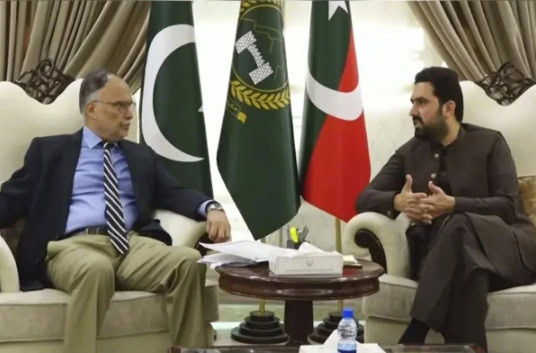
PESHAWAR – Khyber Pakhtunkhwa Chief Minister Sohail Afridi met a federal negotiating team led by Federal Minister Ahsan Iqbal and presented a series of complaints regarding what he described as unfair treatment of the province by the federal government.
According to reports, the meeting discussed a range of intergovernmental issues, including consultation with and access to Imran Khan, the upcoming meeting of the National Economic Council, provincial financial and constitutional rights, development funds for merged districts, energy issues, wheat supply, hydropower projects, and other key matters.
The chief minister told the federal delegation that Khyber Pakhtunkhwa was being subjected to continuous discrimination and injustice. He warned that if the province continued to be denied its constitutional and financial rights, participation in the NEC meeting could become difficult.
He stressed that consultation with Imran Khan was essential before making key budgetary and national decisions, arguing that all political parties seek guidance from their leadership on important matters and that the provincial government follows the same democratic principle.
Afridi said cuts to the province’s development and financial allocations had reached an alarming level. He claimed that funds under the Accelerated Implementation Programme (AIP) had been reduced from Rs37 billion to Rs27 billion, while the development budget for the merged districts had been cut from Rs66 billion to Rs56 billion.
The chief minister further alleged that the merged districts’ share under the National Finance Commission (NFC) Award had been withheld unconstitutionally for the past eight years, hampering development and public welfare in those areas.
He maintained that instead of resolving provincial concerns, meetings with federal representatives often resulted in further grievances. He asserted that the people of Khyber Pakhtunkhwa would not compromise on their constitutional rights and urged the federal government to review its policies toward the province.
Afridi also raised concerns over obstacles to wheat supplies from Punjab, provincial gas rights, and issues related to hydropower projects. He said Khyber Pakhtunkhwa produces more than 500 million cubic feet of gas per day, yet its residents continue to face severe shortages and load-shedding despite provincial consumption being around 150 million cubic feet per day.
He argued that depriving a gas-producing province of its due share violated constitutional principles and the fair distribution of resources.
The chief minister also highlighted delays in operationalizing a completed dam project in Swat, claiming that the project remained inactive because Chinese engineers had not been issued the required No Objection Certificate (NOC). Similarly, he said a completed bus terminal project could not be opened to the public because the National Highway Authority had not issued the necessary NOC.
He further remarked that if Punjab was unwilling to supply wheat to Khyber Pakhtunkhwa, then Articles 151 and 158 of the Constitution should be repealed, as those provisions guarantee interprovincial trade, free movement, and equitable access to resources.
Afridi called for full and non-discriminatory implementation of the Constitution and demanded the immediate provision of the province’s constitutional, financial, and developmental rights.
During the meeting, Ahsan Iqbal assured the provincial government that the NOC required for the bus terminal project would be issued within 24 hours. He also pledged to raise Khyber Pakhtunkhwa’s concerns, demands, and issues before the prime minister and other relevant federal forums and to support efforts aimed at resolving them.
Web Desk
About the Author