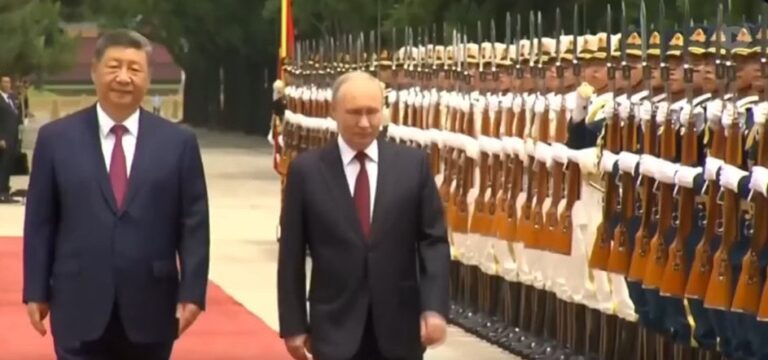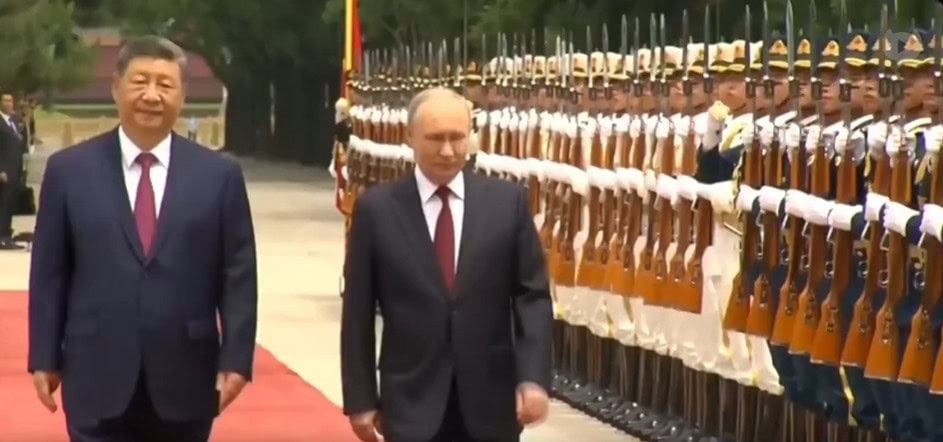
MOSCOW – Russian President Vladimir Putin and Chinese President Xi Jinping met in Beijing and projected that the relationship now standing at an “extraordinarily high level.”
The meeting, held during Putin’s first foreign trip of the year, comes amid mounting geopolitical tensions, war in the Middle East, and increasing competition between global powers. While the phrase about ties reaching “historic heights” has been repeated by Russian officials many times before, this summit carried unusual significance because of the broader international climate surrounding it.
Putin once again praised Xi Jinping as “dear friend,” while Chinese leader referred to the ties between Moscow and Beijing as “unshakable.” Yet despite the warm language, observers note a striking contrast in tone between the two sides: Russia speaks with urgency and enthusiasm, while China continues to communicate with calculated restraint and strategic confidence.
That difference reflects a deeper reality behind the partnership.
Russia increasingly depends on China economically and diplomatically, while Beijing, possessing far greater economic power and global influence, appears firmly positioned to shape the pace, direction, and conditions of the relationship. One of the most dramatic moments of the summit came when Xi Jinping addressed the rapidly shifting crisis in the Middle East.
Calling the regional situation a “critical turning point,” Xi said the region is entering a transition “from war to peace,” but warned that any renewed outbreak of conflict would be “unacceptable.”
Chinese state media reported that Xi described the current global environment as “complex and unstable,” signaling Beijing’s concern over widening geopolitical fractures across multiple regions.
Xi Jinping also urged both countries to work together to create what he called a “fairer and more equal system of global governance” — language widely interpreted as a challenge to Western-led international structures.
Xi further promoted China’s “four-point proposal” for peace and stability in the Middle East, a framework he introduced last month during talks with Abu Dhabi’s crown prince. The proposal emphasized Peaceful coexistence, Respect for national sovereignty, Adherence to international law and integrated strategies for development and security.
According to Xi, the initiative is intended to strengthen international consensus, reduce tensions, de-escalate conflicts, and prevent the region from sliding back into war.
Putin highlighted the explosive growth in Russia-China trade, claiming bilateral commerce has expanded more than thirtyfold over the past 25 years.
Trade between the two countries has indeed reached record levels, especially after Western sanctions pushed Moscow to deepen economic dependence on Beijing following the Ukraine war.
Chinese leaders rarely use emotionally charged rhetoric. Instead, Beijing’s strategy has focused on maintaining leverage, avoiding unnecessary confrontation, and preserving flexibility in an increasingly divided global order.
After leaders’ initial closed-door meeting in Beijing, both countries moved into broader delegation-level negotiations described by the Kremlin as a “wide-format” summit.
At the same time, Russian Foreign Minister Sergey Lavrov held separate discussions with Chinese Foreign Minister Wang Yi, underscoring the growing coordination between Moscow and Beijing on international affairs.
Pakistan slams attack on Putin’s home, calls it Threat to World Peace
About the Author