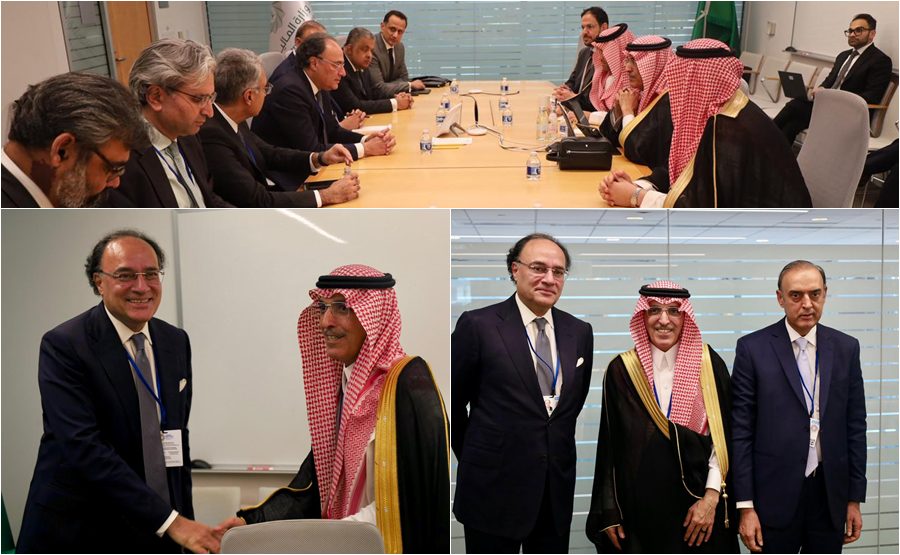
ISLAMABAD – Relief for Pakistan came at critical economic moment as Saudi Arabia stepped in with fresh $3 billion financial support package and extended its existing $5 billion deposit for a longer term.
The announcement, made by Finance Minister Muhammad Aurangzeb during his visit to Washington for the IMF–World Bank Spring Meetings, signals renewed backing for Pakistan’s fragile external account. With rising repayment pressures and limited foreign exchange reserves, the Saudi support is seen as a timely boost that could help stabilize the country’s financial outlook and ease immediate funding concerns.
Saudi Arabia Announces USD 3 Billion Additional Support, Extends USD 5 Billion Deposit: Finance Minister
Federal Minister for Finance and Revenue, Senator Muhammad Aurangzeb, has informed that the Kingdom of Saudi Arabia has committed USD 3 billion in additional deposits, with… pic.twitter.com/E8dXPg6g9Y
— Ministry of Finance, Government of Pakistan (@Financegovpk) April 15, 2026
FinMin Aurangzeb revealed financial breakthrough, saying that Saudi Arabia will pump additional $3 billion in emergency financial support, expected to be disbursed as early as next week. KSA also agreed to extend its existing $5 billion deposit for a longer tenure, moving away from short-term annual rollovers.
He called package as arriving at a “critical moment” for Pakistan’s economy, helping shore up foreign exchange reserves and stabilize the country’s external account position.
The announcement comes at a time when Pakistan is under mounting external repayment pressure. Islamabad is reportedly engaged in active discussions with Saudi Arabia and China for additional financial inflows, as it prepares to repay nearly $3 billion owed to the United Arab Emirates.
The broader negotiations under discussion could exceed $3.5 billion in combined loans and investments, in light of scale of Pakistan’s urgent financing needs.
The development comes as Pakistan failed to secure rollover of UAE loan for first time in seven years. As a result, the country is now expected to repay the full amount by the end of the month, putting strain on already fragile reserves estimated at around $16 billion.
Despite the pressure, Aurangzeb insisted that the government remains firmly aligned with its commitments under the International Monetary Fund programme, targeting reserves of approximately $18 billion (3.3 months of import cover) by the end of the fiscal year.
He further stressed that Saudi decision to convert its $5 billion deposit into a longer-term arrangement represents a major stabilizing shift, reducing rollover uncertainty and strengthening macroeconomic predictability.
He further outlined Pakistan’s broader strategy to reduce reliance on emergency financing, including plans to launch a Global Medium-Term Note (GMTN) programme and its upcoming first-ever Panda Bond issuance, aimed at diversifying funding sources and expanding access to global capital markets.
News Desk
About the Author