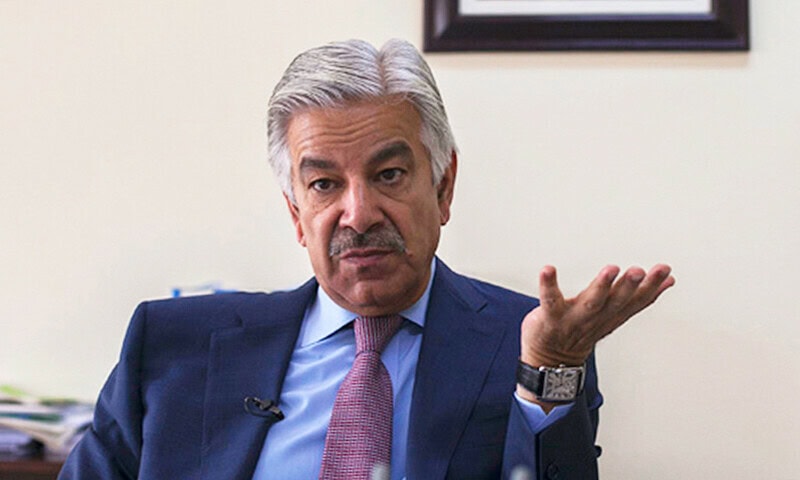
ISLAMABAD – Defence Minister Khawaja Asif, commenting on the recent wave of terrorism, said that due to Balochistan’s geography, large-scale deployment of military personnel is necessary in the province.
Speaking on the floor of the National Assembly, he said the government took strict measures to curb smuggling. Smugglers were buying oil from Iran at Rs40 per litre and selling it for Rs200, earning around Rs4 billion daily through oil smuggling. These illegal businesses have now been shut down. He added that a major protest also took place at the Chaman border, with people demanding negotiations with so-called nationalist movements.
Khawaja Asif said these groups have neither a political nor a nationalist identity; rather, movements are being launched primarily to recover business losses.
The defence minister stated that criminals operating under the name of the Baloch Liberation Army (BLA) are providing protection to smugglers, and that a nexus has developed in Balochistan involving tribal elders, bureaucracy, and separatist movements.
He said that over the past two days, 177 terrorists have been killed in Balochistan, while 16 security personnel and 33 civilians were martyred.
Reiterating his point, Khawaja Asif said Balochistan’s geography necessitates the deployment of a large number of military personnel.
He said there are currently 15,096 schools, 13 cadet colleges, and 13 major hospitals in Balochistan, yet a narrative of deprivation is being created.
He added that Balochistan’s NFC share stands at Rs933 billion, Iranian oil pumps are found in the middle of Quetta, and the sardari (tribal) system has plundered all the province’s resources.
He said no other province has as many airports as Balochistan, and non-operational airports are being made functional. He claimed that those being killed as terrorists are listed as missing persons, while many “missing persons” are actually living abroad and their families are receiving money. Managing such a vast province, he said, is a very difficult task.
The defence minister said multiple operations have been conducted in Balochistan and that Indian proxies are currently active there. He added that wherever local government systems have been introduced, including in Balochistan, they have contributed to development. Compared to the time of Pakistan’s partition, he said, educational institutions, hospitals, and other facilities in Balochistan have increased many times over.
Khawaja Asif said corruption is a termite that exists in Balochistan, all provinces, and the federal government, and that national unity is required to eradicate it. He said blackmailing has been used to obstruct development in Balochistan and that the sardari system has prevented progress.
He added that when he previously obtained figures on missing persons, the number ranged between 700 and 750.
He questioned where Kulbhushan Jadhav was arrested, saying Balochistan is such a vast area that controlling it is extremely difficult. He said militants in Balochistan possess weapons even more advanced than those held by security forces, questioning where such sophisticated arms are coming from.
He claimed terrorists are equipped with weapons worth up to $20,000 and asked who is supplying them, adding that they possess American-made weapons.
Referring to the Jaffar Express incident, he said labourers were killed and questioned what kind of narrative justifies the killing of innocent people. He described the BLA as an “army of thieves” that provides protection to smugglers, saying negotiations cannot be held with those involved in violence.
He asserted that there would be no talks with such elements and that terrorists would be responded to with full force.
Khawaja Asif said political differences must be set aside and the nation should stand behind the Pakistan Army. He assured the House that there would be no dialogue with terrorists in Balochistan and that the state would respond with full strength to those who martyr women, children, and security personnel. He said it cannot be allowed that political interests prevent participation in the funerals of martyrs, and stressed that all politicians must unite against terrorism.
He further said members of the National Assembly should examine the level of corruption in their own constituencies, questioning what would happen if the country’s political leadership failed to monitor corruption. He criticised lawmakers for chatting during a serious debate, calling it a reflection of the House’s lack of seriousness. He said alliances have formed between organisations like the BLA and smuggling mafias, with profits from Iranian oil being shared per litre between smugglers and the BLA.
Khawaja Asif said there was consensus that terrorism spread as a result of the Afghan war, adding that during the Soviet era and General Pervez Musharraf’s time, Pakistan took on proxy wars. He said Pakistani children are losing their lives to terrorism. Recalling a visit to Kabul, he said Afghan authorities demanded Rs10 billion to resettle people away from the border, and while Pakistan was willing to provide the funds, no guarantee was given. He said regardless of how terrorism emerged, the nation cannot abandon its martyrs.
He said that in Afghanistan and Balochistan, only 50 percent of young soldiers return alive, while the rest are martyred. He added that Pakistani youth are paying a debt that was never theirs, and stressed that today both the government and opposition must stand united with the country’s soldiers.
About the Author