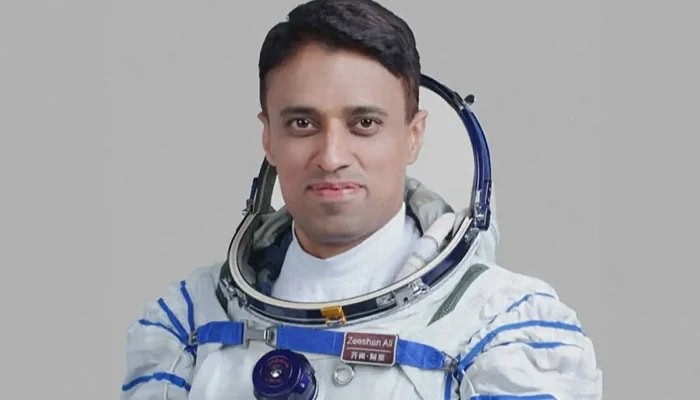
JIUQUAN – Pakistan is all set to achieve a major milestone in its space programme as astronaut Muhammad Zeeshan Ali is scheduled to travel to China’s Tiangong space station on November 25 aboard the Shenzhou-24 spacecraft.
The launch is scheduled for 8:18am Beijing time (5:18am Pakistan time) from the Jiuquan Satellite Launch Centre in north-western China, according to the China Manned Space Agency (CMSA).
Ali will become the first Pakistani citizen to venture into space and the first international astronaut to visit China’s space station. He will join Chinese astronauts Tang Hongbo and Wu Yi, serving as a payload specialist during the mission.
Tang Hongbo will lead the three-member crew, while Wu Yi will work as the flight engineer. The mission will also mark Tang’s third visit to the Tiangong station, making him the first Chinese astronaut to achieve this distinction.
During his approximately seven-day stay, Ali will participate in scientific research conducted under the Pakistan-China space cooperation programme. His duties will include managing experimental equipment, handling research samples and performing scheduled scientific activities.
The research programme features four biotechnology experiments selected from more than 300 submissions received by Pakistan’s Space and Upper Atmosphere Research Commission (SUPARCO). The projects are aimed at exploring scientific challenges associated with food production and climate change.
Extensive preparations have been completed to ensure the Pakistani astronaut can operate effectively in the space environment. His training covered spacecraft operations, laboratory procedures, emergency management and coordination with fellow crew members.
Chinese authorities also provided language instruction, bilingual operational documentation and halal meals to accommodate his communication and dietary requirements.
Pakistan and China formalised their astronaut cooperation programme in February 2025. Following a competitive selection process, Ali and Khurram Dawood were chosen for training, with Dawood designated as the backup astronaut.
The mission represents a significant expansion of bilateral scientific cooperation and opens new opportunities for Pakistan’s participation in international human spaceflight and space-based research.
About the Author