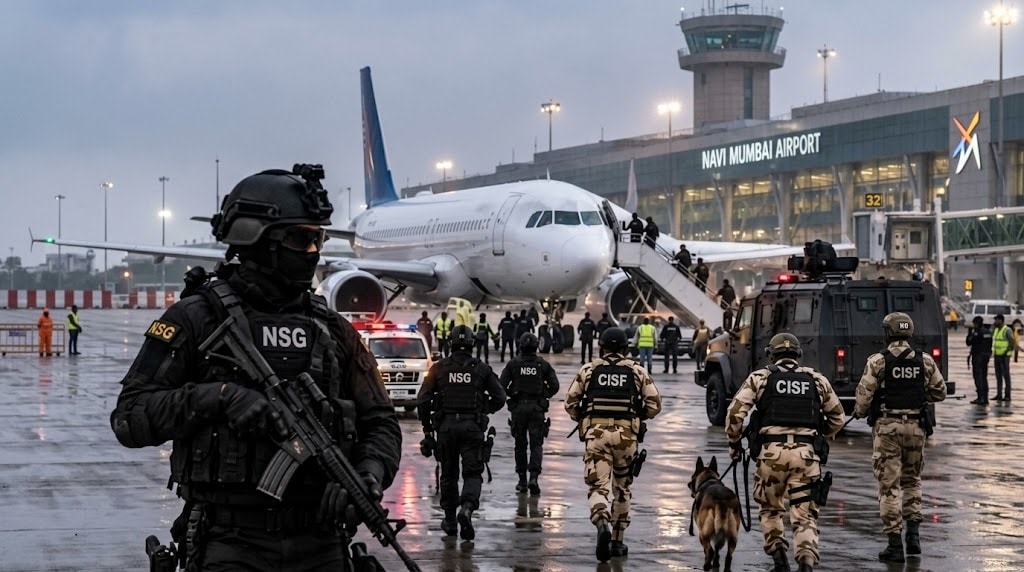
DUBAI – A Flydubai flight from Dubai to Tel Aviv suddenly sparked scare after aircraft flashed a hijacking alert, changed course and triggered an Israeli fighter-jet response. But the startling truth emerged later as the emergency was reportedly caused by a brawl between pilots inside the cockpit.
Boeing 737 eventually diverted safely to Saudi Arabia, turning what looked like a potential hijacking into one of the day’s most extraordinary aviation incidents.
The trouble, according to Flydubai and Israeli reports, was happening inside the cockpit. Flight FZ1073, a Boeing 737 MAX 8 registered as A6-FKF, departed from Dubai International Airport at around 7:05 a.m. local time, carrying somewhere between 174 and 180 passengers. Most were reportedly Israeli travelers, with several reports putting the number of children on board at around 27.
For the first part of the journey, there was nothing unusual. Then, about 90 minutes after takeoff, the aircraft’s emergency signals changed. The plane transmitted 7700, the standard international code for a general emergency. Shortly afterward, it briefly switched to 7500, a code that indicates unlawful interference and is widely associated with a hijacking.
Israeli fighters Jets in action
The aircraft was approaching or entering Jordanian airspace when the unusual sequence unfolded. Israeli authorities began trying to establish what was happening aboard the plane, and fighter jets were scrambled to monitor it.
The situation was serious enough to reach the highest levels of Israel’s government. Prime Minister Benjamin Netanyahu and Defense Minister Israel Katz held an emergency consultation with senior military and intelligence officials as authorities worked to establish whether the aircraft had actually been taken over.
There was also uncertainty over communications with the flight. Then the aircraft changed course. Instead of continuing toward Ben Gurion Airport, it turned back toward Saudi Arabia and began descending. Reports put its altitude at around 15,000 feet or lower as it headed toward the Tabuk area in northern Saudi Arabia.
At points, the aircraft also became difficult to follow on some public flight-tracking services, adding to the uncertainty surrounding the incident. From the outside, the picture was alarming: a possible hijacking code, a change in course, a significant descent and military aircraft in the air. But the explanation that emerged was very different from what authorities initially feared.
As more information became available, Israeli officials concluded that the aircraft had not been hijacked. Instead, reports said the pilots had become involved in a physical confrontation inside the cockpit.
Flydubai later confirmed that there had been a fight between the pilots, effectively explaining the extraordinary sequence of events that had prompted the security response. One report identified the captain as Russian and the co-pilot as Ukrainian. Details about what started the confrontation, however, were not immediately clear.
The fight appears to have led to the emergency situation and the transmission of the distress codes, including the brief 7500 signal. What authorities initially had to treat as a potential hostile takeover was therefore ultimately understood as an internal crew incident.
FZ1073 eventually landed safely in the Tabuk area, bringing the tense episode to an end. There were no reports of a hijacking, an outside attacker taking control of the aircraft or passengers being injured. Israeli fighter jets had been scrambled. Senior government and security officials had been brought into the loop. And an ordinary passenger flight had briefly become the subject of a regional security operation.
The sequence of transponder codes helps explain the reaction. 7700 tells air traffic authorities that an aircraft is experiencing a general emergency. 7500, by contrast, is reserved for unlawful interference. When the latter appeared, authorities could not simply assume it was a mistake.
The aircraft was carrying a large number of Israelis and was flying through a region where security concerns remain particularly sensitive. The unexpected turn toward Saudi Arabia and the difficulties in tracking or contacting the aircraft only increased the uncertainty.

News Desk
About the Author