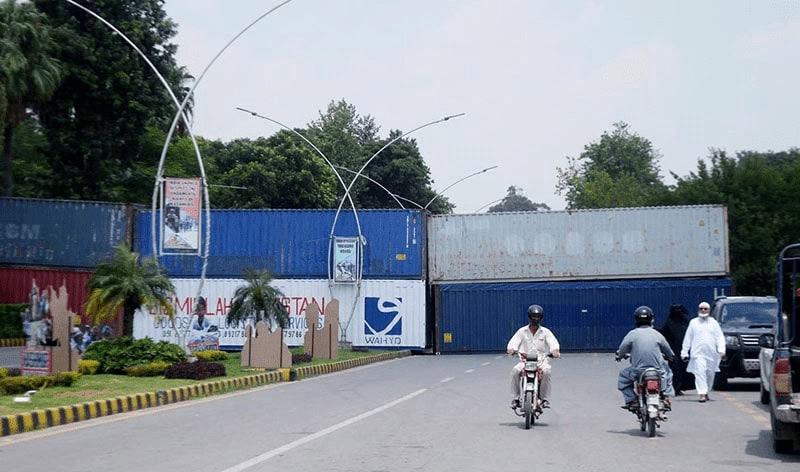
ISLAMABAD – Pakistan’s capital is once again bracing for a major face-off, with more than 1,000 containers placed across Islamabad ahead of PTI’s September 27 long march, raising fresh questions over who supplied the containers, how much they cost and who will ultimately foot the bill.
The capital is again witnessing roads lined with giant freight containers as authorities prepare for possible protests and blockades. The latest deployment comes as PTI has announced its September 27 march, while Jamaat-e-Islami has also planned a September protest over the petroleum levy, adding to the security preparations in the capital.
Authorities are also seeking additional containers on rent through the Interior Ministry as part of preparations to maintain law and order and restrict protesters’ movement into the capital. Interior Minister Mohsin Naqvi has said that, in light of a recent Islamabad High Court ruling, no one would be permitted to enter Islamabad.
Police officials say the Red Zone will be completely sealed before September 27. The highly sensitive area includes the Diplomatic Enclave, Prime Minister’s House, President’s House, Parliament House, Islamabad High Court, Supreme Court and other important government buildings.
The blockade preparations are not limited to simply parking containers on the roads. According to the Islamabad police spokesperson, empty containers are being filled with sand, soil and other construction material to make them heavier and more difficult to move.
Another police official said containers positioned around the Red Zone, particularly near the Diplomatic Enclave, have been welded together to reinforce the barricades. A district administration official said the Interior Ministry has initially released Rs400 million for measures aimed at preventing the PTI protest and maintaining law and order.
The official said most containers have been obtained on a rental basis. Under reported rates, a 40-foot container costs Rs20,000 per day, while a shorter container costs Rs10,000 per day. Container owners are expected to be paid according to the number of days their containers remain in use.
At current reported rate, even 1,000 40-foot containers would amount to Rs20 million for a single day, before accounting for shorter containers, additional containers, transportation or other security-related costs.
But the transport industry has presented a very different picture. All Pakistan Goods Transport Association officials said police and the administration had so far taken more than 1,000 containers belonging to transporters. He claimed that hundreds more were being taken from areas of Punjab including Jatli, Mandi Bahauddin and Gujranwala.
Containers have been held in the jurisdictions of I-9, Tarnol and Sihala police stations before being moved to different roads in Islamabad. He further claimed that police were holding drivers’ licences and vehicle documents, forcing the drivers to remain at the locations.
Although drivers were eventually given back their licences and vehicle documents after the protest ended, the container owners were not paid. The organisation approached the Islamabad administration and police to establish a formal system for recording the containers and determining payments.
The government, however, has rejected this version of events. Minister of State for Interior Talal Chaudhry termed the claim “false” and said the authorities have established a formal procedure for obtaining containers. According to Chaudhry, the containers are provided by members of the transport association themselves, who receive rent in return.
He said there is a defined mechanism determining when containers are taken and when they are returned.
The container operation is only one part of the preparations. Islamabad administration and police have requested more than 15,000 police personnel from Punjab and Sindh. Punjab Police is also expected to perform duties in areas including Attock and Hasan Abdal.
Personnel arriving from other provinces could be accommodated in government schools in Islamabad, with some educational institutions potentially being closed temporarily. However, Talal Chaudhry said the government had made no decision to close educational institutions. He said security personnel from other provinces were instead being accommodated in buildings where vacant space was available.
About the Author